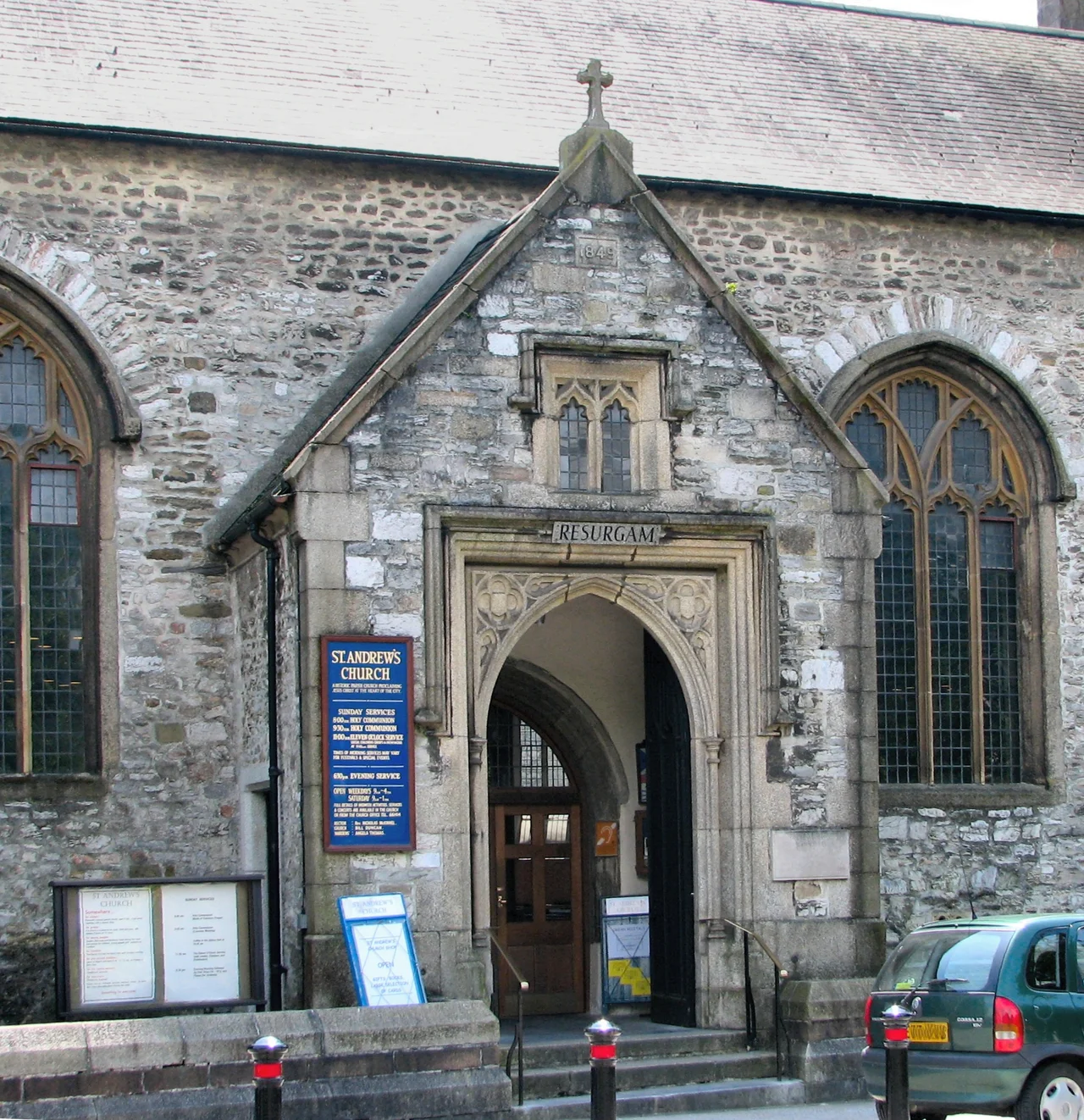

St Andrew's Church, Plymouth
On the morning after the worst night of the Plymouth Blitz, in March 1941, the great parish church of St Andrew lay open to the sky. The roof had been ripped off. The chancel was a ruin. The stained glass that had filled the windows for centuries had been blown across the city in fragments. A headmistress walked through the smoking ruins, found a wooden board, and nailed a single Latin word above the shattered north door: Resurgam. I shall rise again. That word - and the door it was nailed to - became one of the defining images of wartime Britain. The church was reroofed and reconsecrated on St Andrew's Day, 1957. The original Resurgam door is gone, but the word is now carved permanently above the entrance.
The Mother Church of Sutton
Plymouth grew out of three separate medieval settlements - Sutton, Stonehouse, and Devonport - and St Andrew's was the original parish church of Sutton, the eastern one that eventually gave the modern city its harbour. A Saxon church may have stood here as early as the 8th century, and there is documentary evidence of a church on the site by the early 11th century. Long attached to the great Augustinian priory at Plympton, St Andrew's was always the most important religious building in Plymouth, and as the town outgrew its medieval bounds it had to be enlarged. The principal rebuild took place between 1430 and 1490, in the late Perpendicular style, using Plymouth's distinctive blue-grey limestone with corner buttressing of Dartmoor granite. The result was a parish church the size of a small cathedral - in fact the largest parish church in the historic county of Devon.
Three Plymouth Names
Three lives are tied to this church in ways that mark the history of the seafaring city around it. In 1501 Katherine of Aragon stopped in Plymouth on her way from Spain to marry Prince Arthur and came to St Andrew's to give thanks for a safe Atlantic crossing - the future queen of England, then fifteen years old, lighting candles in a Plymouth church before her life took the turns history would remember. In the 1560s and 70s the Elizabethan privateer John Hawkins, who built the Tudor Royal Navy almost single-handedly and helped resist the Spanish Armada from Plymouth in 1588, worshipped here as one of the town's senior figures. And in 1754, an infant named William Bligh was carried up the aisle to be baptised at the font. He would grow up to captain HMS Bounty, lose his ship to mutiny in 1789, and survive one of the most famous open-boat voyages in maritime history. A single Plymouth church, three names from the age of sail.
The Night of 21 March 1941
Plymouth was hit harder than almost any English city outside London during the German bombing campaigns of 1940 and 1941, because the Devonport dockyards were a critical Royal Navy facility. On the night of 21 March 1941, the heart of the city was firebombed and St Andrew's was struck. The roof collapsed. The chancel was destroyed. Every panel of stained glass shattered. When the all-clear sounded and Plymouth came out to count what had been lost, the church was a shell open to the rain. It was at this point that the headmistress - whose name is not always remembered, though some accounts give it as Miss Edith Ada Hooper of St Dunstan's Abbey School - found the wooden board and the single word in Latin. The Resurgam plaque was a refusal to mourn. The promise to rebuild was made before the ruins had cooled.
John Piper's Windows
The Church was reroofed and reconsecrated on 30 November 1957 - St Andrew's Day - with a new chancel rising where the old one had been left in ruins. The empty stone tracery of the windows demanded new glass. In 1957 the artist John Piper, one of the most important British painters of the twentieth century, was commissioned to design a new west tower window. The glass itself was executed by his lifelong collaborator Patrick Reyntiens and installed in 1962. The result was so well received that Piper and Reyntiens were commissioned to provide five more windows between 1963 and 1968 - in the east chancel, the southeast chapel, the northeast chapel, the south chapel, and the north aisle. Together these six windows constitute one of the most comprehensive cycles of Piper-Reyntiens work anywhere in Britain. The light that pours through them is unmistakable: bold blocks of cobalt, ruby, and amber, abstracted figures and symbols, the saturated colour of mid-century modernism brought into a fifteenth-century stone shell.
Plymouth Minster
The largest parish church in Devon was raised to Minster status in 2009 - a formal recognition of its role as the focus for Plymouth's civic religious life. Lord mayors are still installed here. Memorial services for ships lost and sailors drowned still fill the nave. The vast Rushworth and Dreaper organ, the largest west of Bristol, was designed by George Harry Moreton (who served as organist here from 1885 to 1958), and by William Lloyd Webber and Osborne Peasgood; it can still rattle the lead in the new windows. A notable collection of seventeenth-century plate is kept in the vestry, with a single chalice and cover dating to 1590. The medieval Purbeck marble effigy tomb in the north transept survived the bombs - the only original feature of the older church still standing. Resurgam, the headmistress's word, is now carved permanently in the stone above the door, where the wooden plaque once was.
From the Air
St Andrew's stands at 50.3698 deg N, 4.1399 deg W, in the centre of Plymouth's historic core just north of Sutton Harbour and the Hoe. The Perpendicular tower is the highest pre-war building in central Plymouth and remains an obvious visual landmark from the air. Best viewed at 1,500-3,000 ft, ideally on departure to or arrival from the south. The Royal Citadel sits a quarter mile to the southeast, Smeaton's Tower a half mile south on the Hoe. Exeter (EGTE) is the nearest active commercial airport.
Nearby Stories
- Davidstow Circuit 3.7 km away
- Golden Hind 3.9 km away
- Powderham Castle 4.4 km away
- Fowey Lifeboat Station 5.1 km away
- Okehampton Castle 12 km away
- Battle of Plymouth (1652) 19 km away
- Goonhilly Satellite Earth Station 44 km away
- German Submarine U-672 73 km away