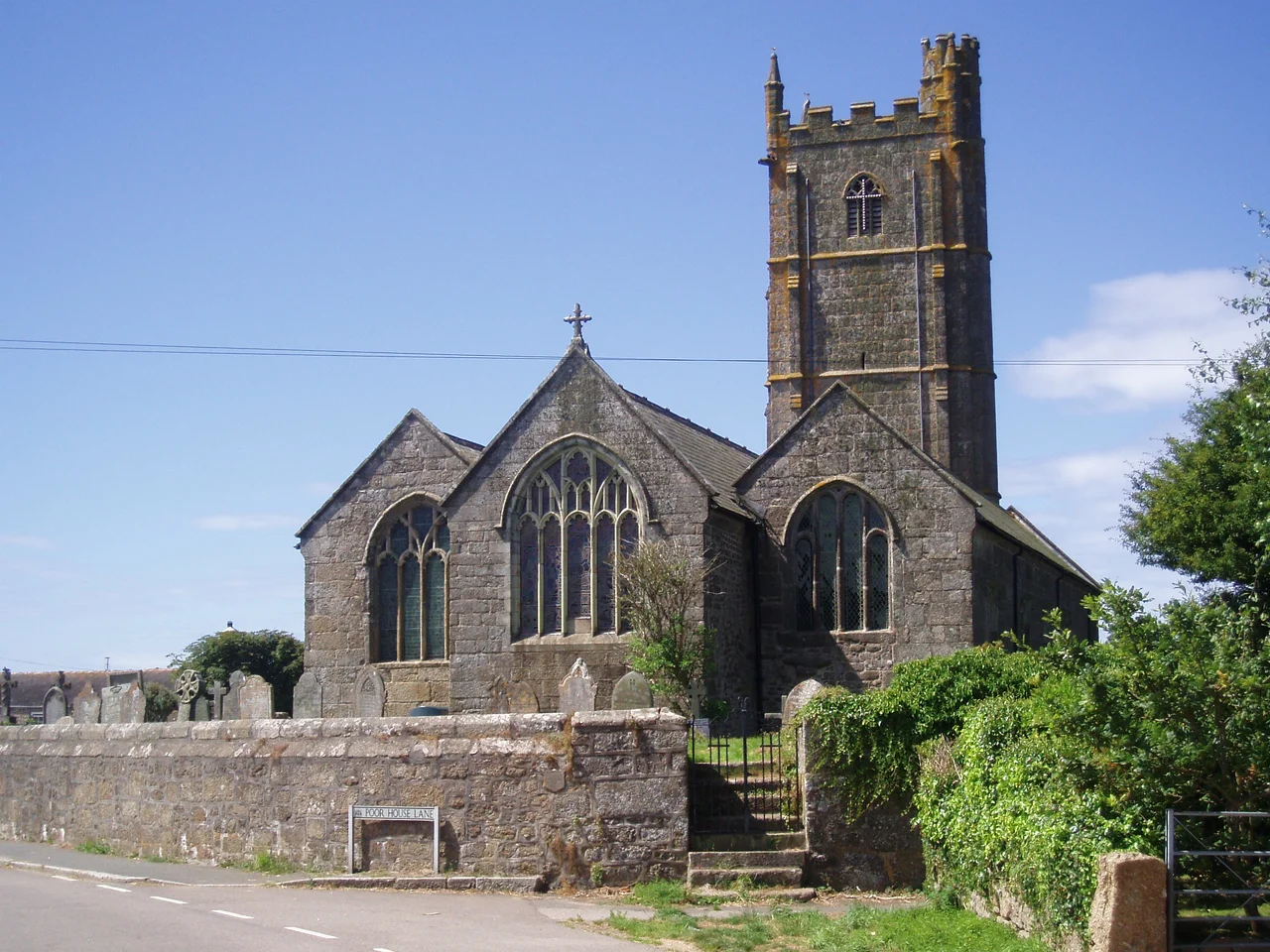

St Buryan's Church
King Athelstan paused here to pray on his way to war. Before launching his campaign against the Scilly Isles around 932 CE, the Anglo-Saxon king who had just unified England stopped at a small Celtic oratory dedicated to a possibly-Irish saint named Buriana, and he made God a deal. If his expedition succeeded, he would endow a college of clergy on this spot. Scilly fell. Athelstan came back. The charter he granted made St Buryan one of the earliest monasteries in Cornwall, and a Royal Peculiar - a church reporting not to a bishop but directly to the Crown. The deal stood for the better part of a thousand years. The building that fulfilled it has been rebuilt, neglected, partly ruined, restored, and rebuilt again, but the granite tower that rises above the Penwith moors today still stands on the ground where Athelstan stopped.
A King's Vow
A church has stood on the site since around 930. Saint Buriana's original chapel, of which almost nothing remains, was the kind of Celtic oratory that dotted West Cornwall in the centuries after Roman withdrawal - small, low, stone, perhaps with a thatched roof. When Athelstan stopped to pray here before sailing for Scilly, he was completing the first true conquest of all the territory that would become England. His subsequent endowment was generous and unusual: the parish of St Buryan was made a Royal Peculiar, which in practice meant the king appointed its dean and the bishops had no jurisdiction. In theory this was prestigious. In practice it meant successive royal-appointed deans rarely bothered to live in this remote corner of Penwith. Only two are recorded as actually residing in their diocese for more than a few months. By 1473 the church was a wreck. Large sections had to be torn down and rebuilt.
Granite and Bells
The tower that dominates St Buryan today was completed in 1501 - ninety-two feet of wrought granite quarried at Lamorna, the same granite that would later be shipped up to London to build Old London Bridge. The tower divides into four stages with double buttresses at every corner, and an octagonal turret rises from the south-east corner enclosing a spiral staircase. Inside, in the bell chamber, hangs the heaviest peal of six bells anywhere in the world. The tenor is the heaviest tenor of any six-bell peal in existence, and the treble is the world's third heaviest. The combination gives St Buryan a sound that carries across the moors of Penwith for miles in the right weather. The bell history is one of long ups and downs. The 1901 refurbishment by Warner's foundry was undone by local indifference - ringers preferred the eight-bell peal of St Mary's in Penzance, and St Buryan's six fell silent again. It took Chris Venn and a nationwide campaign from 1990 to 2001, raising eighty thousand pounds with the public support of Norma Major, wife of the then Prime Minister, to cast two new bells at the Whitechapel Bell Foundry and bring the peal back into use.
The Annexation Trick
The deanery's strange status survived for centuries. After the English Civil War the deanery was annexed in 1663 to the Bishopric of Exeter - an attempt to bring it under normal church hierarchy. The annexation was later severed during the rule of Bishop Harris, who became the first dean truly independent of a higher bishopric. By 1831 the diocese held jurisdiction over the parishes of St Buryan, St Levan, and Sennen - three of the remotest villages in England, on the toe of the Cornish peninsula. The arrangement was eventually wound up, but the architecture of royal exemption is still visible in the building's setting: a parish church on village scale but with a tower that signals importance, a stone-walled churchyard with a fifteenth-century cross, a bell sound disproportionate to the population it has ever served. The church holds a pipe organ by Heard and Sons of 1895 and a Lady Chapel built in 1956 as a gift from John Franklin Tonkin in memory of his uncle Robert Edmund Tonkin of Treverven.
Crosses, Bonfires, and a Grave
Arthur Langdon's 1896 survey records twelve early Christian stone crosses in the parish of St Buryan, of which one stands in the churchyard. In 1879 The Cornishman printed a complaint about the village cross in front of the churchyard gate: the platform was being used as the site of the mid-summer bonfire, which was leaving the cross blackened and charred. The bonfire and the cross had probably coexisted on the same patch of ground for longer than anyone could remember - midsummer fires being one of the durable folk customs of West Cornwall, lit on the highest ground and on church platforms long after the church became Christian. Buried in the churchyard is Augustus Smith, who lived from 1804 to 1872 and became the first Lord Proprietor of the Isles of Scilly - the same Isles that Athelstan sailed to conquer. Smith took a lease on the entire archipelago in 1834 and ran it as his personal kingdom, building schools, evicting families he considered surplus, and laying out the gardens at Tresco Abbey. The church that began with a vow before a Scilly campaign holds, a thousand years later, the bones of the man who governed Scilly. The arc of the parish is unusually neat.
From the Air
St Buryan sits at 50.08 N, 5.62 W on the high ground of West Penwith, about 4 nm east of Land's End. The 92-foot granite church tower is the highest landmark for miles and was historically used as a navigation aid for shipping in the Atlantic approaches. Land's End airfield (EGHC) is 3 nm to the south-west; Newquay (EGHQ) is 32 nm to the north-east. From 2,500 feet the tower stands out against the patchwork of small fields - the ancient Celtic field system of Penwith - and is visible against the Atlantic horizon even on hazy days. The Merry Maidens stone circle is 1 nm to the south on the road toward Lamorna; Boscawen-Un stone circle is 1 nm to the north-west. This is one of the densest concentrations of prehistoric and early-medieval sites in Britain.
Nearby Stories
- Seven Stones Reef 7.8 km away
- Lost Gardens of Heligan 8 km away
- Great Wheal Charlotte 15 km away
- SS Georgia (1890) 21 km away
- Caerhays Castle 26 km away
- SS Irma (1905) 34 km away
- 1979 Fastnet Race 77 km away
- HMS Affray 101 km away