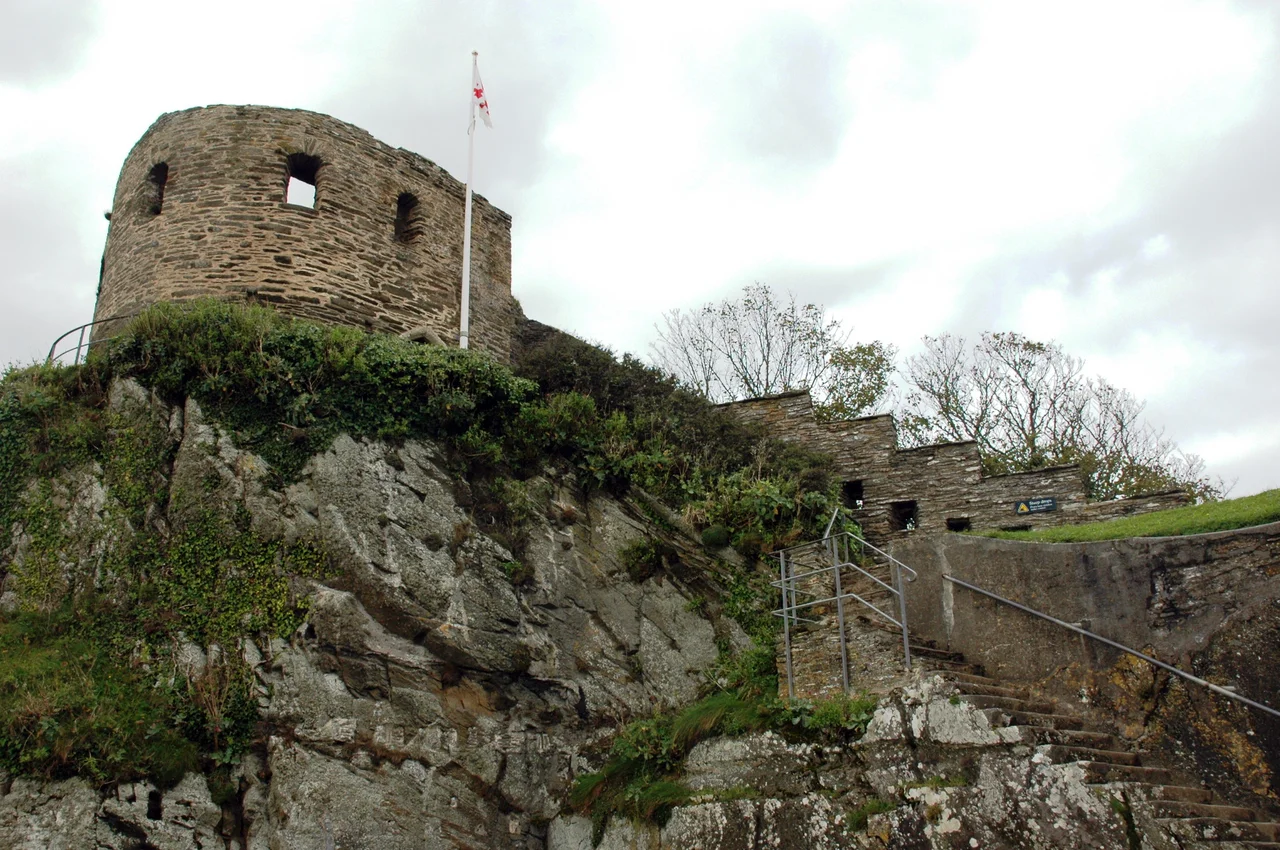

St Catherine's Castle
Henry VIII annulled his marriage to Catherine of Aragon and Cornwall got a fort. The chain of causation is more direct than it sounds. Catherine was the aunt of Charles V, the Holy Roman Emperor, and Charles took the annulment as a personal insult. France and the Empire declared an alliance against England in 1538, with the Pope encouraging an invasion. Henry, who had previously left coastal defense to local lords, started writing checks. Up and down the south coast, masons began stacking stone for the device forts that would bristle with cannon if the imperial fleet appeared. At Fowey, a Cornish gentleman named Thomas Treffry agreed to build one half at the King's expense and half at his own.
Half-Made by 1540
Work on St Catherine's Castle began at some point between 1538 and 1540 on a rocky outcrop overlooking the mouth of the River Fowey. The design was modest: a two-storey D-shaped blockhouse 8 metres by 5 internally, walls of slate rubble up to 1.35 metres thick resting on bedrock cut to receive them. The ground floor had three semi-circular gun-ports facing the sea and the estuary, two more on the first floor, and smaller windows for hand-held gunpowder weapons. A fireplace and chimney, a small guard chamber by the entrance, a parapet walk on top. A curtain wall enclosed about 500 square metres around the blockhouse, with musket slits cut through. By 1540 the local map labeled the castle only half-made, and when the antiquary John Leland visited in 1542 he stayed with Treffry himself, who described how the construction was being paid for jointly by the Crown and Fowey. The fort was a partnership between a king with a grudge and a town that needed protecting.
The Long Working Life
St Catherine's Castle outlived the diplomatic crisis that built it. The imperial invasion of England never came. The blockhouse remained in service through the Tudor and Stuart periods, holding for the Royalists during the Civil War of the 1640s under Charles I. By 1684 the local burgesses were complaining that the fort was in a runious state, but a visitor of that period found it picturesque and romantic, the ruins more impressive than the building itself had ever been. Even so, six cannons still sat in the gun-ports, and the castle continued as an active battery until the end of the Napoleonic Wars in 1815. Three centuries of continuous service for a place described as half-made on the day it opened. When the Crimean War broke out in 1853, the same fears that built the castle came back. In 1855 the War Department added two new gun positions around the original blockhouse, marked their work with WD 1855 plaques on the curtain wall, and cut a flat-roofed magazine into the rock just below the blockhouse to hold powder.
The Last Garrison
The final military use came in living memory. In June 1940, with France falling and a German invasion of Britain expected, St Catherine's Castle was refitted as a coast battery and observation post. Concrete defenses were laid around the position, the old gun platforms were retasked, and the 364 Coast Battery of the Royal Artillery moved in. They were later replaced by the 379 Battery of the 557 Coast Regiment. The gunners watched the channel through the same gun-ports Tudor masons had cut to fire iron balls at Imperial Spanish ships. After November 1943 the battery was retired from active operations as the invasion threat ended, and by 1945 the fort was decommissioned entirely. The newer defenses were removed in the post-war years, returning the castle visually to something close to its 19th-century condition. Where Tudor soldiers had once peered out at sails on the horizon, modern visitors now look at sailing yachts and the white houses of Polruan across the estuary mouth.
Reading the Layers
Today the blockhouse sits in the care of English Heritage, free to visit, easy to walk to from the village along a footpath that climbs through holm oaks and gorse. The architecture rewards close attention. One of the original three sea-facing gun-ports has been blocked up, one of the first-floor ports filled in, and the original pathway to the blockhouse buried under later work. The steps you climb today are 19th century. The granite parapet on the gun platform protected Crimean War cannon. The concrete pads still visible in places held Second World War mountings. Each renovation respected what had come before, layering function on function until the building became a textbook in coastal defense history. Across the estuary, the Polruan Blockhouse and the matching Fowey Blockhouse remind you that this was not a single fort but a coordinated defense, designed to catch any hostile ship between three sets of cannon. The boom chain that once hung between Fowey and Polruan is gone. The geometry of the defense remains.
From the Air
St Catherine's Castle stands at 50.33 N, 4.64 W on the western headland at the mouth of the River Fowey, mid-Cornwall. Approach from Newquay (EGHQ) about 16 nautical miles northwest, or Exeter (EGTE) roughly 50 nautical miles east-northeast. From 1,000 feet AGL the D-shaped blockhouse and the curtain wall are clearly visible against the green headland. The matching Polruan Blockhouse sits across the estuary 300 metres east. Fowey town curves up the western shore, with the deepwater china-clay port of Carne Point and Bodinnick visible upstream. The English Channel opens to the south. The castle is managed by English Heritage and open all year. Coastal haze and sea fog common in summer; clear westerly air in autumn.
Nearby Stories
- Mount Edgcumbe Country Park 2.6 km away
- Tintagel 4.2 km away
- Wheal Trewavas 6.1 km away
- Tehidy Country Park 14 km away
- Battle of Plymouth (1652) 15 km away
- Okehampton Castle 19 km away
- Goonhilly Satellite Earth Station 32 km away
- Action of 17 November 1917 101 km away