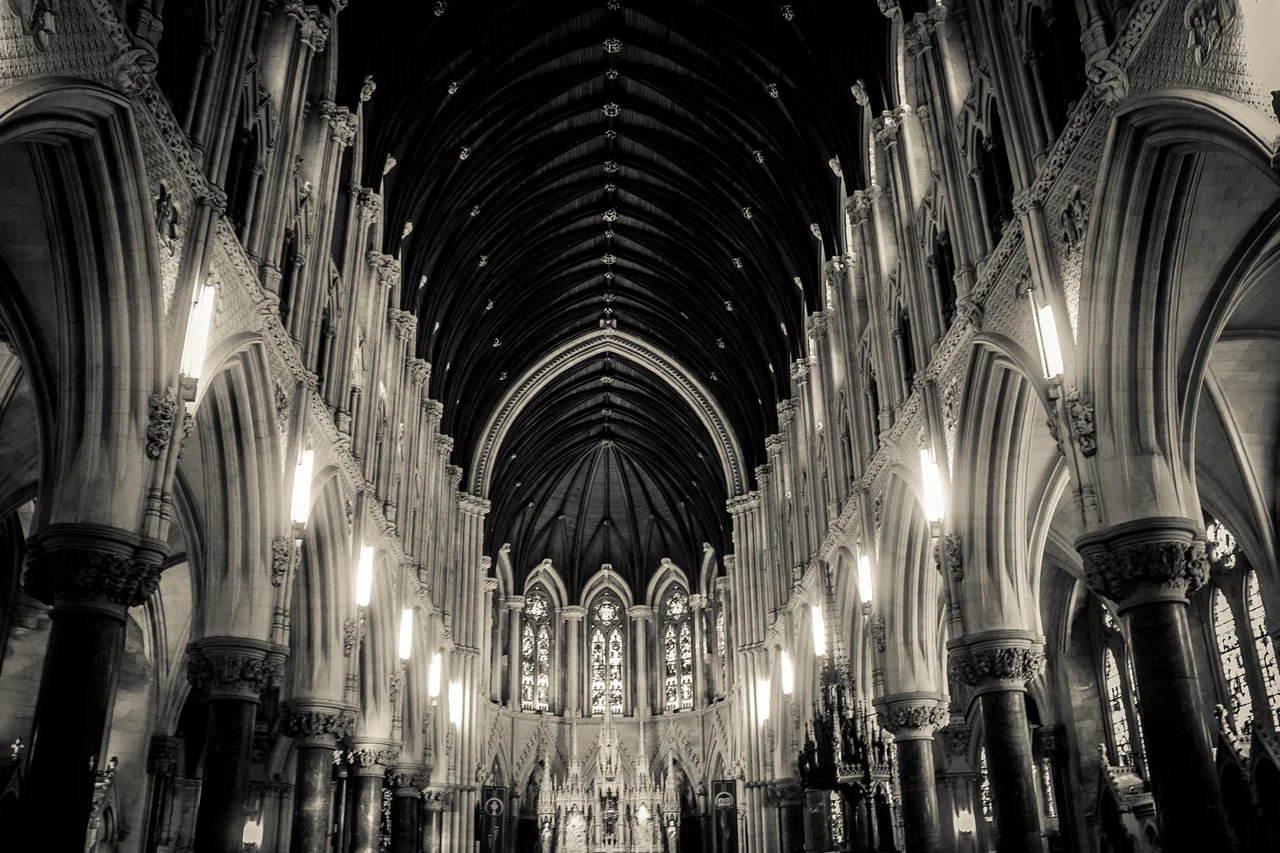

St Colman's Cathedral, Cobh
It took fifty-one years to finish, and twice ran out of money before it did. Edward Welby Pugin began drawing it in 1867, and he was dead before the walls reached the height of a person. When the cathedral was finally consecrated on 24 August 1919, the bill had ballooned from a planned £25,000 to £235,000 - one of the most expensive churches ever built in Ireland - and the architect's son, George Ashlin, had spent his career finishing what his father started. The reason for the wait is now the thing you see first from any approach to Cobh: a 91-metre Gothic spire, the tallest church in Ireland, lifted above a hillside town that lifts itself above the harbour.
Why Cobh, Why So Big
When Bishop Timothy Murphy died in 1856, the long-united dioceses of Cloyne and Ross were finally split. The new Bishop of Cloyne, William Keane, decided his see needed a purpose-built cathedral - the small 'Pro-Cathedral' that had stood on the site since 1769 would not do. In 1867 the diocesan building committee invited three of the country's most prominent church architects to compete: Edward Welby Pugin paired with George Ashlin, James Joseph McCarthy, and George Goldie. McCarthy and Goldie suspected the fix was in. Ashlin was a family friend of the bishop, and his brother worked for the building committee. They were right - Pugin and Ashlin won. They were also the only firm willing to accept the £25,000 cost ceiling. None of them, in 1867, had any idea what the bishop would actually demand.
The Bishop Wanted More
Excavation began in 1868. The cornerstone was laid on 30 September that same year. The walls were 3.5 metres high - barely above head height - when Bishop Keane stopped construction. He had decided he wanted something more elaborate. None of the original drawings except the ground plan survived his demand. Pugin and Ashlin added flying buttresses, traceried parapets, arcading, niches, and more, requiring many thousands of additional cubic feet of stone. The contractor Michael Meade, faced with a contract that no longer described what he was building, refused to renegotiate and walked off the site. After a brief halt, work resumed under new builders. Pugin died in 1875. By 1879 the congregation could gather inside for the first Mass, said by Bishop McCarthy. By 1883 the money had run out again. Construction stopped for six years.
Granite, Marble, Patience
When Bishop McCarthy resumed building in 1889, the west front was finished in a year. The interior began to take shape in 1893 - walls clad in Bath and Portland stone, the roof sheeted in pitch-pine vaults. The materials roll out as a kind of geological tour of the British Isles: blue Dalkey granite from Dublin, limestone dressings from Mallow in north Cork, foundation sandstone from Carrigmore and Castle Oliver, red Aberdeen granite for the west-front pillars, Belgian blue slate on the roof, Middleton red marble in the shrines and confessionals, and Newry granite for the tower. The spire itself was raised between 1911 and 1915, octagonal in section, capped with a 3.3-metre bronze cross. Bishop Robert Browne, Pugin's old client's successor, blessed that cross. He was also the one who finally consecrated the building in 1919, in the presence of three Irish archbishops.
Ireland's Only Carillon
The tower holds something no other Irish church has - a carillon, a bell instrument played from a keyboard rather than rung individually. 42 bells were hung in 1916, in the middle of the First World War; another five were added in 1958, bringing the total to 49 - the most of any carillon in the British Isles. The heaviest is named St Colman after the diocese's 6th-century patron, and weighs 3.6 tons, the largest bell in Ireland. An automated mechanism strikes the hour and quarter-hours and plays appropriate sequences for Masses, weddings and funerals. On most Sunday afternoons, carillonneur Adrian Gebruers climbs to the keyboard chamber and plays the bells by hand - hour-long programmes that drift over Cork Harbour, audible across the water on Spike Island and Haulbowline.
A Spire Above a Hill Above a Harbour
The cathedral is dedicated to Colman of Cloyne, the 6th-century poet-monk who established the diocese around 560. But the building stands above Cobh, not Cloyne - because by 1769 the bishops had moved their residence to what was then called Queenstown, on the north shore of Cork Harbour. The cathedral followed the bishops, and the bishops followed the harbour. The harbour did the rest. Cobh in the late 19th and early 20th century was the last European port for emigrants leaving for America; it was where the Titanic stopped on her maiden voyage in 1912 and never returned; it was where the Lusitania survivors were brought ashore in 1915. The 300-foot French-Gothic spire became the last thing many emigrants saw of Ireland, and the first thing returning ones saw coming home.
From the Air
Cobh Cathedral stands at 51.851 degrees N, 8.293 degrees W on a steep hillside above Cobh town, on the south shore of Great Island in Cork Harbour. The 91.4-metre French-Gothic spire is visible from 30-plus nautical miles in good conditions and dominates the harbour from any angle. Best viewed from 2,000 to 5,000 feet on approach to Cork Harbour, with Haulbowline naval base immediately south, Spike Island just southeast, and the harbour mouth and Roche's Point Lighthouse marking the seaward approach. Cork Airport (EICK) is 12 km west-southwest; expect controlled airspace near Cork.
Nearby Stories
- Walter Siepmann 6.3 km away
- Gaeltacht na nDéise 11 km away
- Fermoy 12 km away
- Canovee 14 km away
- Rathcoole Ambush 16 km away
- SS Folia (1907) 20 km away
- Cloghan Castle, Lough Hyne 35 km away
- SM U-27 91 km away