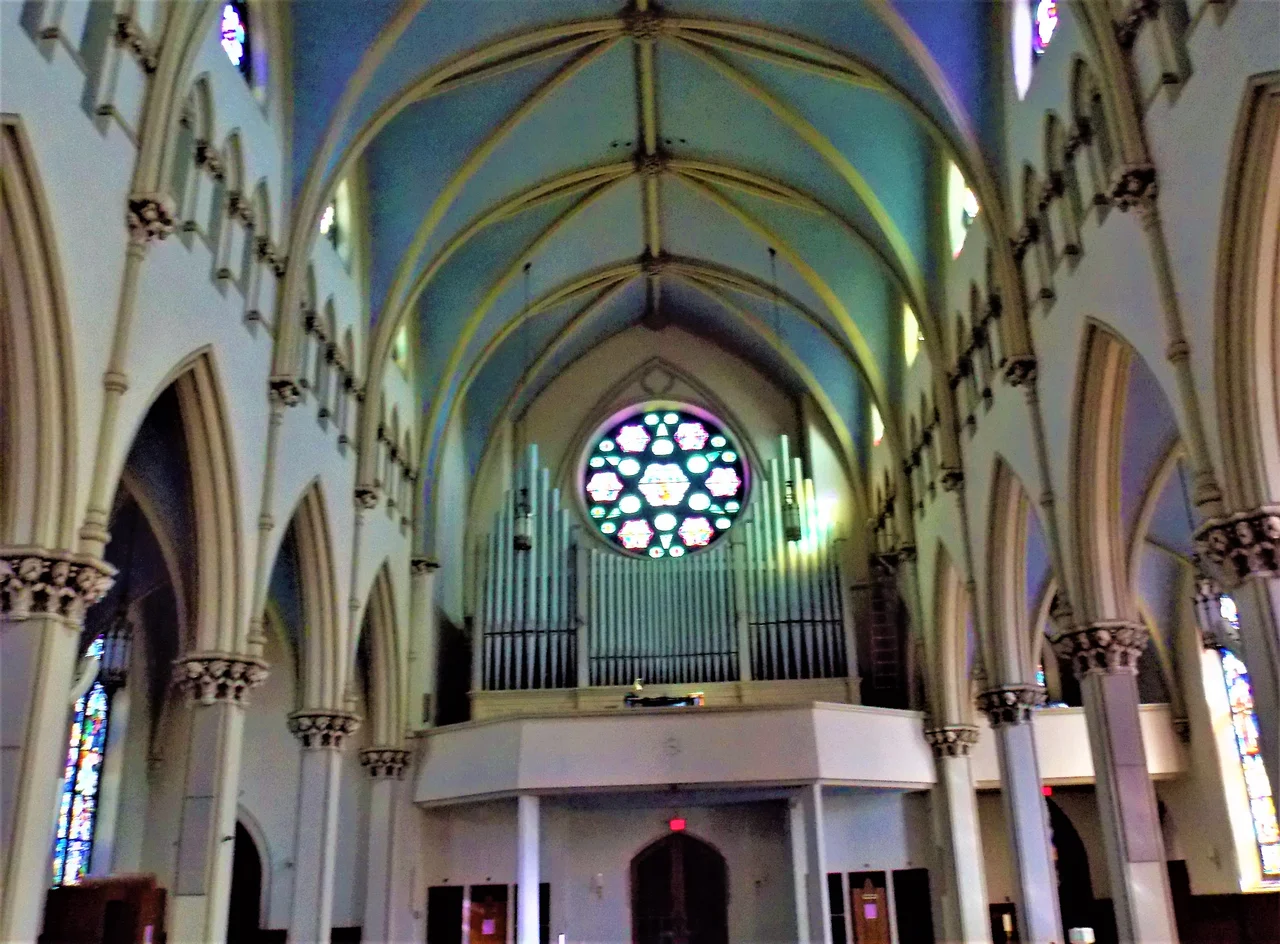

St. Dominic Catholic Church (Washington, D.C.)
When Lyndon Johnson needed somewhere to think, he sometimes asked his Secret Service to drive him to a Gothic Revival church on E Street SW, three blocks from where the Department of Housing and Urban Development now stands. His daughter Luci had converted to Catholicism in 1965, attending Mass at St. Dominic Church with the Dominican friars she called her Little Monks. She asked them to pray for her father through the worst years of the Vietnam War, and Johnson - a Disciples of Christ Christian who never formally joined any Catholic church - would come too, sometimes for instruction with the friars, sometimes just to sit. He never converted. When he died in January 1973, a Catholic graveside service was said in his memory, at Luci's request. The church Johnson visited had survived an 1885 fire that gutted its interior, the 1950s urban renewal that demolished nearly every building around it, and a Supreme Court case (Berman v. Parker) that displaced four thousand families from the neighborhood and reshaped American property law.
The Island
St. Dominic Church was founded in 1852 on land that had been in Catholic hands since at least 1735. Notley Rozier Young - a wealthy Catholic planter whose property included much of what is now Southwest Washington - inherited the parcel from his father, Benjamin Young, who had lost his colonial post as Commissioner of Crown Lands when he converted to Catholicism. Notley Young married Mary Carroll, sister of John Carroll, the first Catholic bishop in the United States. Square 466, the block where the church now stands, passed through the family to Reverend Notley Young Jr., a Jesuit philosophy professor at Georgetown, and from him to Georgetown College. In 1853 the Dominican order bought the lot from Georgetown for $5,055. The neighborhood was then called The Island because the Washington City Canal - a now-buried waterway that connected the Potomac and Anacostia along what is today Constitution Avenue - separated Southwest from the rest of the federal city. The Dominicans said Mass in private houses while the church was being built, with worshippers spilling out of George Mattingly's residence and kneeling in the street.
Fire and Stained Glass
On the morning of March 12, 1885, fire broke out in the boiler room of the church basement shortly after ten o'clock. It worked its way up through the floor and into the sanctuary, eventually engulfing the altar. The church's engineer Florence McCauliff, the housekeeper Kate Duffy, and Officer Burns of the First Precinct Station House ran into the burning building together and stripped the altar of everything they could carry. Officer Burns sustained serious burns to his hands and wrists before being driven out by the flames. The fire brigade extinguished the blaze by two in the afternoon, smashing holes in the roof and stained-glass windows to do it. Parishioners gathered outside in tears, then walked into the ankle-deep water inside and carried out what they could. The damage was estimated at $50,000 - a two-thousand-dollar organ and a thousand-dollar window over the main entrance were total losses. The church was rebuilt. The architect Patrick Keely - the prolific Irish-born designer of hundreds of Catholic churches and cathedrals across North America - had designed the structure originally. The windows installed in 1875 still flank the sanctuary: the Sacred Heart over the high altar, donated by George Mattingly; St. Joseph beside it, given by Ellen Ewing Sherman, wife of General William Tecumseh Sherman.
Berman v. Parker
In the 1950s the District of Columbia Redevelopment Land Agency designated most of Southwest Washington a 'blighted area' eligible for federal urban renewal. The plan would eventually displace more than four thousand families - the largest residential displacement in District history. Goldie Schneider, owner of a small hardware store at 716 Fourth Street SW, refused to sell. Her son Joseph H. Schneider, president of the Southwest Businessmen's Association, took the case all the way to the Supreme Court. In Berman v. Parker, decided in 1954, the Court ruled unanimously that the government could use eminent domain to take private property not merely for direct public use but for any 'public purpose' Congress saw fit. The decision became one of the most consequential property-rights rulings in American history, and remains the foundation of the modern urban-renewal authority that produced Kelo v. New London a half-century later. St. Dominic Church survived the demolition. Its priory, school, and convent did not - the ramps for Interstate 395 at Sixth and Seventh Streets passed directly through where they had stood. The Dominicans leased temporary quarters down the street while a new four-story priory was built. It opened in 1960 with forty rooms and a section for elderly friars.
The Sherman Window
Look closely at the sanctuary windows installed in 1875 and you find a small Civil War memorial hidden in plain view. The window of Saint Joseph, just to the right of the Sacred Heart above the altar, was a gift of Ellen Ewing Sherman. She was the daughter of Senator Thomas Ewing of Ohio, the wife of General William Tecumseh Sherman, and a devout Catholic who refused to follow her husband into the Episcopal Church. Their son Thomas Ewing Sherman became a Jesuit priest. Ellen's gift to St. Dominic - the Joseph window, patron saint of the worker and protector of the family - was the kind of devotional gesture she made repeatedly during the decade after the war, when her marriage to the general was strained partly over religious differences. The rose window at the rear of the church depicts St. Cecilia, patron of music. Other windows show St. Cecilia, St. Peter, St. Paul, the Dominican family, and a series of scenes from the life of St. Dominic - including the moment, recorded in early biographies, when he offered himself as a ransom to free a man held in slavery by the Moors in Palencia.
What Survives
St. Dominic today is a small parish in a part of the city that has changed almost beyond recognition. The Department of Housing and Urban Development sits across the street. L'Enfant Plaza, the Brutalist megablock that replaced much of pre-1960 Southwest, looms a block north. The Metro's L'Enfant Plaza Station opened in 1977. The interior of the church preserves its 1875 stained glass, a reredos installed in 2013, an ornately carved wooden altar donated by the Lynch family in memory of a friar ordained at the church in 1938, and a Belgian tabernacle added around 2011. A 1898 McShane Bell Foundry bell hangs in the tower, inscribed in Latin with the traditional bell-tolling rhyme: I praise the true God, call the people, gather the clergy, mourn the dead. The church holds a relic of the True Cross, a relic of the manger, and a relic of St. Martin de Porres - the Afro-Peruvian Dominican lay brother whose statue, carved by Dominican artist Thomas McGlynn, stands in a shrine blessed in 2018. Around it, the Southwest neighborhood that Lyndon Johnson knew has almost vanished. The church remains.
From the Air
St. Dominic Catholic Church sits at 38.8830 degrees N, 77.0207 degrees W, at 630 E Street SW in the Southwest Federal Center, three blocks south of the National Mall and adjacent to the Department of Housing and Urban Development. From the air the Gothic Revival brick church reads as a small steeply-roofed structure with a single spire, immediately next to the much taller HUD headquarters and L'Enfant Plaza. Best viewed at 1,500 to 2,500 feet AGL; the entire site lies within the Washington FRZ and the prohibited area P-56A. Nearest airports are Ronald Reagan Washington National (KDCA) 2 nm south, College Park (KCGS) 8 nm northeast, and Washington Dulles (KIAD) 22 nm west.
Nearby Stories
- Gunston Hall 1.1 km away
- 2023 Baltimore Shooting 4.9 km away
- Battle of Middleburg 6.6 km away
- Crownsville Hospital Center 10 km away
- Battle of Loudoun Heights 13 km away
- First Battle of Rappahannock Station 20 km away
- Howard County, Maryland 21 km away
- Harriet Tubman Underground Railroad 50 km away