.jpg)
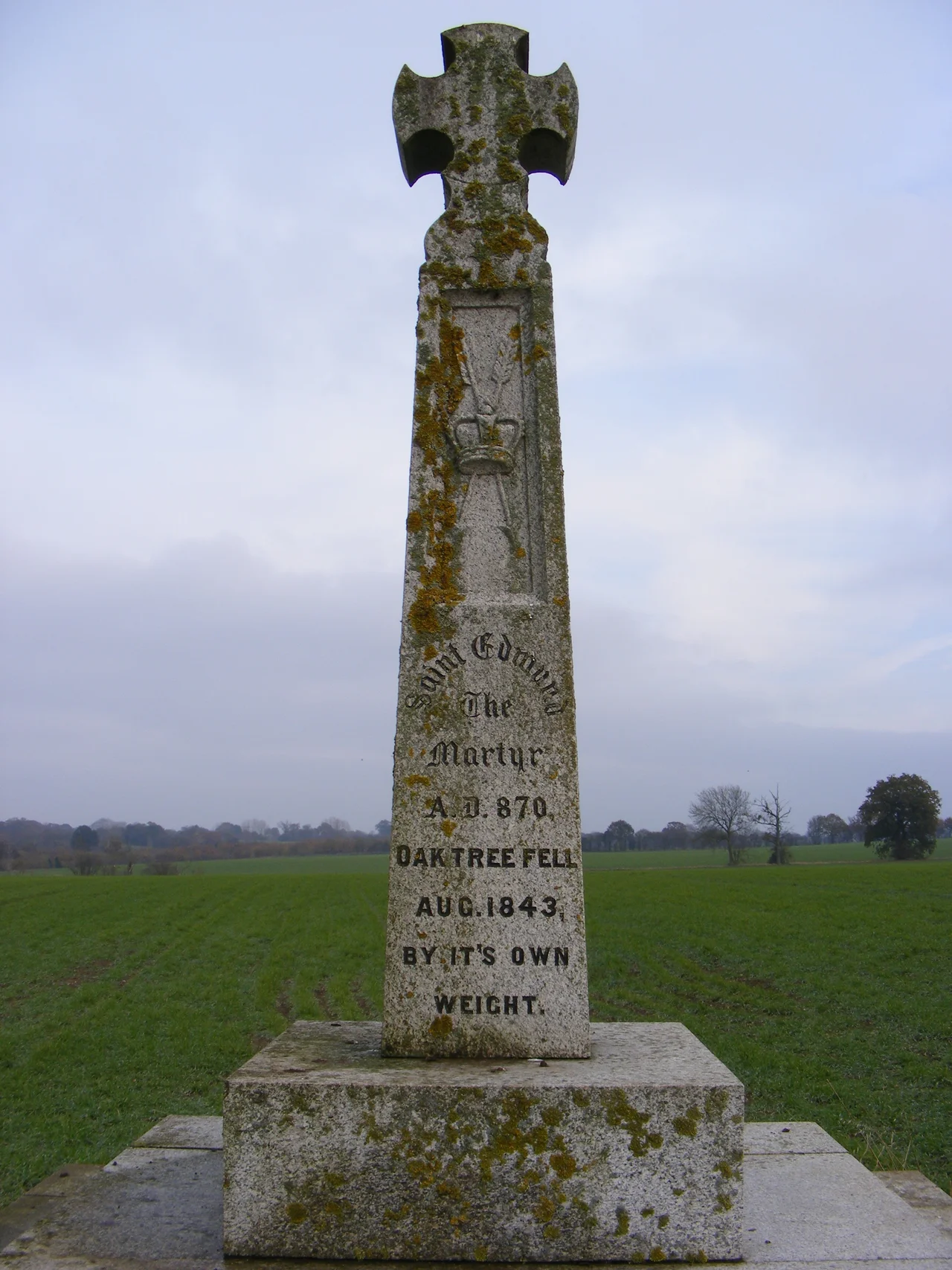
St Edmund's Memorial, Hoxne
In September 1848, one of the oldest oaks in Suffolk fell under its own weight. The tree was 20 feet in circumference at the trunk, spread its branches over 28 yards, and was judged by experts to show more than a thousand years of annual growth rings. When it came down, searchers found an arrowhead embedded in the wood — a spike of iron covered over by a foot of sound timber, with the rest of the trunk rotted to sawdust inside. The tree was said to be the one to which King Edmund of East Anglia had been tied when the Vikings killed him in 869 AD. The arrowhead appeared to confirm it. Whether this was the right tree, or the right place, remains genuinely uncertain. The monument that marks the spot — a stone in a field 95 meters east of Abbey Hill in the village of Hoxne — is listed as a Grade II building. It claims to mark the location of a martyrdom. It may well be right.
The King and the Great Heathen Army
Edmund was King of East Anglia. In 865, a Viking force known in the Anglo-Saxon Chronicle as the Great Heathen Army landed in England and worked its way across the country. By 869, the force was wintering at Thetford, in Edmund's kingdom. The Chronicle notes only that Edmund fought them and was defeated and killed. But subsequent accounts, particularly the Passio Sancti Eadmundi written by the monk Abbo of Fleury in the 10th century, offer considerably more detail. According to Abbo, Edmund chose not to fight — he refused to renounce his Christian faith and chose martyrdom instead. He was tied to a tree, shot with arrows, and beheaded. His head was thrown into a thicket, where it was found guarded by a wolf calling out 'here, here, here' to the searchers. The wolf then departed. Edmund's body and head were buried at a place called Haegelisdun before being translated to the monastery at Beodricesworth — modern Bury St Edmunds — where he became the focus of an important medieval cult.
Hoxne's Claim
Hoxne has traditionally been identified as Haegelisdun — the place where Edmund died and was first buried. The claim is supported by medieval tradition and local topography, but it is disputed by modern historians, who note that other locations fit the available evidence. The arrowhead found in the fallen oak in 1848 was exhibited to the Society of Antiquaries by Lord Mahon, who was the son-in-law of Sir Edward Kerrison, then owner of Hoxne Hall. The account given to the Bury and West Suffolk Archaeological Institute that year described the tree as 'apparently in the vigour of health' when it fell — the foliage too heavy for the rotted trunk to support. In Hoxne church, a carved pew head still shows Edmund's crowned head supported by wolves' paws. The iconography of the martyr persists in the village regardless of what historians conclude about geography.
The Monument and Its Errors
The original monument at the site collapsed in a storm on 27 June 1905. It was rebuilt by Agnes Burrell Bateman-Hanbury, the daughter of Sir Edward Kerrison, 1st Baronet, who had inherited the estate following her brother's death in 1886. She commissioned a stone mason based in Diss, Richard F. Perfitt, to carry out the work. Faulty instructions led to errors in the inscription — the month and year of the oak's collapse are both wrong on the current stone, a small irony for a monument meant to preserve historical memory. The rebuilt monument stands in a field, Grade II listed since 2019, marking a martyrdom that may or may not have occurred here, on behalf of a king who chose death over apostasy and was remembered for over a thousand years for it.
From the Air
Located at 52.34°N, 1.20°E in the village of Hoxne, north Suffolk, approximately 22 miles north of Ipswich. The monument stands in a field east of Abbey Hill, not easily visible from altitude. Norwich Airport (EGSH) is approximately 18 miles to the north-northeast. The surrounding landscape is gently rolling agricultural land in the valley of the River Waveney. The village itself is small, with the parish church of St Peter and St Paul nearby.
Nearby Stories
- RAF Hethel 4.1 km away
- West Stow Anglo-Saxon Village 4.9 km away
- Castle Hedingham 8.1 km away
- Shotley Gate 8.5 km away
- RAF Marham 14 km away
- Four Days' Battle 52 km away
- Southern Bight 79 km away
- SS Elbe 113 km away