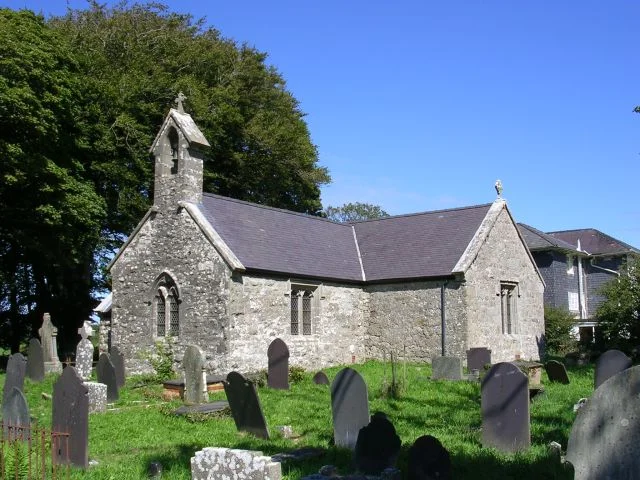

St Gallgo's Church, Llanallgo
The church is small, set back from the village, cross-shaped, built of grey rubble masonry with a slate roof and a stone bellcote at one end. From outside, it looks like one of a hundred small Welsh country churches. Inside, beside the chancel, hangs a late thirteenth-century bell with the impression of a coin of King Edward I pressed into the metal — an accidental dating stamp left by a medieval bellmaker. In the churchyard outside lie the dead of one of Britain's worst maritime disasters, and the rector who buried them.
From the Sixth Century
Tradition says Gallgo founded the church here in the early sixth century, which would make it — in the words of the historian Geraint Jones — 'one of the oldest Christian sites in Anglesey'. Gallgo was a son of St Caw, a king from somewhere in what is now southern Scotland, and a brother of two more famous saints: Gildas, whose De Excidio et Conquestu Britanniae is one of the few surviving British accounts of the post-Roman collapse, and Eugrad, who founded another church a short walk from this one. A holy well dedicated to Gallgo once flowed nearby; nineteenth-century writers noted that the local water, heavily mineralised with sulphate of lime, was credited with miraculous cures. The Norwich Taxation of 1254 records a church here, but the oldest standing parts of the present building — the chancel and the north and south transepts — are late fifteenth century, built in the Perpendicular style that flourished in late medieval England and Wales.
October 1859: The Wreck on the Doorstep
The Royal Charter, a steam clipper coming home to Liverpool from Melbourne with hundreds of passengers and crew aboard, was driven onto the rocks just north of Moelfre on the night of 25-26 October 1859 by the worst storm to hit the Irish Sea in the nineteenth century. More than 450 people died within a few hundred metres of land. The dead came ashore for weeks. Many of them, returning gold miners, were carrying the wealth they had spent years digging out of the Australian goldfields — and that wealth, sewn into belts and stitched into coats, helped pull them under. Llanallgo was the nearest parish church to the wreck. Its rector, the Reverend Stephen Roose Hughes, took on the work of receiving the dead, recording their names and possessions where these could be determined, organising the burials, and corresponding with their families. By contemporary accounts he wrote more than a thousand letters in reply to grieving relatives, mostly by hand, at his own expense. The churchyard filled with new graves.
The Cost of That Work
Stephen Roose Hughes did not survive the experience for long. He died in 1862, at the age of forty-eight, three years after the Royal Charter went down. His brother Hugh Robert Hughes, rector of the neighbouring parish of Penrhosllugwy, had shared the worst of the work and died within months of Stephen. Charles Dickens, who visited Anglesey for All the Year Round to report on the disaster, devoted much of his piece in The Uncommercial Traveller to the rector — to the methodical kindness of the recording, the care with which possessions were returned to families, the dignity of the burials in a small Welsh churchyard far from the homes the dead had been trying to reach. In 1934 the church sanctuary was restored in Stephen Roose Hughes's memory. The website of the present church bears the title 'Royal Charter Church'. The connection is not a tourism slogan: it is the entire weight of the parish's recent history.
Architecture and the Cluttered Centuries
The cross-shaped plan dates from the late medieval rebuilding. You enter through a porch on the north side, where the doorway has been built from reused older stones — a small piece of medieval recycling that hints at how many earlier buildings have stood on this site. Inside, the timber braces of the nave roof are exposed; the chancel and transepts have barrel-shaped boarded ceilings; the chancel floor is local limestone. The east window of the chancel dates from the fifteenth century, although its delicate stone tracery was renewed later. The nineteenth-century antiquarian Harold Hughes — no relation to Stephen — thought the walls had been lowered at some point after the church's first construction, because the top of the east window sits awkwardly close to the roof. The church furniture from the early twentieth century is in the Arts and Crafts style. The vestry was badly damaged by fire in 2004 and has since been repaired. Beneath the bellcote at the west end, that thirteenth-century bell still rings, its surface dimpled with the imprint of a coin of King Edward I that a long-dead foundryman pressed into the wax before casting.
Quiet Sundays and the Graves Outside
St Gallgo's is one of four churches in the combined benefice of Llaneugrad and Llanallgo with Penrhosllugwy with Llanfihangel Tre'r Beirdd — a long Welsh phrase for a small Welsh ministry. The poet Dafydd Trefor, recorded as rector here in 1504, is buried in the churchyard. So is John Williams, the nineteenth-century poet and historian known by the bardic name 'Glanmor'. Two Commonwealth war graves — a Royal Engineers soldier of the First World War, a Merchant Navy sailor of the Second — share the ground with the unnamed and named dead of the Royal Charter. The churchyard, in other words, holds a thousand years of Anglesey's history compressed into one sloping field beside a small Welsh village. The church website now bears the name 'Royal Charter Church'. The bell rings on Sunday morning.
Flight Context
St Gallgo's sits at 53.341°N, 4.252°W, about three kilometres southwest of Moelfre on the east coast of Anglesey. From the air the church is a small grey building with a slate roof, set in a green churchyard between scattered fields and farms. The crucial geography for understanding this place is its relationship with the Royal Charter wreck site: the rocks where the ship broke up lie just over 3 km to the northeast, near Point Lynas. RAF Valley (ICAO EGOV) lies 33 km to the west; Liverpool's approach corridor is to the east. Low-altitude transits along the east coast of Anglesey show the wreck site, Moelfre village, and Llanallgo as a single connected landscape of disaster, rescue, and remembrance.
From the Air
Coordinates 53.341°N, 4.252°W (St Gallgo's Church, Llanallgo, east coast of Anglesey). Recommended viewing altitude 2,000–3,000 ft AGL. Nearest airport RAF Valley (EGOV), 33 km west. The crucial nearby landmark is the Royal Charter wreck site (3 km northeast, near Point Lynas) — the church holds the graves and the memory. Moelfre village and its RNLI station lie between the church and the wreck.
Nearby Stories
- Llandudno Lifeboat Station 3.8 km away
- Glynllifon 6.1 km away
- German submarine U-1024 9.4 km away
- Irish Sea Bridge 11 km away
- Ysbyty Ifan 12 km away
- Irish Sea 18 km away
- Celtic Array 18 km away
- Birkdale Palace Hotel 56 km away