
St. Gereon's Basilica, Cologne
Between the dome of Hagia Sophia and the dome of Florence Cathedral, nearly nine hundred years passed in the West without a builder daring to vault a space this wide. Then, in a side street of medieval Cologne, between 1219 and 1227, masons closed a ten-sided dome over an oval Roman building from the fourth century, and for two more centuries no one in Western Europe matched what they had done. St. Gereon's Basilica is not the most famous church in Cologne. The cathedral two kilometres to the southeast claims that. But St. Gereon is the older puzzle, and the more surprising one.
The Roman Mystery
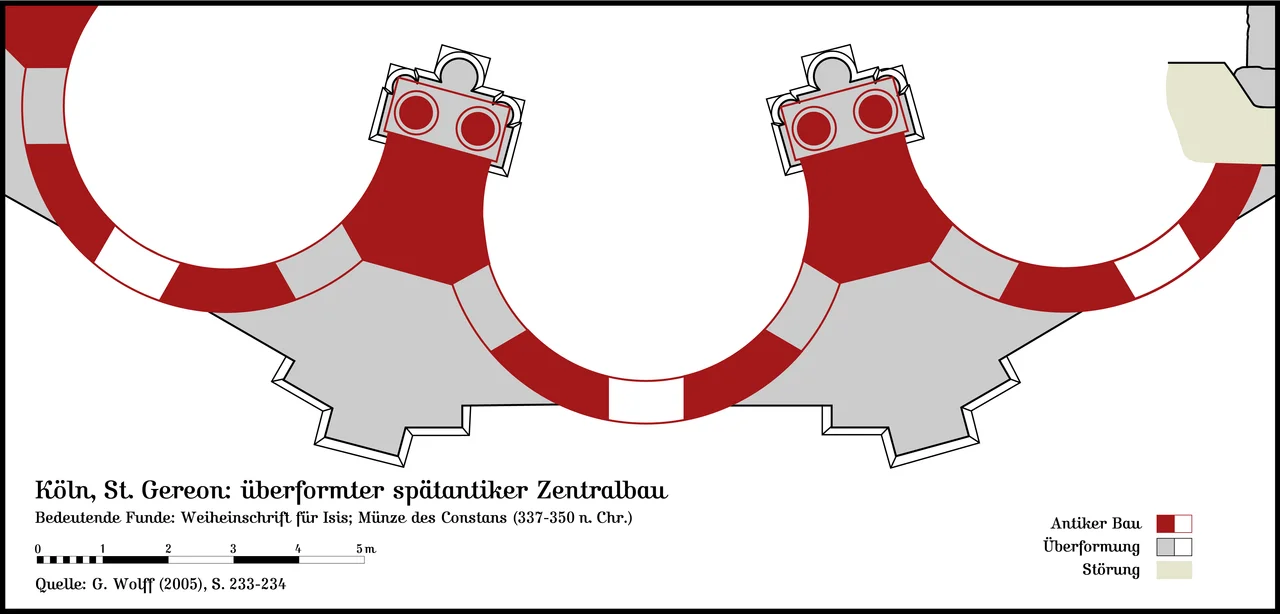
Sometime between 350 and 365 CE, in the late Roman city of Colonia Claudia Ara Agrippinensium, someone with money built an oval domed structure on the northwest edge of the city's oldest cemetery. The dome was 23.70 by 19.80 metres, lined inside with gold-ground mosaics and marble panels, ringed by horseshoe-shaped niches that once held statues or shrines. The interior must have glowed. No one knows who built it or why. The leading guess is that it was a mausoleum for a rich early Christian family in the provincial capital, possibly during the reign of Constantius II. Gregory of Tours, writing two centuries later, may have referred to it as the church of the Golden Saints, ad sanctos aureos. The first secure documentary reference to a church on the spot dates from 612. Whoever the original patron was, they left no name.
Layers of Time
Cologne's first archbishop, Hildebold, added a rectangular choir around 800 and founded a community of canons here in the early ninth century. The bones of Saint Gereon, a Roman soldier said to have been martyred at this site, were enshrined as a relic from 1121 onward. Archbishop Anno II extended the canons' choir between 1060 and 1062. Arnold von Wied lengthened the choir again from 1151, flanked it with two towers, and added a semicircular apse. Each archbishop wanted to leave his mark, and each one was building on a structure that was already centuries old. By the late twelfth century the building was a strange composite: a four-hundred-year-old Roman oval at the west end, with a centuries-newer choir stretching east. What the thirteenth century did to it changed everything.
The Dome
Between 1219 and 1227 the masons of Cologne wrapped the old Roman oval in fresh supporting masonry, turning the curved walls into a ten-sided polygon (a decagon) seen from outside. They added Gothic galleries above the antique conches, and over the whole thing they built a dome. The oval was 21.0 by 16.9 metres, and it had to be constructed by laying out the curve from four separate centres arranged in a cross around the room's middle. The model, in spirit if not detail, was Charlemagne's Palatine Chapel in Aachen, the coronation chapel of the Kings of the Romans, but the Cologne builders worked in contemporary Gothic, not the older Carolingian style. The result was structurally extraordinary. Until Brunelleschi closed his dome over Florence Cathedral in the fifteenth century, no dome built in the West would span as far.
What the Bombs Could Not Take
The Bombing of Cologne in World War II hit the building hard. By 1952 the decagon was in acute danger of collapse and had to be closed off from the long choir, which served the congregation alone for years. Structural stabilisation went on through 1968 and again until 1985. When the decagon and apse were finally reopened, the postwar artist Georg Meistermann and his colleague Wilhelm Buschulte filled them with colour-window cycles in a confidently modern visual language, glowing against the medieval stone. Step into the decagon today and look up. Sixteen metres of the wall around you is the original late-Roman fabric, with the bricked-up arched windows of the fourth century still visible. Above that, the Gothic galleries and the great dome of 1227. The ancient floor mosaic survives in fragments in one of the south conches.
What Wandered Off
Two of St. Gereon's greatest treasures no longer live here. The Sacramentary of St. Gereon, made for a canon around the year 1000, is a peak of Ottonian manuscript illumination, with full-page miniatures of the life of Christ and an enthroned Christ in majesty. In 1703 it slipped away to the French court, and today it sits in the Bibliothèque nationale de France in Paris as Latin 817. The Cloth of St. Gereon, an eleventh-century textile that once hung in the choir, is the oldest surviving European tapestry. Its fragments are scattered between Nuremberg, Berlin, Lyon, and the Victoria and Albert Museum in London. The basilica that built them no longer holds them, but it is still standing, still consecrated, still the strangest Romanesque church in Germany.
From the Air
50.9432 N, 6.9460 E. St. Gereon sits in the northwestern part of the inner ring of Cologne's Altstadt, roughly 1 km northwest of the cathedral. From altitude the distinctive decagonal dome of the western core stands out from the surrounding rectangular roofs. Cologne/Bonn (EDDK) is 16 km southeast. Düsseldorf (EDDL) 32 km north. Rhine valley haze and low cloud are common; the church is best seen on a clear morning.
Nearby Stories
- Diamond Interchange: How a Simple Idea Reshapes Towns Like Julich 2.8 km away
- Dusseldorf-Unterbach 6.1 km away
- Baumwollspinnerei Ermen & Engels 11 km away
- RAF Bruggen 15 km away
- Hagen Open-air Museum 21 km away
- Belgium 130 km away
- Marcinelle Mining Disaster 173 km away
- Zwingenberg Castle 178 km away