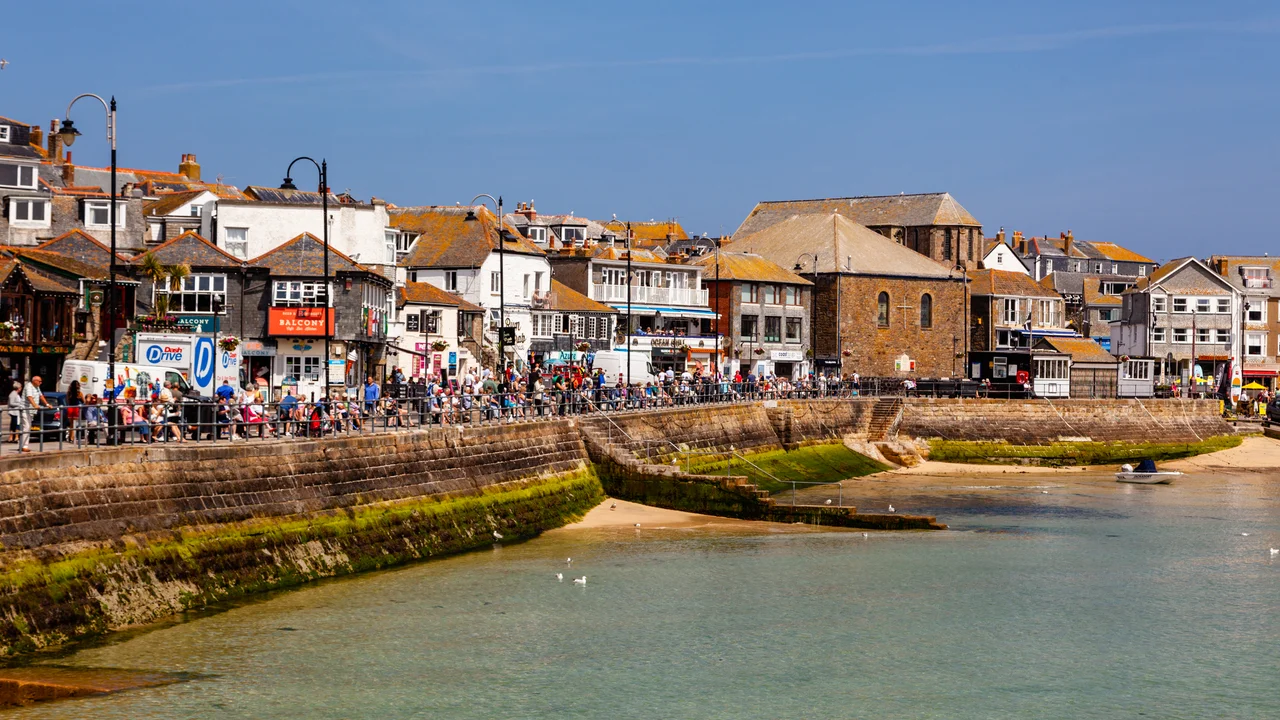

St Ives, Cornwall
There is a quality of light in St Ives that painters argue about. Some say it comes from the bay's three open sides, water on the north, west, and east bouncing reflections back at the granite cliffs. Some credit the proximity to the Atlantic, which keeps the sky stripped of haze for days at a time. Virginia Woolf, who summered here as a child between 1882 and 1894, simply called the months at the family's Talland House 'the best beginning to life imaginable'. She would write Godrevy lighthouse, visible across the bay from her bedroom window, into To the Lighthouse forty years later. The four kinds of people who come to St Ives — artists, surfers, holiday-makers, and the literary pilgrims — each show up looking for something different, and the town has spent two hundred years politely letting all of them think they found it.
The pilchard town
Long before the painters, St Ives was a working fishing port, one of the busiest on the north Cornish coast. Between 1747 and 1756 the four principal Cornish ports — Falmouth, Fowey, Penzance, and St Ives — together shipped some thirty thousand hogsheads of cured pilchards every year, roughly nine hundred million fish bound mostly for Catholic Italy. In 1868 a single seine net hauled at St Ives took 5,600 hogsheads in one cast, a number so absurd that the town still tells it. The pier was rebuilt by John Smeaton between 1766 and 1770; his octagonal lookout with a cupola survives at the harbour's end. The Sloop Inn, on the wharf, claims a date of circa 1312 and is one of the oldest pubs in Cornwall. The pilchards collapsed in 1924. The seine boats were beached. The harbour had to find another reason to exist, and it had already started.
The first wave: artists
J. M. W. Turner came in 1811. Whistler and Walter Sickert followed in 1884, riding the new railway that had reached St Ives in 1877 and broken open the western tip of Cornwall to anyone with a return fare from Paddington. In 1920 the potter Bernard Leach set up the Leach Pottery with the Japanese master Shoji Hamada, marrying Western and Eastern ceramic traditions in a stone building on the Stennack road; the pottery is still working a century on. In 1928 Christopher Wood and Ben Nicholson stumbled across the unschooled Cornish painter Alfred Wallis painting boats on cardboard scraps in his cottage. The encounter became the founding myth of the St Ives School. By 1939 Nicholson, Barbara Hepworth, and the Russian constructivist Naum Gabo had moved down, attracted by the light and pushed out of London by the threat of war. Hepworth worked here until her death in 1975; her Trewyn Studio is preserved as the Barbara Hepworth Museum, her bronzes set in the sub-tropical garden she planted herself. The BBC's James Fox once said that for a few dazzling years 'this place was as famous as Paris, as exciting as New York and infinitely more progressive than London'.
The second wave: holiday-makers and surfers
The railway brought Victorian seaside tourists, and the seaside tourists brought everyone else. By the late twentieth century Porthmeor beach on the town's seaward side had become one of England's most reliable surf breaks, big enough to host UK championships, sheltered enough for beginners. St Ives won The Guardian's Best UK Seaside Town in 2007 and the British Travel Awards' equivalent in 2010 and 2011. Around 540,000 day-trippers and 220,000 staying visitors arrive every year, spending £85 million between them. Success has a price the town now openly resents. By 2016 average house prices had pushed past £320,000, almost fourteen times the median Cornish income, and St Ives residents voted 83 per cent in favour of banning second-home owners from buying new-build housing. In 2021 the town had more than a thousand properties available for short-term holiday let and exactly one available for a long-term rental.
The third wave: Tate St Ives
Tate St Ives opened in June 1993 on the site of an old gasworks above Porthmeor beach, designed by Eldred Evans and David Shalev in a curved cliff-coloured shell that quotes the gasworks it replaced. The gallery exists to show the modern British artists who worked in or near the town: Hepworth, Nicholson, Patrick Heron, Peter Lanyon, Bryan Wynter, Naum Gabo. A 2017 Jamie Fobert extension doubled its size; in 2018 it won the Art Fund Museum of the Year prize and £100,000. The gallery and the Barbara Hepworth Museum together draw an audience that would have astonished the painters who put St Ives on the artistic map in the 1920s. Below the Tate, on Porthmeor, you can still rent one of the original artists' studios built into the back wall of the beach. Some of them are still occupied by working painters trying to do what Turner and Hepworth came here to do.
Three Februaries and a steeple
St Ives keeps two festivals nobody quite explains to outsiders. The Knill Ceremony, devised in 1797 by an eccentric former mayor and customs officer named John Knill, takes place every five years on 25 July. Ten girls — the original instructions require 'daughters of fishermen, tinners, or seamen' — dance around Knill's granite steeple above the town. And every February, on the Sunday and Monday nearest the third, the town celebrates St Ives Feast for the Irish saint Ia, who according to legend floated across the Irish Sea on a leaf in the fifth century. The festival includes a silver ball thrown from the parade through the streets in a survival of Cornish Hurling. The visitors don't see it, mostly. The town keeps the saint to itself.
From the Air
St Ives sits on the north Cornish coast at 50.21 N, 5.48 W, on a peninsula between Porthmeor and Porthminster beaches with the harbour wrapped around Smeaton's Pier. Best approached from the east at 1,500 to 2,000 feet to catch Godrevy lighthouse on its rock four miles across the bay, then the curve of golden sand into the town. Newquay (EGHQ) lies 20 miles north-east; Land's End (EGHC) is 12 miles south-west. Atlantic light unpredictable; afternoon thermals over the moors inland.
Nearby Stories
- Wadebridge 8.1 km away
- Caerhays Castle 8.1 km away
- Sevenstones Lightship 16 km away
- Battle off Lizard Point 20 km away
- MV Cita 22 km away
- Carnewas and Bedruthan Steps 30 km away
- 1979 Fastnet Race 71 km away
- HMS Affray 108 km away