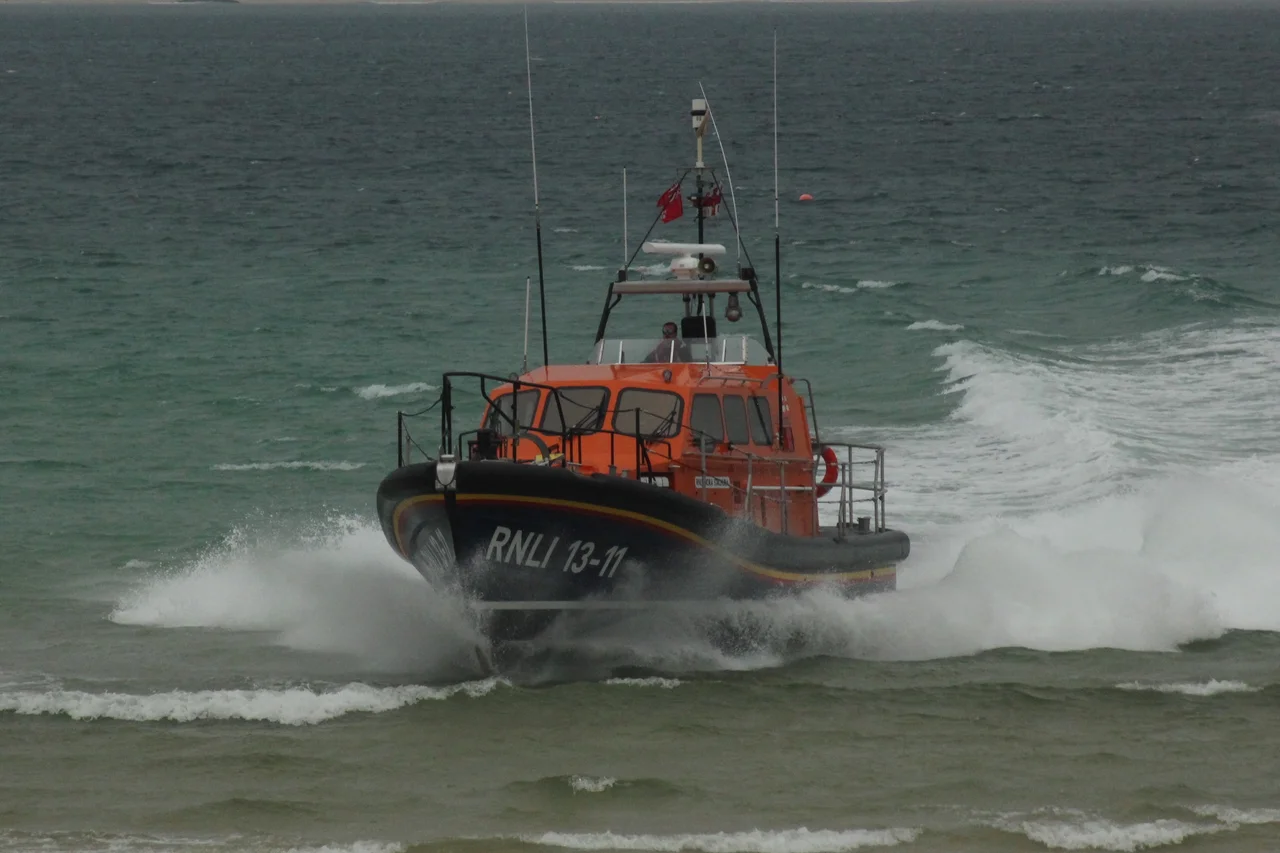

St Ives Lifeboat Station
The 23rd of January 1939 was not the kind of storm anyone remembers in degrees of severity. A Force 10 was blowing across the western approaches with gusts touching a hundred miles an hour, and at three in the morning a coxswain named Thomas Cocking gave the order to launch the John and Sarah Eliza Stych into the dark. A large steamship had been reported in trouble off Cape Cornwall. He took seven men with him. Four of them had survived a different lifeboat wreck the year before. By dawn only one of the eight would still be alive, and the rolling tradition of the St Ives lifeboat — first established in 1840, almost ninety years older than the RNLI itself was old in 1939 — would carry the family name forward into the next century anyway.
Building the first boat
On Christmas Eve 1838 the schooner Rival tried to enter St Ives harbour in a gale and broke up on one of its piers. Five people were pulled out by people ashore who had no proper rescue gear and only their courage. The town held a meeting. They decided that St Ives, the busiest fishing port on the north Cornish coast, could not go on without a boat of its own. A local man named Francis Adams had recently won a prize from the Royal Cornwall Polytechnic Society for a design: a double-ended, self-righting lifeboat that would come upright on its own if rolled. He was commissioned to build one. The Hope entered service in 1840 and made her first save on 7 April when she went out to the Mary Ann of Poole in a storm. By 1860 she had worn out. In the long run, building boats was the easier problem.
The Alba and the Caroline Parsons
On 31 January 1938 the motor lifeboat Caroline Parsons launched in heavy weather to assist the SS Alba, aground on the rocks. The crew got twenty-three men off the steamer and turned for home. A wave caught them broadside. The lifeboat capsized, righted itself, and then ran onto rocks. Coxswain Thomas Cocking and his eight crewmen got ashore safely, but five of the men they had just rescued were lost in the surf trying to follow. Cocking received the RNLI Silver Medal. His eight crew received bronze. They went home, repaired what was broken, and waited for the next call. It came less than a year later.
Three capsizes
When the John and Sarah Eliza Stych rounded The Island in the small hours of 23 January 1939, it met the storm head-on. The boat was crewed by Cocking, his son John, Matthew and William Barber and John Thomas — four men who had been in the Caroline Parsons the year before — and Edgar Bassett, Richard Stevens, and William Freeman. Off Clodgy Point the boat went over. The self-righting hull did what it was designed to do and came upright, but five men were in the sea and only Freeman scrambled back on board. They restarted the engine. The propeller fouled. They drifted toward The Island, dropped anchor, and the rope parted. The boat went over a second time and righted; three men were left. It drifted north-east across St Ives Bay toward Godrevy Point and capsized for a third time. When it came up only Freeman remained. The boat smashed on the rocks and he scrambled ashore. Seven men did not. Of the eight who launched, one survivor. Eleven children were left fatherless. The town did not have time to bury its grief properly before the next launch.
Three Tommy Cockings
Two more generations of the family stepped forward. Thomas Cocking's son and grandson both served as coxswain of the St Ives lifeboat in the decades after their father and grandfather drowned. The pattern is not unusual along this coast: lifeboat crews here are families, not appointees, and the loss of one generation tightens rather than loosens the obligation of the next. The granite boathouse on the landward end of the West Pier was opened in 1994, replacing the earlier sheds on Fore Street and the Quay. In 2015 the building was widened to accommodate a Shannon-class lifeboat with a Supacat launching rig — modern technology that, in a Force 10 off Godrevy, would still ask the same thing of the crew it asked of the men in the John and Sarah Eliza Stych.
Range and reach
The St Ives boat now covers 250 nautical miles of coast at a top speed of 27 knots, with sister stations at Padstow to the east and Sennen Cove to the west. The Hayle lifeboat station closed in 1920, doubling St Ives's working area; the boat goes out for fishing vessels, pleasure craft, broken yachts, swimmers swept off Porthmeor, the steady catalogue of marine emergency that has not slowed since the Rival's last hour in 1838. Outside the gift shop on the harbour wing of the boathouse, the bronze and silver medals from 1938 and 1939 are mounted under glass. The Cocking name appears more often than any other.
From the Air
St Ives Lifeboat Station stands at the landward end of West Pier on St Ives harbour, 50.21 N, 5.48 W. Best photographed from 1,000 to 1,500 feet on a southerly approach to catch the granite boathouse alongside Smeaton's Pier and the curve of harbour beach. Godrevy lighthouse, where the John and Sarah Eliza Stych ended in 1939, lies four miles east across the bay. Newquay (EGHQ) is 20 miles north-east; Land's End (EGHC) is 12 miles south-west. Atlantic swell can be visible from altitude on rough days.
Nearby Stories
- Wadebridge 8.1 km away
- Caerhays Castle 8.1 km away
- Sevenstones Lightship 16 km away
- Battle off Lizard Point 20 km away
- MV Cita 22 km away
- Carnewas and Bedruthan Steps 30 km away
- 1979 Fastnet Race 71 km away
- HMS Affray 108 km away