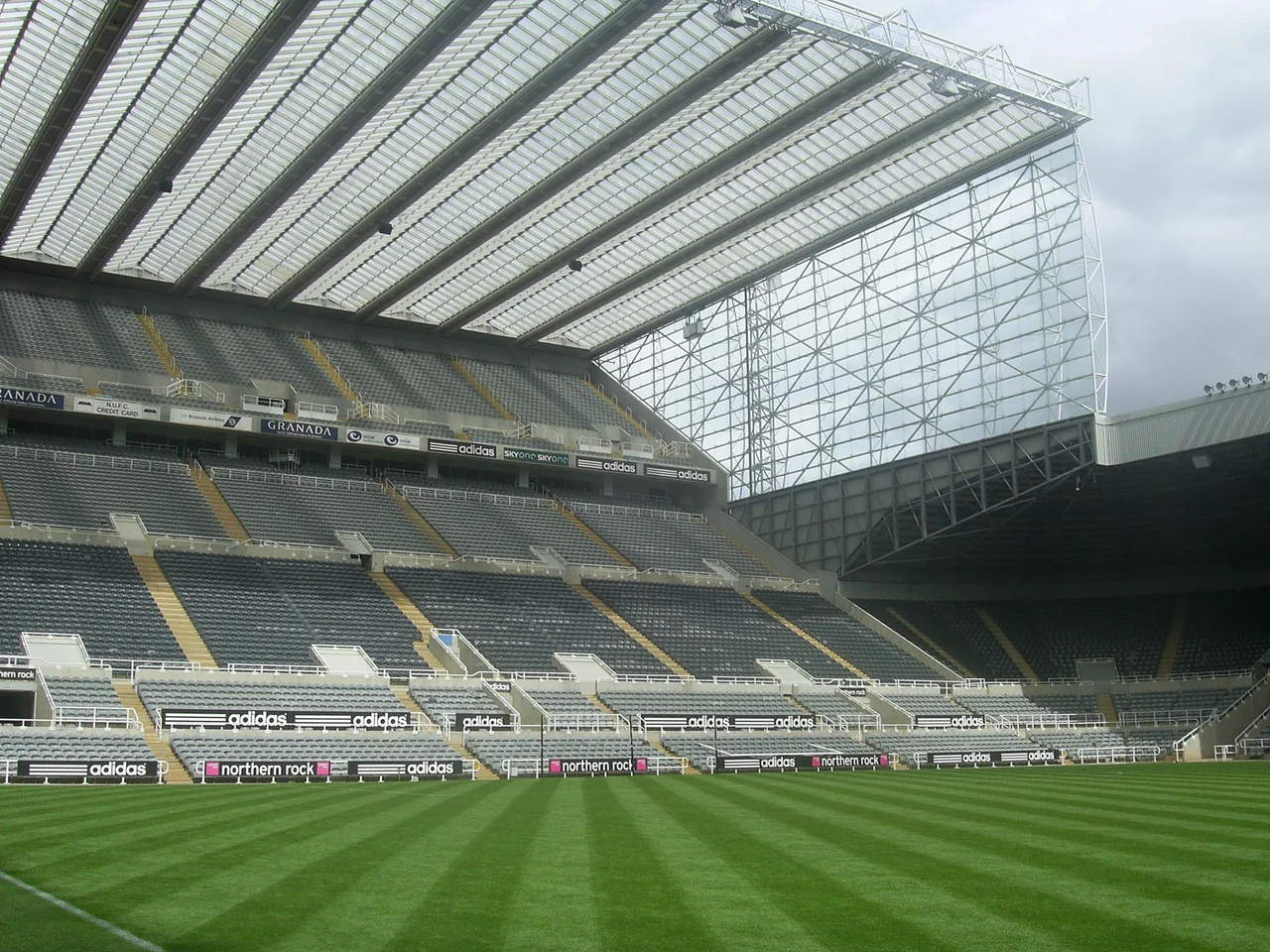

St James' Park
Newcastle United's home stand is called the Gallowgate End because for centuries that is exactly what it was - the spot just outside the city walls where condemned criminals were hanged in public, last used in 1844. Football arrived on the slope above the gallows in 1880 and never left. The current stadium holds 52,264 fans, making it the ninth-largest football stadium in England, but it has been expanded so often, against so much resistance, that the architecture tells the story almost on its own. Three tall stands and one stubbornly low one - the East Stand - because the Grade I listed Georgian terrace of Leazes Terrace blocks it. The Magpies play in a stadium shaped by the city around it.
Sloping Grazing Land
The site was originally sloping ground bordered by the Georgian Leazes Terrace and near the historic Town Moor, owned by the Freemen of the city. Both have shaped the stadium ever since - the Freemen restrict what can be built on adjacent land; Leazes Terrace, designed around 1830 by Thomas Oliver and Richard Grainger, is Grade I listed and now houses postgraduates from Newcastle University. The gallows that gave the south end its name moved from the site in 1844. A football team called Stanley played on the ground briefly, then Rosewood, then Newcastle East End, which had originally been based at Byker. West End took over the ground in 1886, folded in 1892, and effectively merged into East End. On 3 September 1892, the newly formed Newcastle United played its first match at St James' Park.
A Swimming Pool and a World Cup Snub
By 1899, a redeveloped Gallowgate End and other new stands brought capacity to 30,000 standing. In 1905, a doubling to 60,000 produced a state-of-the-art Edwardian stadium that boasted a swimming pool under the main stand on Barrack Road - the stand now known as the Milburn. After that the politics turned against the club. Local residents, the Freemen, and a succession of conservation groups blocked expansion for decades. The lack of development was cited as the reason Newcastle lost the right to host group-stage matches at the 1966 World Cup. In 1971, after mediation by Minister for Sport Denis Howell, an agreement to redevelop St James' was finally reached. The East Stand was built in 1972, fifty years after the previous expansion.
Sir John Hall and the Petition
In January 1992 businessman Sir John Hall led a hostile takeover of the club. He was a property developer; he understood land deals. He wanted to relocate to a new stadium on Leazes Park itself. Newcastle responded with a 36,000-signature petition - the equal of the then stadium capacity - and a conservation group called Friends of Leazes Park, led by Dolly Potter, mobilised against him. Hall withdrew the relocation plan and chose instead to expand the current ground. In 1998, a vast second tier was added over the Milburn Stand, Leazes End, and the corner between them, taking capacity past 52,000. The expansion further blocked views of Leazes Park from Leazes Terrace, but the terrace was student housing by then. Four thousand season ticket holders, including 'bondholders' who had paid 500 pounds in 1994 for a guaranteed seat option, found their seats reclassified as corporate. The Save Our Seats campaign that followed was bitter.
Names, Sponsors, Sir Bobby
On 10 November 2011, the stadium was renamed the Sports Direct Arena, owner Mike Ashley's attempt to make naming rights commercially attractive. Geordies hated it. Parliament debated it. When Wonga.com bought the sponsorship in October 2012, the St James' Park name was restored as part of the deal - the only fan victory of the Ashley era. The takeover of the club by a Saudi-led consortium in 2021 finally removed Sports Direct branding entirely; in 2024 the original 'Newcastle United' signage in its original font was restored above the East Stand. Sir Bobby Robson, who managed the club from 1999 to 2004 and died of cancer in July 2009 aged 76, watched a charity match here just five days before his death. After he died, fans laid floral tributes in the Leazes End for ten days. The stadium became a shrine, then a wake, then a stadium again.
More Than Football
St James' has hosted football matches at the 2012 Olympics, three games of the 2015 Rugby World Cup, multiple seasons of the Super League Magic Weekend rugby league showcase, England rugby internationals, concerts by The Rolling Stones, Bruce Springsteen, Queen, Bob Dylan, and Ed Sheeran. Geordie singer Sam Fender sold out two nights here in 2023 and three more in 2025. The stadium will host matches at UEFA Euro 2028. Above it all, the names of the club's heroes are cast in bronze: Joe Harvey, who managed Newcastle to their last major trophy in 1969, looks out from the Gallowgate Wall; Alan Shearer, the club's record goalscorer, stands by the south-west corner. The pitch dimensions are international maximum - 105 by 68 metres - because that is what the modern game requires. The gallows are long gone. The football remains.
From the Air
St James' Park sits at 54.976 degrees N, 1.622 degrees W, in the centre of Newcastle upon Tyne, roughly 500 metres north of Newcastle Central railway station. Newcastle International (EGNT) is 5 nautical miles north-west. From the air, the stadium is unmistakable - a tall asymmetric bowl with three high tiers (Milburn, Leazes, Gallowgate) and a noticeably lower East Stand backed by the Georgian terrace of Leazes Terrace. The Tyne Bridge crosses the river 800 metres south. The Town Moor stretches north of the stadium. Best viewed at 1,500-3,000 feet AGL in clear weather.
Nearby Stories
- Cresswell Lifeboat Station 5.2 km away
- Auckland Castle 5.7 km away
- Battle of Otterburn 7.1 km away
- Saltburn Pier 11 km away
- Hadrian's Wall Path 11 km away
- Battle of Stainmore 18 km away
- Saltburn-by-the-Sea 39 km away
- Alexander L. Kielland (Platform) 296 km away