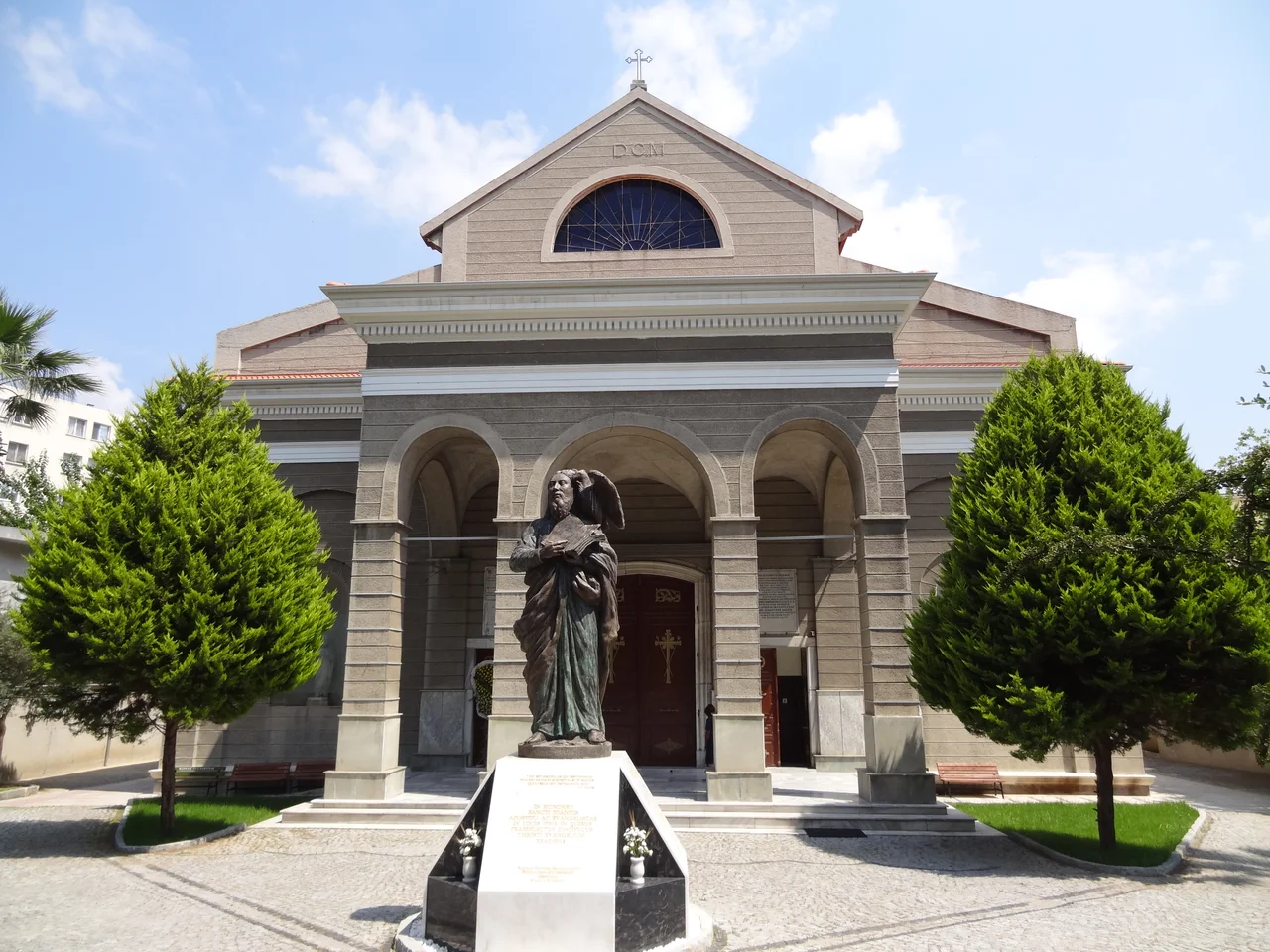
,_Izmir.JPG)
St. John's Cathedral (Izmir)
Sultan Abdulaziz of the Ottoman Empire donated 11,000 gold lira to the construction of a Catholic cathedral in 1863, and that fact alone tells you more about late-nineteenth-century Smyrna than most history books will. The city was Ottoman, the city was Greek, the city was Armenian, and the city was Levantine, all at the same time. Smyrna had Catholics enough to need a cathedral, and a sultan willing to fund one. The cornerstone of St. John's was laid on 26 November 1862. The building was dedicated on 25 May 1874 to John the Evangelist, whose letter in the Book of Revelation greeted the church at Smyrna and warned it that some of its members would be tested.
A Donation from Lyon
The other major donor was an unexpected one: Christians from Lyon, in central France. The link between the two cities is older than the cathedral by seventeen centuries. According to ancient tradition, missionaries from Smyrna brought Christianity to Lyon in the second century. Polycarp, bishop of Smyrna, sent the priest Irenaeus to the new community on the Rhone, and Irenaeus eventually became Lyon's most famous bishop and one of the great Christian theologians of the second century. When Smyrna's Catholics needed money for their cathedral seventeen hundred years later, the Lyonnais remembered. They sent funds. The story is recorded inside the cathedral on a painting near the main entrance, where three early bishops of the region appear together: Ignatius of Antioch, Polycarp of Smyrna, and Irenaeus of Lyon, with the artist's idea of ancient Smyrna in the background.
The Eagle and the Pen
Above the high altar hangs a painting of John the Evangelist with his liturgical symbol the eagle, pen and scroll in his hands as he writes the gospel. The painter signed it: A. Von Kramer. Around the sanctuary, paintings of Augustine, Andrew, and Athanasius face Polycarp and John Chrysostom across the nave. One panel is blank where a fire destroyed the original early in the twentieth century, presumably the Great Fire of 1922 or one of the smaller fires that periodically swept the Levantine quarters. Mounted above the inside of the entrance is a panel of seven bishops representing the seven churches of Asia from the Apocalypse, brought to the cathedral in May 1970 from a sacrament chapel at the nearby Cigli air base.
A Long Tradition Carved in Carrara
Pope Pius IX granted St. John's the rank of minor basilica during the cathedral's construction, with the same indulgences as St. John Lateran in Rome, and donated the high altar with its precious stones and metals. He also lent his image, along with Gregory XVI and Leo XIII, to the medallion portraits ranged thirty feet up the cathedral walls. Three local archbishops join them across the nave: Anthony Mussabini, who served from 1838 to 1861, Vincent Spaccapietra, who oversaw construction from 1862 to 1878, and Andrew Timoni, archbishop from 1879 to 1904 and the figure who would later authorize the building of nearby St. Helena Church in Karsiyaka. The memorial tombs of Mussabini and Spaccapietra sit in the cathedral garden, carved by artisans from Carrara.
NATO at Mass
Archbishop Joseph Emmanuel Descuffi opened the cathedral in 1965 to the NATO military personnel and their dependents stationed at Cigli and across the Izmir region. Both Catholic and Protestant services were welcomed; the building took on a different congregation alongside its Levantine and Italian core. The dedicatory plaque to the right of the main entrance still reads, in eighteenth-century Latin formula, that the temple was built to honour John, apostle and writer, with offerings from local citizens and contributions by foreigners. The baptistry to the right was outfitted only in 1916, the gift of a parishioner named John Moriconi during the rectorship of Father Peter Longinotti, in a year when Smyrna's foreign communities were already shrinking under wartime conditions.
What a Cathedral Holds
Above the sanctuary, near the ceiling, a painted triangle frames an eye, the symbol of the Trinity and of the all-seeing wisdom of God. The phrase Deo Optimo Maximo, abbreviated D.O.M., is carved over the main entrance: to God, the best, the greatest. The Catholic community of Izmir is much smaller now than it was when the sultan opened his treasury, but the cathedral remains the seat of the Roman Catholic Archdiocese of Izmir and serves an active parish. Polycarp's image still presides among the saints in the sanctuary, the bishop of Smyrna who, by tradition, was burned at the stake in this city in the year 155 for refusing to curse Christ. He is the thread that runs from John's letter through Irenaeus to Lyon to Pius IX to the cathedral as it stands today, with the Book of Revelation lying open in everyone's memory: I know thy works, and tribulation, and poverty, but thou art rich.
From the Air
St. John's Cathedral stands at 38.43 degrees north, 27.14 degrees east, in the centre of Izmir near Sehit Nevres Boulevard. Adnan Menderes Airport (LTBJ) is 19 km south, the main civil gateway; Cigli (LTBL), now mainly military, lies 11 km north. Izmir Bay opens to the west; the city climbs the slopes east of the harbour. Cathedral spires are difficult to spot from cruise altitude but the bay's dramatic curve and the slope of Mount Pagos behind the city are unmistakable.
Nearby Stories
- Battle of Corycus 12 km away
- Battle of the Oinousses Islands 19 km away
- Eğlenhoca 20 km away
- Temple of Artemis at Ephesus 24 km away
- Akhisar Museum 28 km away
- Ottoman conquest of Lesbos 77 km away
- Hadrianotherae 134 km away
- Palace of the Grand Master of the Knights of Rhodes 193 km away