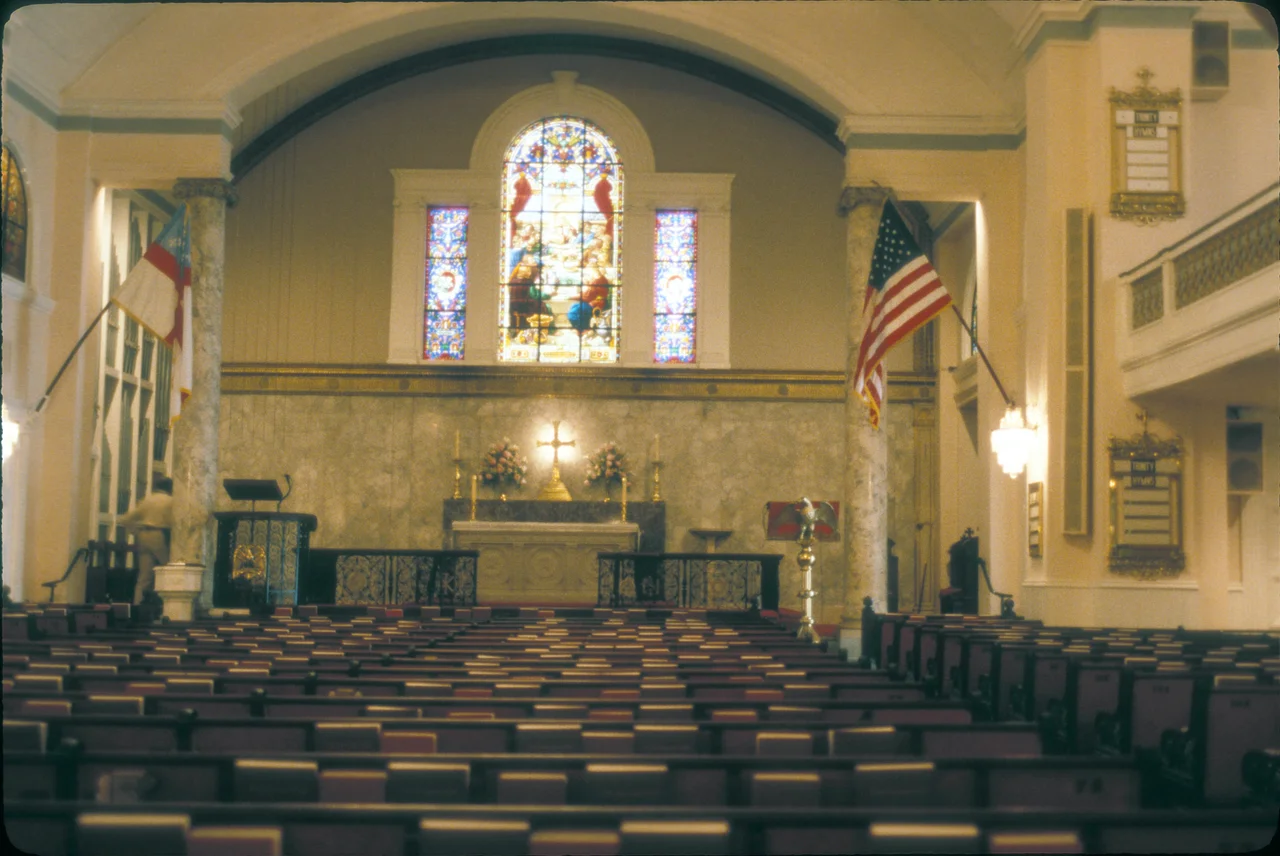

St. John's Episcopal Church (Lafayette Square)
On the evening of June 1, 2020, federal officers used tear gas, smoke canisters, and pepper balls to clear demonstrators from Lafayette Square. The clearing was to install anti-scale fencing - the stated and officially documented reason. The Department of the Interior's inspector general reported in 2021 that Park Police did not clear the area for Trump's photo op, though witnesses including the church's own rector reported being driven from the patio with tear gas and concussion grenades. Attorney General William Barr was present and had ordered the timeline for fence installation accelerated that afternoon. He went to St. John's Episcopal Church - the small Latrobe-designed Greek Revival building at Sixteenth and H Streets NW that has hosted at least one prayer service from every American president since James Madison - and held up a Bible for photographers in front of its boarded-up parish house. The fire that had given the operation its pretext, in the basement of Ashburton House the night before, had been confined to the church nursery. The Episcopal Bishop of Washington, Mariann Budde, called the use of tear gas to clear the church grounds for a photo opportunity 'antithetical to the teachings of Jesus.'
The Church James Madison Built
Before St. John's, Episcopalians in the western wards of Washington had three places of worship - one in Georgetown, one near the Capitol, and one in Rock Creek Parish - none of which were practically reachable, as one early parish history put it, in the era of almost impassable roads. In 1814, the residents between Georgetown and Sixth Street decided to build their own. A small committee of trustees - John Tayloe III (whose Octagon House had sheltered President Madison after the British burned the executive mansion), John Peter Van Ness, William Winston Seaton of the National Intelligencer, James H. Blake, Roger Chew Weightman (a future mayor), and Joseph Gales Jr. - asked Benjamin Henry Latrobe to design the building. Latrobe was the architect of the Capitol. He drew a Greek-cross plan in stucco-covered brick, with a central dome, and built it without compensation. The vestry offered him a free pew. He declined and asked for a piece of plate instead so he could pass it down to his children. The first service was held on October 27, 1816. Bishop James Kemp of Maryland presided at the consecration on St. John's Day - December 27 - 1816. The portico and tower were added in 1820, and a 1,000-pound bell cast by Paul Revere's son Joseph at his Boston foundry arrived in 1822, installed with the help of a $100 federal subsidy that President James Monroe personally authorized.
Pew 28
James Madison, then in the final months of his presidency, attended the consecration on December 27, 1816, and chose Pew 28 as his regular seat. The pew has been kept available for the sitting president of the United States ever since, by tradition rather than by law, and bears a small brass plaque. Every president from Madison forward has attended at least one service at St. John's, which is how the parish acquired its informal name, the Church of the Presidents. Some presidents - Madison, Quincy Adams, Tyler, Polk, Pierce, Lincoln, Garfield, Harrison, McKinley, Theodore Roosevelt, Taft, Wilson, Coolidge, Hoover, FDR, Truman, Eisenhower, Kennedy, Johnson, Nixon, Ford, Reagan, Bush 41, Clinton, Bush 43, Obama, Trump, Biden - have been more frequent than others. Lincoln walked across Lafayette Square most weeks during the Civil War. Franklin Roosevelt held a quiet Inauguration Day service at St. John's in 1933. The bell tolls when a notable death occurs - and according to two old Washington ghost stories, six men in white robes appear at midnight in Pew 28 and then vanish, though no rector has yet documented the apparition firsthand.
Latrobe's Greek Cross
The building today reflects two rounds of expansion. By 1842 the original Greek cross had become too small for the growing parish. A committee led by John Canfield Spencer, Benjamin Ogle Tayloe (son of John III), and General Winfield Scott reconfigured the interior - lowering the high-back pews, removing the wine-glass pulpit, replacing the brick floor, enlarging the chancel. An 1883 renovation under Bancroft Davis and General Peter V. Hagner added 180 more seats, brought the total capacity to 780, installed stained glass in nearly every window (most dedicated to deceased parishioners), expanded the chancel further, and added a chantry chapel, a new organ within the chancel rail, and new vestry and choir rooms. The exterior preserves Latrobe's profile largely as he drew it - a low cross-shaped block with a stucco-over-brick portico facing H Street, a slender bell tower above. The National Register added the church in 1966; the Department of the Interior designated it a National Historic Landmark in 1960. It is a contributing property to both the Lafayette Square Historic District and the Sixteenth Street Historic District.
Ashburton House
Across the small garden from the church stands the rectory, known as Ashburton House. It was the residence in 1842 of Alexander Baring, the first Baron Ashburton, the British envoy who negotiated the Webster-Ashburton Treaty settling the long-disputed border between Maine and New Brunswick. Daniel Webster, then Secretary of State, walked between the State Department building and Ashburton House for weeks of meetings that resulted in the treaty signed on August 9, 1842. The British government bought the house for Ashburton's use; the parish later acquired it as its rectory. The basement was the site of the fire set on the night of May 31, 2020 during the George Floyd protests. The damage was limited to the church nursery and was quickly extinguished. The next afternoon brought the events that put St. John's on the front page of every newspaper in the world: the Lafayette Square clearing, the photograph, the bishop's denunciation, and the controversy that became one of the most contested moments of the Trump presidency.
What Remains
The bell that Joseph Revere cast in 1822 still rings every Sunday morning. It is one of only two Revere bells in Washington, and the only one in continuous service since installation. The interior preserves a chapel cross in polished brass, two sculptures by Jay Hall Carpenter, and Ascent Into Heaven, a three-quarter lifesize bronze of an angel carrying a child that watches over the church's columbarium. The communion silver donated by John Tayloe III in 1816 - rescued, according to one tradition, from the sale of effects at the Lunenburg Parish Church in Richmond County, Virginia, to prevent its secular use - is still on the altar. The membership is smaller than it once was: 2,445 reported in 2019, 1,527 in 2023, with average Sunday attendance of 351 in 2024. Beneath those numbers, the building does what it has done since Madison's pewholders first sat in it on a December morning two hundred and ten years ago. It holds the prayers of the people who came in, and it tolls when one of them dies.
From the Air
St. John's Episcopal Church sits at 38.9004 degrees N, 77.0361 degrees W, at the corner of 16th Street and H Street NW, directly across Lafayette Square from the White House. From the air the small Greek-cross church with its slender bell tower and yellow stucco walls is recognizable just north of the executive mansion, with the modernist mass of the Hay-Adams Hotel immediately behind it. Best viewed at 1,500 to 2,500 feet AGL; the entire site lies within the Washington FRZ and the prohibited area P-56A. Nearest airports are Ronald Reagan Washington National (KDCA) 3 nm south, College Park (KCGS) 7 nm northeast, and Washington Dulles (KIAD) 23 nm west.
Nearby Stories
- Gunston Hall 1.1 km away
- 2023 Baltimore Shooting 4.9 km away
- Battle of Middleburg 6.6 km away
- Crownsville Hospital Center 10 km away
- Battle of Loudoun Heights 13 km away
- First Battle of Rappahannock Station 20 km away
- Howard County, Maryland 21 km away
- Harriet Tubman Underground Railroad 50 km away