.jpg)
St. Maria im Kapitol
The wooden doors weigh several hundred kilograms each, and they are nearly nine hundred and sixty years old. They have hung at the north entrance of St. Maria im Kapitol since around 1065. Twenty-six carved panels show the childhood of Jesus on one wing and the passion and resurrection on the other, the figures still standing in the framed compositions of late antiquity, traces of original paint still in the wood. Across all of Romanesque Europe, no other complete wooden church doors of this age survive in place. They open into a church standing where a Roman temple once stood, where a Frankish queen lay buried, where Cologne's largest Romanesque basilica spread its three apses in the shape of a clover.
Temple of the Capitoline Three
In the first century, when Cologne was promoted from a Rhine garrison to a Roman colonia, the Roman colonists built a temple on a small hill in the southernmost corner of the new city to thank the three gods who watched over Rome itself: Jupiter, Juno, and Minerva, the Capitoline Triad. The temple measured 33 by 29.5 metres and sat inside a much larger walled courtyard, 97 by 69 metres, with three inner chambers, a cella for each deity. When the Romans eventually withdrew, the masonry stayed. The temple walls became the foundations of what came next, and the nave of the church standing on the site today still rests on the layout of that first-century pagan precinct. The name im Kapitol is a thousand years' worth of memory of those three gods.
Plectrude's Church
After the Franks took Cologne in the fifth century, the most powerful men in the kingdom kept houses on the Capitoline hill. Pepin of Herstal, the Frankish ruler who effectively ran the kingdom from 687, lived for a time in the city. His wife Plectrude came from an Austrasian noble family with deep landholdings around Cologne, and the Capitol's ruins probably stood on her family's property. Sometime before her death around 718, Plectrude built an aisleless church on the remains of the old temple, and was buried in it. In the winter of 881-882 the Normans raided up the Rhine as far as Bonn and burned the city. Plectrude's church burned with it. But she was not forgotten; in the twelfth and thirteenth centuries, two carved slabs of her sarcophagus were made, and both are still in the church she founded.
The Clover Plan
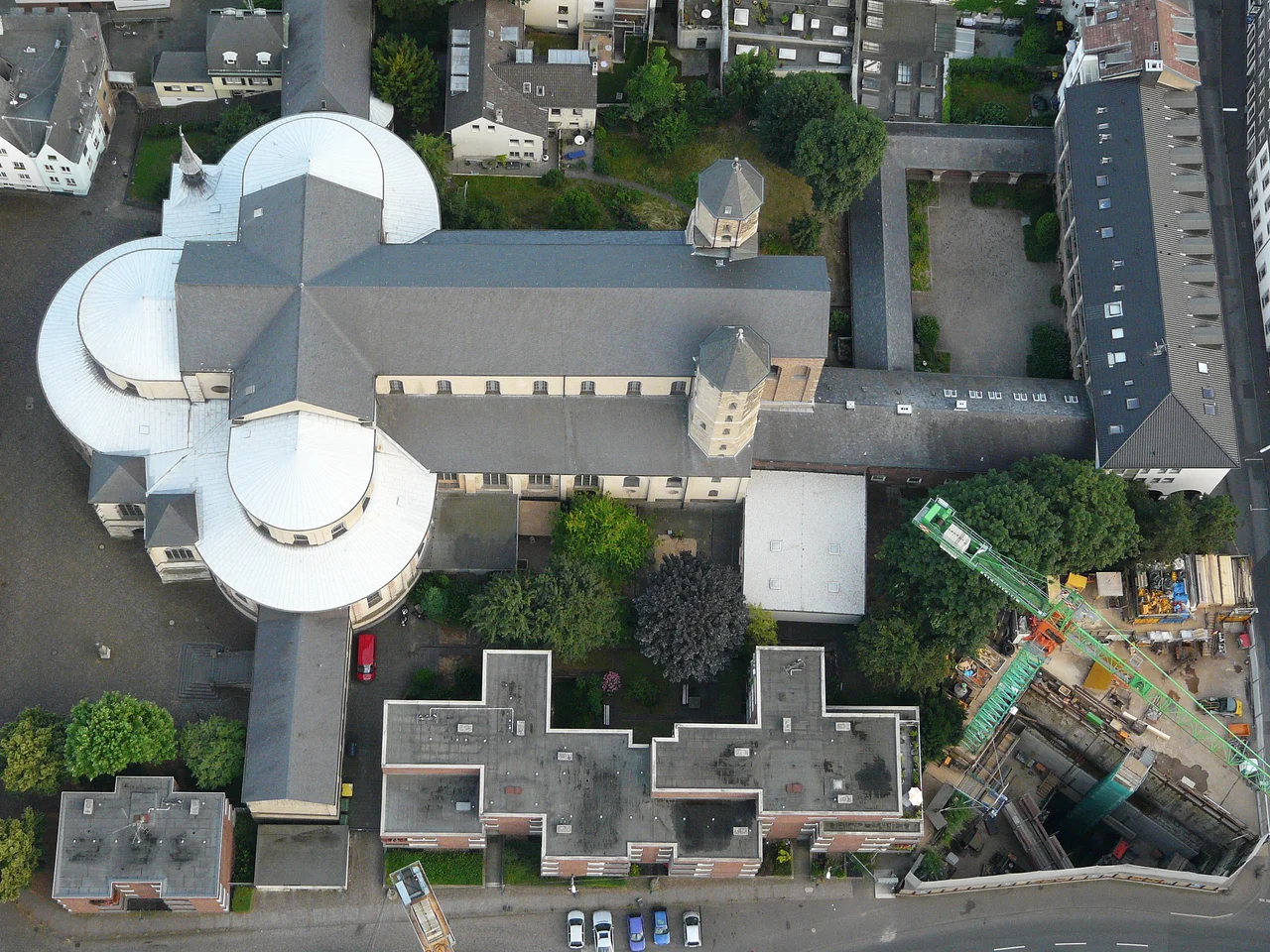
In the middle of the eleventh century Archbishop Hermann II and his sister Ida, the abbess of what was now a women's monastery, began an extraordinary church. Pope Leo IX himself came to Cologne and consecrated the altar and the nave. The plan was modeled, deliberately, on the Church of the Nativity in Bethlehem: a basilica whose east end opens into three almost equal semicircular apses around a central crossing. Architects call this the trefoil or three-conch plan, and St. Maria im Kapitol is its grandest German example. Measuring 100 by 40 metres and enclosing 4,000 square metres of interior, it remains the largest of the twelve great Romanesque churches of Cologne. In 1170 a three-tower westwork was added at the opposite end, and around 1240 the nave was raised and crowned with a six-part Gothic ribbed vault.
The Doors That Lasted
Of everything the church holds, the wooden doors from around 1065 are the strangest survival. Made for the north conche, they hung there for almost nine centuries, opened and closed by countless hands. They were modelled on the early Christian doors of Santa Sabina in Rome and Sant'Ambrogio in Milan, and their compositions follow late antique conventions: each scene from the life of Christ sits inside its own carved frame, the figures squat and emphatic, drapery falling in deeply cut folds. Wood does not usually last this long in a working building. Fire, war, weather, and renovation kill it. The doors of St. Maria im Kapitol survived all four, including the Allied bombing that gutted Cologne in 1942. They were sheltered, returned, and today are exhibited inside the church, still bearing flecks of the paint that originally covered them.
Closed, Reopened
World War II was brutal to St. Maria im Kapitol. The six-part Gothic ribbed vault that had crowned the nave since 1240 collapsed. Until 1956 only the western part of the church could be used. The eastern half, with the great three-conch sanctuary, stayed closed for almost forty years and was not reopened until 1984. Walk through it now and the layered history is everywhere. The east conche has a Romanesque clerestory restored from the postwar reconstruction, late Gothic windows still in the ambulatory below, and the medieval dwarf gallery wrapping around the outside. Plectrude's sarcophagus reliefs, the Hermann-Josef Virgin from around 1180, the throned Virgin from about 1200, the plague crucifix from around 1300, all of them survived. And on a slow afternoon, when the church is almost empty, the doors are still there, hung in the north portal as they have been since the Salian dynasty ruled Germany.
From the Air
50.9346 N, 6.9586 E. St. Maria im Kapitol sits in the Kapitol-Viertel of Cologne's Altstadt, about 700 m south-southeast of the cathedral and 400 m back from the Rhine. From altitude the trefoil east end, three semicircular apses arranged around a central crossing, is recognisable among the rectangular roofs of the old town. Cologne/Bonn (EDDK) is 15 km southeast; Düsseldorf (EDDL) 33 km north.
Nearby Stories
- Diamond Interchange: How a Simple Idea Reshapes Towns Like Julich 2.8 km away
- Dusseldorf-Unterbach 6.1 km away
- Baumwollspinnerei Ermen & Engels 11 km away
- RAF Bruggen 15 km away
- Hagen Open-air Museum 21 km away
- Belgium 130 km away
- Marcinelle Mining Disaster 173 km away
- Zwingenberg Castle 178 km away