
St Mary Redcliffe
In 1574, Queen Elizabeth I came to Bristol and was taken to see the parish church of Redcliffe. She is said to have called it 'the fairest, goodliest and most famous parish church in England.' Half a century later, her grandson Charles I echoed her: 'one of the moste famous absolute fayrest and goodliest parish churches within the Realm of England.' Modern critics have not dialled this back. Simon Jenkins gives St Mary Redcliffe the maximum five-star rating in England's Thousand Best Churches, one of only eighteen churches in the country to receive it. Nikolaus Pevsner wrote that it 'need not fear comparison with any other English parish church.' It is so large that tourists routinely mistake it for Bristol Cathedral.
A spire and a lightning strike
The spire reaches 274 feet - 84 metres - to the top of the weathervane, making St Mary Redcliffe the second-tallest structure in Bristol and the sixth-tallest parish church in England. Until the completion of Castle Park View in 2020, it was the tallest building ever erected in the city. The original spire was even taller. In 1480, the antiquary William Worcestre recorded that the tower of Redcliffe 'contains 300 feet, of which 100 feet have been thrown down by lightning.' A strike, sometime in the medieval period, had snapped the upper third of the spire off. For nearly four hundred years afterwards the tower was capped with a stump. The full spire was only rebuilt in the nineteenth century, in a Victorian campaign of restoration that completed the church as you see it now.
Stone vaults from floor to roof
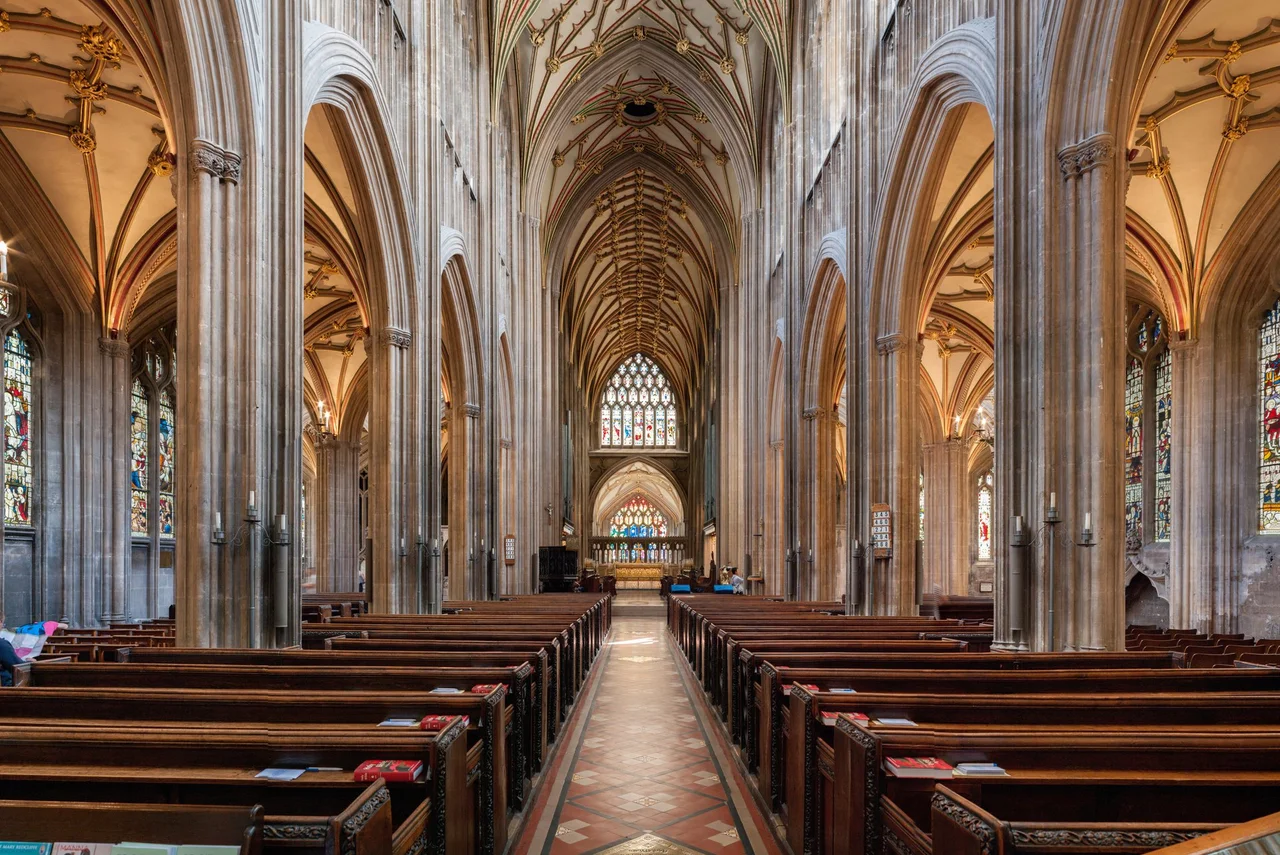
Inside, the church is the only parish church in England to be vaulted entirely in stone throughout the medieval period. Every bay, every aisle, every chapel - all of it covered in carved stone ribs and bosses, not the timber ceilings that almost every other English parish church relies on. The construction reflects the wealth of the merchants who paid for it, in particular the Canynges family, who financed work on the church for generations. William II Canynges, who died in 1474, founded chantry chapels and effectively rebuilt the nave. The church covers 1,916 square metres - about 20,620 square feet - which puts it among the very largest parish churches in England, behind only Great Yarmouth Minster, Hull Minster, Boston Stump, and the church at Newark-on-Trent.
A tram rail in the churchyard
On Good Friday in 1941, a German bomb fell in a nearby street during the Bristol Blitz. The explosion threw debris in every direction. One piece - a heavy chunk of tram rail, ripped out of the road - hurtled into the churchyard and embedded itself in the ground. It is still there. It was left where it landed, partially buried by the force that drove it home, as a memorial to how close the church came to destruction. A small plaque explains it. People walk past, see the iron, and feel the war from eighty years ago coming briefly close. The Lady Chapel windows above were destroyed in the same campaign and replaced in the 1960s by the stained glass artist Harry Stammers, whose vivid colours are now one of the church's most loved features.
Bells, organs, and the Colston window
The bells at St Mary Redcliffe are among the finest rings in existence. The tower holds twelve bells (with a thirteenth, a 'flat sixth' added in 1951), cast in their current form by John Taylor & Co of Loughborough. Ringers travel from across the British Isles to ring them. Over 300 full peals have been rung here since the first in 1768; the most recent commemorative peal marked the state funeral of Queen Elizabeth II in September 2022. The organ, built by Harrison & Harrison of Durham in 1910-12, is one of the largest in southern England. In June 2020, in the wake of the toppling of the Statue of Edward Colston in Bristol, a stained glass window in the church that commemorated the Royal African Company - the slave-trading corporation Colston had served - was removed. A new window depicting the 1963 Bristol Bus Boycott, a civil rights protest that ended racial discrimination on the city's buses, was installed in its place.
The Redcliffe Pipe
Threading through the churchyard runs the Redcliffe Pipe - a conduit given to the church in 1190 by Robert de Berkeley, Lord of Bedminster Manor. He granted the parishioners the right to build a pipe 2,514 metres long, from a spring on Knowle Hill down to the church, to bring fresh water to the community. A walk along the line of the pipe is still made every year. The pipe was damaged during the Bristol Blitz. The present terminus is a brass drinking fountain from 1823 set near the west front - though, in one of those quiet jokes that old buildings keep telling, the actual water from the pipe no longer flows through the fountain. The fountain is decorative. The pipe is older.
From the Air
St Mary Redcliffe at 51.4482 N, 2.5899 W in the Redcliffe district of Bristol, just south of the Floating Harbour. Best viewed from low altitude (1,500-3,000 ft) over central Bristol. The Gothic spire is the most prominent landmark from the air, visible from miles away. Visual references: the Floating Harbour and Temple Meads station to the north, the SS Great Britain berth to the north-west, the M Shed museum on Princes Wharf. Nearest airports: Bristol (EGGD) approximately 6 nm south-west.
Nearby Stories
- Cosmeston Medieval Village 1.4 km away
- Glastonbury Festival 3.5 km away
- Tintern Abbey 3.6 km away
- Quantock Hills 4.8 km away
- Ebbw Vale Steelworks 10 km away
- New Wardour Castle 12 km away
- Windmill Hill, Avebury 16 km away
- Cotswolds 18 km away