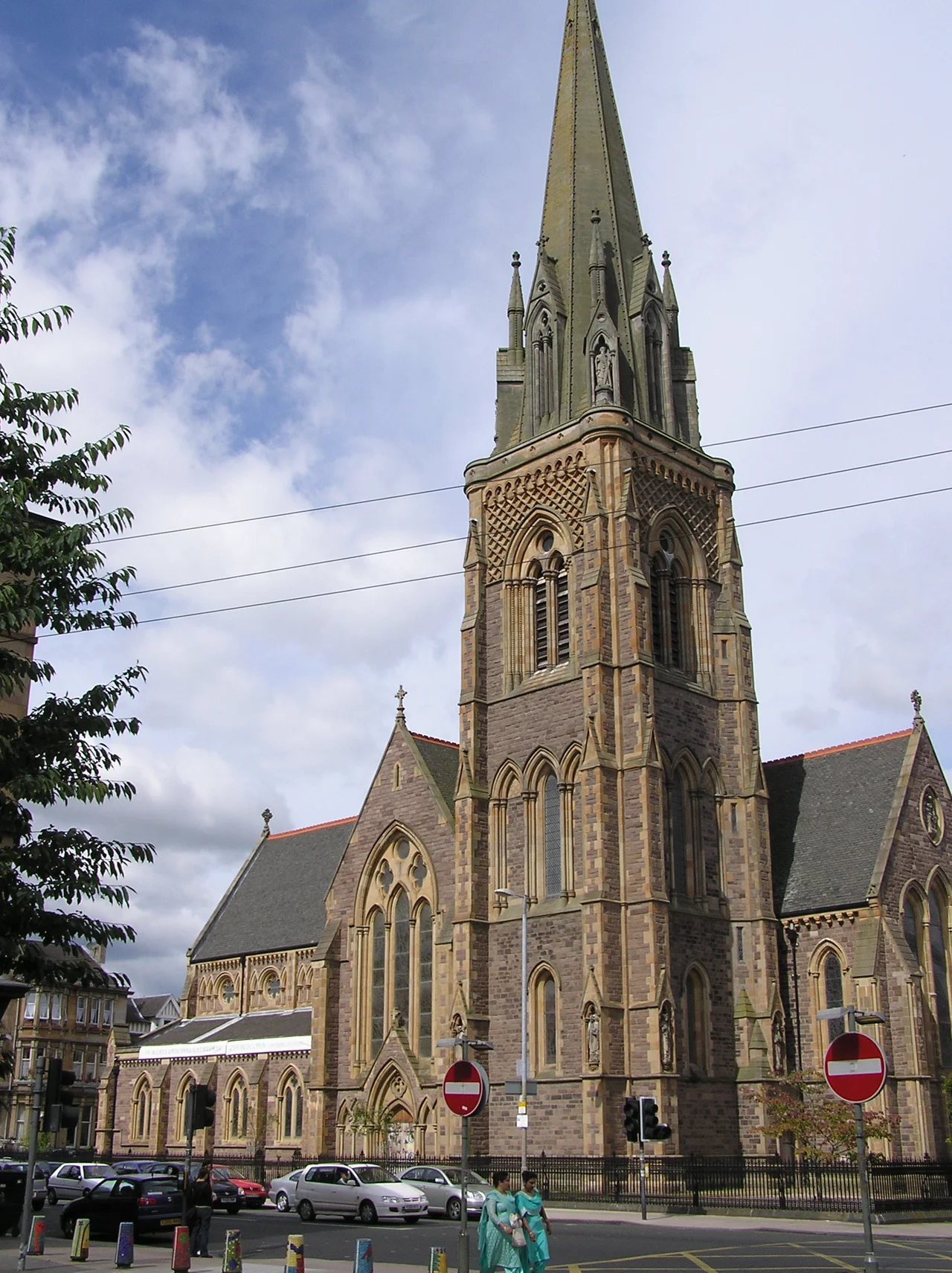

St Mary's Cathedral, Glasgow
On 9 November 1871, a new church opened its doors on Great Western Road, and Glasgow's Episcopalians finally had a building that matched the long, complicated history they had survived to reach it. The architect was Sir George Gilbert Scott, master of Victorian Gothic Revival, whose railway stations and memorials defined the era's skyline. The spire would not be finished for another twenty-two years - rising eventually to 63 metres, sharp against the West End sky. In 1908, the church was elevated to cathedral status. None of this would have surprised the small, persecuted congregation whose ancestors had once worshipped in a private home with Highland retainers in kilts standing guard at the door.
Rebels in the West End
Glasgow has four cathedrals, and each tells a different story about how Christians in Scotland chose to organize themselves. St Mungo's, medieval and somber, belongs to the Church of Scotland. St Andrew's serves the Roman Catholics. St Luke's holds the Eastern Orthodox tradition. St Mary's belongs to the Scottish Episcopal Church - a denomination born from a quiet act of parliamentary surgery in 1689, when the Episcopalian structure of the Church of Scotland was abolished and bishops were turned out of their jobs. In Glasgow, where Presbyterian feeling ran strong, those who clung to bishops and Book of Common Prayer became outsiders almost overnight. They kept worshipping anyway.
A Service That Ended in a Riot
The earliest documented service of the future St Mary's congregation took place in 1703, in the Saltmarket lodgings of a former Lord Provost of Glasgow named Sir John Bell. The occasion was the anniversary of the execution of Charles I - a date Episcopalians marked with solemn liturgy. Word got out. A mob gathered. The service ended in a riot. The chronicler Robert Wodrow recorded the scene with the dry satisfaction of a Presbyterian historian. For the next several decades, Glasgow's Episcopal clergy were non-jurors, operating outside the law, taking funerals and tending the sick in defiance of restrictive statutes. Sir Donald MacDonald of Sleat sent Gaelic-speaking Highland retainers in kilts to act as guards at their meetings. The congregation collected money for the poor. They held on.
Gilbert Scott's Spire
By 1825, the surviving congregation had built a chapel on Renfield Street and called it St Mary's. By 1871, they needed more room and a more confident statement of who they were. They commissioned George Gilbert Scott - the architect of the Albert Memorial and St Pancras Station - to design the new church on Great Western Road. Scott gave them a soaring Early English Gothic nave, generous in light and proportion. The spire, completed in 1893, became one of the landmarks of the West End. The building is now protected as a Category A listed building, the highest level of architectural protection Scotland offers. In 1908, four years after Frederic Llewellyn Deane became rector, the church was raised to cathedral status. Deane became the first provost.
A House of Music
Walk in on a weekday evening and you may hear the voluntary mixed choir rehearsing under Director of Music Friðrik Walker, who has held the post since 1996. In October 2007, the adult choir was joined by a treble section. The three-manual William Hill organ, rebuilt in 1967 and completely restored in 1990, fills the nave with the kind of sound the Victorians designed these spaces to hold. There are ten bells in the tower, a proper peal. Concerts, art exhibitions, and recitals share the calendar with the Eucharist. The cathedral has spent decades cultivating a reputation as a place where worship and the arts share the same roof - a deliberate choice for an inner-city church whose congregation, drawn from across Glasgow and beyond, turns over often and refreshes itself constantly.
Continuity
Kelvin Holdsworth was installed as rector and provost on 31 May 2006, the Feast of the Visitation - a Mary-themed day for a Mary-named cathedral. He continues a line that runs unbroken back to Richard Samuel Oldham, junior incumbent of the Renfield Street chapel from 1851. The Episcopalians who once worshipped in private homes under threat of magistrates' raids now occupy one of the most architecturally distinguished buildings in the West End. The Bells, Barns, Crawfurds, Grahames, and Walkinshaws - the Glasgow families whose names appeared on the 1713 congregation list - would recognize the worship if not the surroundings.
From the Air
Located at 55.8735°N, 4.275°W, on Great Western Road in Glasgow's West End. The 63-metre Gothic Revival spire is a clear landmark from low altitude, visible above the surrounding tenements. Glasgow Airport (EGPF) lies about 11 km to the west; Glasgow Prestwick (EGPK) is roughly 50 km south-southwest. Best viewed in clear conditions at 1,500-3,000 feet AGL with the West End grid visible below.
Nearby Stories
- Mauchline 3.6 km away
- Shotts 4.2 km away
- HMS Ulysses (1917) 7.7 km away
- Rothesay Castle 8.8 km away
- Inchcailloch 10 km away
- Strachur 14 km away
- Battle of Dollar 16 km away
- Crawford Castle 16 km away