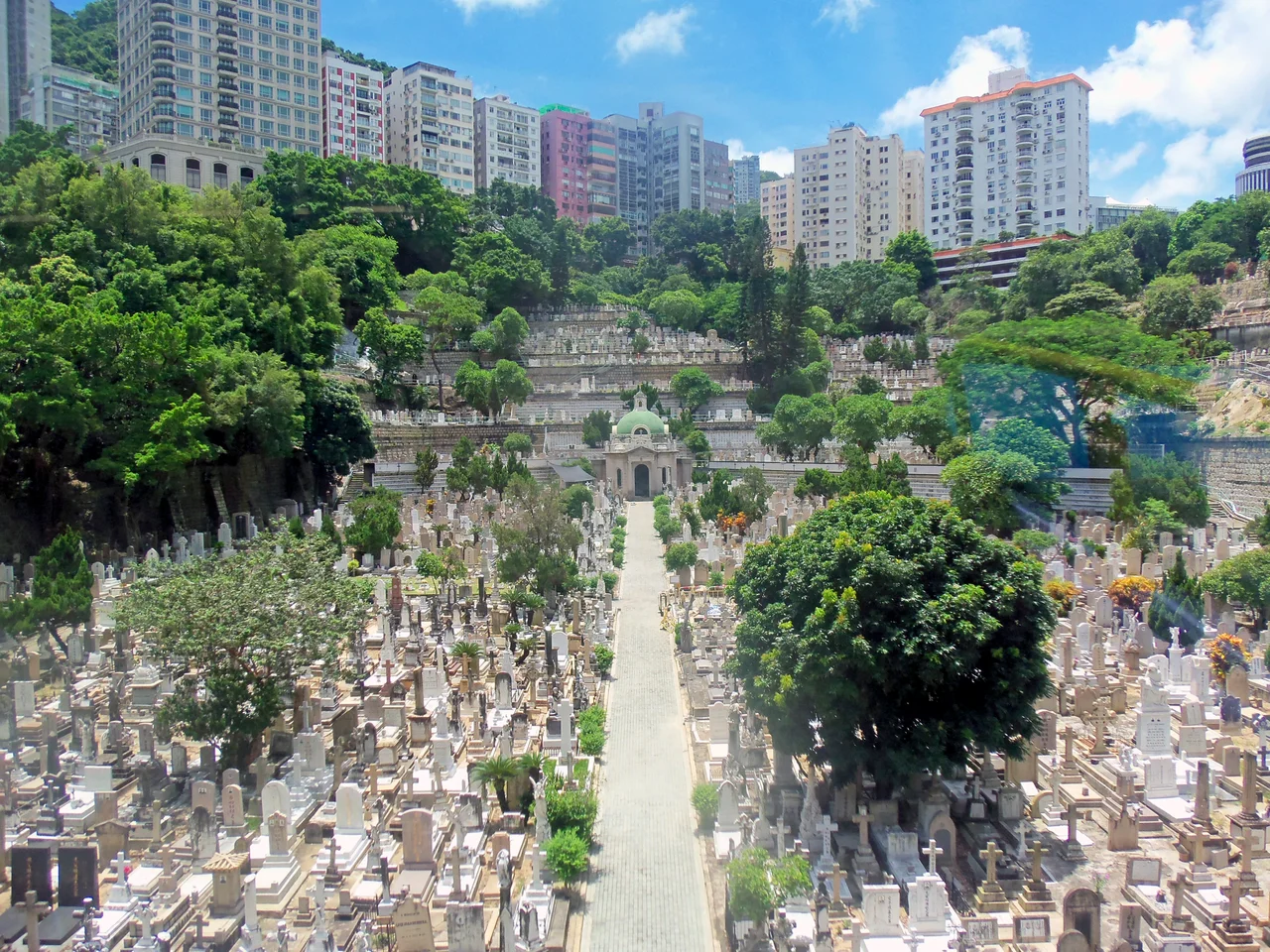

St. Michael's Catholic Cemetery
The gateway went up in 1848, just six years after Britain took possession of a mostly empty peninsula and declared it a colony. Hong Kong was still finding its shape — streets being cut, hillsides being cleared — and yet someone thought to build a proper Catholic cemetery, with an Italian Renaissance arch facing Wong Nei Chong Road. That gateway is still there. The racing crowds thunder past it on big Wednesdays at the Happy Valley track, a few hundred metres away. Inside the walls, it is something else entirely: terraced rows of headstones climbing a quiet hillside, the oldest Catholic cemetery in Hong Kong, and a strange and moving cross-section of the people who built this city.
A Gateway Built Before the City
The cemetery predates almost every landmark Hong Kong considers venerable. The arch at its entrance was constructed in 1848; the chapel at its centre followed in 1916, both in a restrained Italian Renaissance style that speaks of missionaries who carried European forms across oceans and set them down in subtropical heat. The Catholic Diocese of Hong Kong still manages the grounds today, alongside its sister cemeteries at Cape Collinson and Cheung Sha Wan. What makes St. Michael's distinctive — beyond its age — is who is buried here and what their presence reveals about the century and a half of Catholic life on this island. Bishops who governed a diocese through war and handover. Jesuits who taught generations of Hong Kong students. Missionaries who arrived from Milan and Paris and never went home. For a long time, this patch of terraced hillside was one of the very few places a Catholic in Hong Kong could be laid to rest.
The Bishops and Their City
Cardinal John Baptist Wu, who died in 2002, was the 5th Bishop and the first Cardinal of Hong Kong — a man whose ministry spanned colonial rule, cultural revolution just across the border, and the handover to Beijing. He was buried here until 2022, when his remains were exhumed and transferred to the crypt beneath the Cathedral of the Immaculate Conception, a final resting place befitting a prince of the Church. Bishop Michael Yeung, the 8th Bishop, who died in 2019, still lies here. So do several Jesuits who shaped Hong Kong's educational landscape over decades: Fr. Alfred Deignan, former principal of Wah Yan College; Fr. Harold Naylor, who taught at Kowloon Wah Yan College; Fr. George Zee, who supervised the same school into his eighties. The Jesuits ran schools; the PIME missionaries ran parishes. Fr. Antonio Riganti of the Pontifical Institute for Foreign Missions served as Vicar General and Diocesan Administrator of Hong Kong. These men came from Italy, from America, from France, and from across China — and they stayed.
The City's Own Dead
Alongside the clergy lie figures from Hong Kong's civic and cultural life — people who built the city in different ways. Harold Lee, who co-founded Television Broadcasts Limited (TVB) and helped create the broadcasting culture that shaped Cantonese popular life, died in 1980 and was buried here. William Mong, who founded the Shun Hing Group and became known as the "king of rice cookers" for his role in making electrical appliances accessible to Hong Kong households, is here too. Sir Harry Fang, who co-founded the Hong Kong Society for Rehabilitation and devoted decades to disability rights, rests alongside Peter Tsao, once Secretary for Home Affairs, and Tang King Po, an entrepreneur whose career stretched from the early colonial era to the postwar boom. And then there is Linda Lin Dai, the Taiwanese-Hong Kong film actress who became one of the most famous faces in 1950s and 1960s Chinese cinema. She died in 1964 at the age of 29. Her grave is among the most visited in the cemetery.
Quiet Above the Racecourse
On race days, the noise from Happy Valley carries over the cemetery wall — the announcer's voice, the roar when horses round the final bend. The juxtaposition is very Hong Kong: the living city pressing right up against its dead, neither quite drowning out the other. The cemetery climbs the hillside in terraced rows, shaded by trees that have grown tall enough to soften the subtropical glare. Commonwealth War Graves Commission records note a number of military burials here, too — soldiers from conflicts that preceded the racecourse, the skyscrapers, the container port. The chapel at the centre, with its Italian Renaissance facade built in 1916, is classified as a Grade II historic building. The gateway dates to 1848. Between them, two structures frame nearly two centuries of Catholic presence in a city that has never stopped reinventing itself.
From the Air
St. Michael's Catholic Cemetery sits at approximately 22.2730°N, 114.1785°E in Happy Valley on the northern side of Hong Kong Island. Approaching from the south over the Stanley Peninsula, the Happy Valley bowl — with the distinctive oval racecourse — is visible at low altitudes before crossing the island's central ridge. The nearest major airport is Hong Kong International (VHHH) on Lantau Island, roughly 30 km to the northwest. Recommend viewing at 1,500–2,000 ft; the cemetery is nestled between Wong Nei Chong Road and the hillside immediately west of the racecourse.
Nearby Stories
- Lok Ma Chau Loop 2.3 km away
- Portas do Cerco 2.3 km away
- Kweilin Incident 17 km away
- Wanshan Archipelago Campaign 34 km away
- Nanxiong Formation 115 km away
- Battle of Nanpeng Island 148 km away
- Heyuan 169 km away
- Cape Maobitou 632 km away