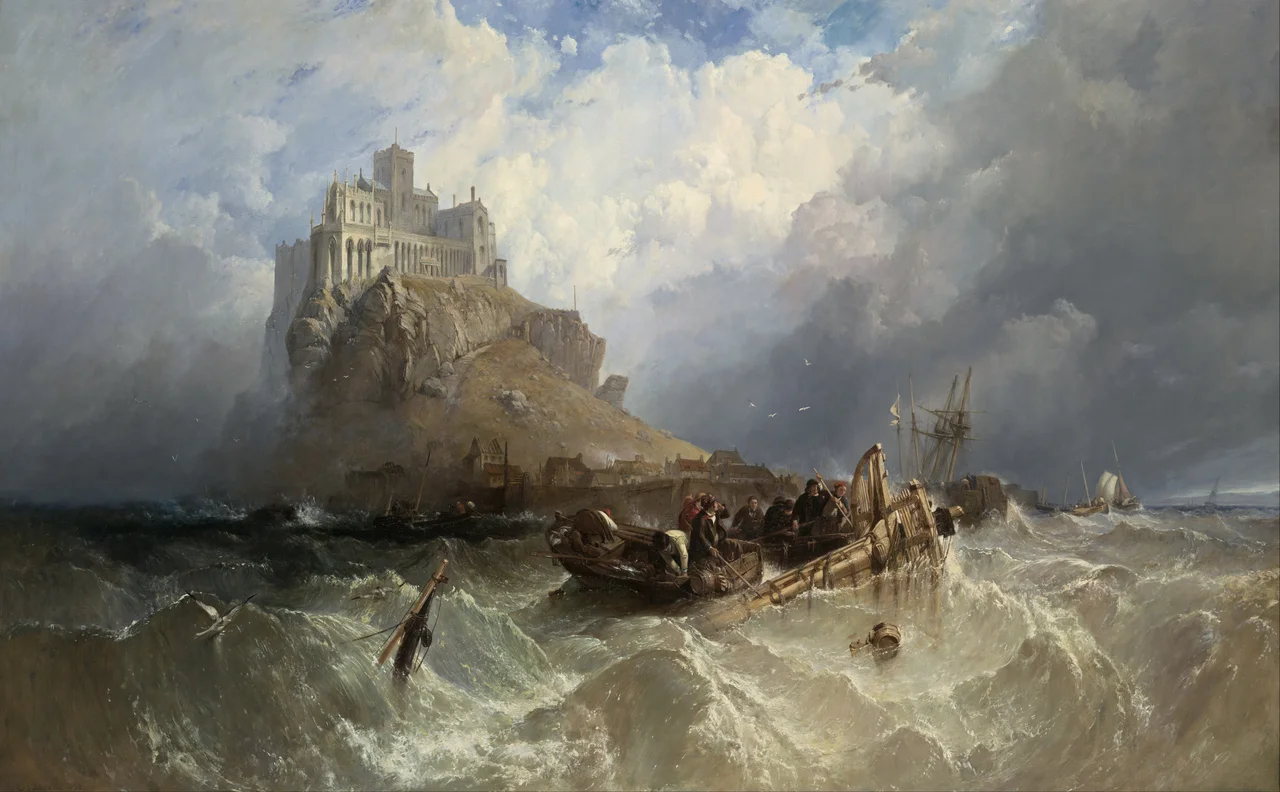

St Michael's Mount
Twice a day the sea uncovers a paved causeway out of Marazion, and for a few hours St Michael's Mount stops being an island. Pilgrims have walked that path since at least the eleventh century, when a Norman priory was tucked into the granite below the summit and the Mount was called simply Sanctus Michael beside the sea. Most days the tide closes the road again. The chapel on the peak, with its embattled tower and its tiny corner turret built as a navigation mark for ships in Mount's Bay, sits above a castle below which sits a village of about thirty-five people, almost all of whom work for one family. The St Aubyns have lived on the Mount since 1659. By any normal scale of English country-house history, they have only just moved in.
The St Aubyns and the National Trust
Colonel John St Aubyn bought the Mount from the Bassett family at the end of the Commonwealth in 1659, three years after the death of the previous Royalist owner. The St Aubyns turned the medieval priory and castle into a country house piece by piece over the following three centuries: a Victorian wing in the 1870s, a series of Edwardian gardens cut into the granite cliffs facing south, a working harbour enlarged in 1823 to take vessels up to five hundred tonnes. In 1954 the third Baron St Levan gave the bulk of the island to the National Trust with a 999-year lease that allowed his family to keep living in the castle in perpetuity. The current Lord St Levan and his family still occupy the upper floors. Staff cottages line the path up; an underground railway built by Cornish miners around 1900, too steep for passengers, still hauls supplies from the harbour. The 2011 census recorded the population of the island parish at thirty-five.
The chapel and the heart stone
The chapel of St Michael, a 15th-century building in the local Perpendicular style, occupies the summit and serves still as a working parish church. Its embattled tower has at one corner a small turret which was built deliberately as a guide for ships at sea; the lantern in the turret was kept burning on storm nights. Set into the cobbled terrace outside the chapel is a heart-shaped stone of dark granite. The legend that has been told around the Mount for centuries identifies it as the buried heart of a giant named Cormoran, who according to the Cornish folktale lived on the Mount, stole livestock from the farms across the bay, and was killed by a Cornish boy named Jack — the same Jack who would graduate, in Victorian retellings, into Jack the Giant-Killer. Walking past the stone, generations of pilgrims and visitors have stopped to listen. Children still believe they hear the giant. Adults find that they remember being children who believed they heard the giant. The story is older than the chapel above it. Chapel Rock down on the beach, half-submerged at most tides, marks the spot where pilgrims paused at a shrine to the Virgin Mary before climbing the holy hill itself.
Royal footsteps
Queen Victoria stepped ashore from the royal yacht at St Michael's Mount in 1846, and somebody had the wit to record the moment with a brass inlay of her shoe pressed into the stone at the top of the landing stage. Edward VII's footprint is set near the bowling green. In 1967 the Queen Mother arrived in a pinnace from the Britannia. The footprints are easy to miss unless you know they are there; once you do, walking the harbour wall becomes a slightly absurd exercise in tracing the social ascent of an island that began as a Benedictine priory of two monks. The harbour itself has been there in some form since the fifteenth century — the medieval pier survives, repaired in 2016 after the 2014 winter storms broke up the causeway and a hundred metres of the harbour wall.
Geology and Lyonesse
The Mount is granite, the same hard intrusive rock that built nearby Tregonning Hill and the wider Cornubian batholith beneath Cornwall. Two types are visible: a tourmaline-muscovite granite that forms most of the bulk, and a sheeted system of greisen veins where superheated fluids reworked the rock and made it mineral-rich. The island's seaward side has been a Site of Special Scientific Interest since 1995. Local memory adds a chronicler's note: John of Worcester, writing of the year 1099, said the Mount had once stood five or six miles from the sea, enclosed in thick woods, until on the third of November the sea-flood swept inland. The Anglo-Saxon Chronicle records the same flood: 'so much harm, as no man remembered that it ever did before'. The Cornish legend of Lyonesse, the drowned kingdom said to have stretched from Penwith to the Isles of Scilly, makes the same claim in legend that the chronicler made in prose. The sea took the country and left the Mount.
On screen, on song
St Michael's Mount has stood in for itself, for France, and for Westeros. Two air-launched cruise missiles fly directly over the chapel in the 1983 James Bond film Never Say Never Again. The 2003 Johnny English used it as the exterior of a French chateau. The 2021 House of the Dragon production set scenes here. Aphex Twin's drukQs has a track titled 'Mt Saint Michel + Saint Michaels Mount'. None of this seems to disturb the island much. The tide still comes in twice a day, the cars still queue at Marazion to time the crossing, and at the chapel above, somebody still rings the bell at the appointed hours for a congregation that on most Sundays could fit comfortably in a single granite pew.
From the Air
St Michael's Mount sits 400 metres off the village of Marazion at 50.117 N, 5.478 W, in the eastern arc of Mount's Bay. Best photographed from 1,200 to 2,000 feet on a south-westerly track to catch the causeway exposed at low tide. Land's End (EGHC) lies 8 miles west; Newquay (EGHQ) is the alternate at 27 miles north. Tide tables matter: the island appearance changes dramatically between high and low water. Atlantic squalls can come up the bay quickly.
Nearby Stories
- Wadebridge 8.1 km away
- Caerhays Castle 8.1 km away
- Sevenstones Lightship 16 km away
- Battle off Lizard Point 20 km away
- MV Cita 22 km away
- Carnewas and Bedruthan Steps 30 km away
- 1979 Fastnet Race 71 km away
- HMS Affray 108 km away