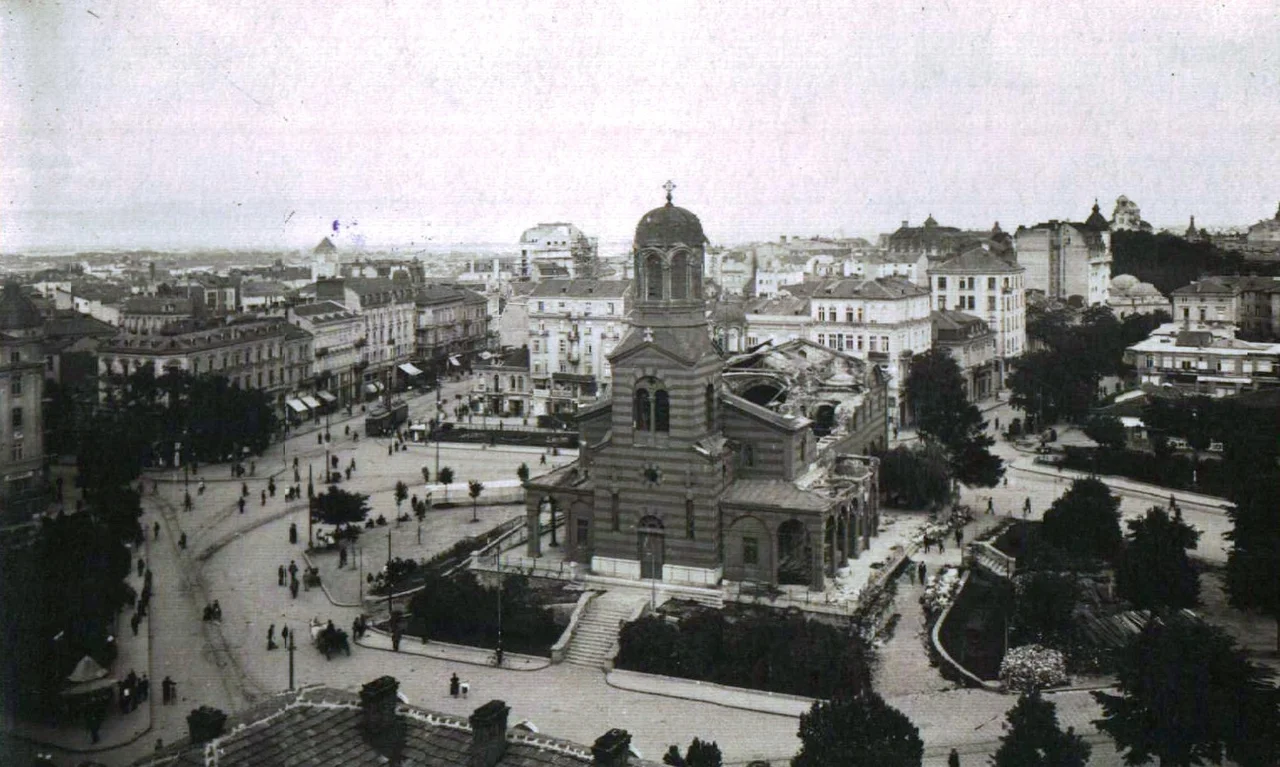
.JPG)
St. Nedelya Church Bombing
Holy Thursday, 16 April 1925. The funeral of General Konstantin Georgiev was filling St. Nedelya Cathedral in central Sofia with the country's political and military elite - generals, ministers, mayors, and the families who had come to mourn alongside them. Two days earlier, the general had been shot in the street as he walked toward another church with his granddaughter at his side. His funeral, the bombers calculated, would draw exactly the people they wanted to kill. At 15:20, twenty-five kilograms of explosives concealed above the south column of the main dome detonated. The dome collapsed inward onto the congregation. By the time the dust settled, 213 people were dead and roughly 500 wounded - the deadliest terrorist attack in European history until Air India Flight 182 sixty years later.
The Plot Hidden in the Attic
The plan came from the Military Organisation of the Bulgarian Communist Party, an underground arm fighting for survival after the failed September Uprising of 1923 had been crushed and the party banned in 1924. By 1925 the Bulgarian government was systematically dismantling the BCP's clandestine structures, and the MO leadership decided that decapitating the state in a single blow might reverse the pressure. Their original target was the police director's funeral; when his security proved too tight, they assassinated General Georgiev instead, knowing his service would draw a similar crowd. A sexton named Petar Zadgorski - quietly recruited the previous December - let two bomb-makers, Petar Abadzhiev and Asen Pavlov, smuggle explosives into the cathedral attic over the course of weeks. They mounted the package above the column closest to the south entrance, where the coffin was expected to rest, and ran a fifteen-metre detonator cord that would let them escape before the blast.
The Holy Thursday Service
Bishop Stefan, the future Bulgarian Exarch, led the service. Forged invitations on behalf of the Association of Reserve Officers had been sent out to swell attendance. The coffin was originally placed beneath the rigged column, but the crowd was so large the bearers shifted it forward - a small displacement that probably saved the entire government, who survived as if by accident. Tsar Boris III was not in the cathedral at all. He was attending a separate funeral elsewhere for those killed two days earlier in a failed assassination attempt against him in the Arabakonak pass. When Zadgorski gave the signal, Nikola Petrov pulled the cord and walked out. The dome came down onto the standing congregation. Among the named dead were General Kalin Naydenov, Bulgaria's wartime minister of war; General Stefan Nerezov, who had commanded at Dojran in the First World War; the mayor of Sofia, Paskal Paskalev; the chief of police; three sitting deputies; and twenty-five women and children whose names did not make the official lists.
The Reprisal
Martial law was declared that night. What followed has its own death toll. Over the next two weeks, roughly 450 people were executed without trial in a wave of killings carried out by the Military Union with the government's quiet approval. The dead included people who had nothing to do with the cathedral - among them the poet Geo Milev, whose body was recognised in a mass grave decades later only by the glass eye he had worn since losing the original at war, and the journalist Yosif Herbst. The MO leaders Kosta Yankov and Ivan Minkov were hunted down and killed. A military court convened in May tried the conspirators it could find. Zadgorski, who had surrendered after his party abandoned him, was hanged alongside Marko Fridman and Lieutenant-Colonel Georgi Koev. Several of the actual planners - Abadzhiev, Petrov, Zlatarev - escaped through Yugoslavia to the Soviet Union, where they lived out the rest of their lives. Many of the 450 executed in the reprisal had no connection to the bombing at all.
What the Cathedral Holds
St. Nedelya was rebuilt; it stands today on the same square in central Sofia, the dome restored, the city flowing around it as the city always had. A plaque inside lists the victims of the bombing. The cathedral is again working - weddings, funerals, ordinary services - and most days the people who pass through its doors do not pause over the date 16 April. The bombing's Bulgarian name is Krvaviyat Chetvurtuk, Bloody Thursday. It sits awkwardly in twentieth-century memory: too political to grieve simply, too brutal on every side to claim any clean lesson. The dead in the dome and the dead from the reprisal are both buried in Sofia's cemeteries, and the city remembers them with the kind of quiet that comes when grief has nowhere clean to go.
From the Air
St. Nedelya Cathedral stands in the heart of Sofia at 42.6967°N, 23.3217°E, just west of the city's Largo plaza. From cruising altitude over the Balkans, the Sofia basin appears as a wide bowl ringed by the Vitosha massif to the south and the Stara Planina to the north. Nearest airport is Sofia (LBSF), with the cathedral roughly 7 km northeast of the runway threshold. Recommended viewing altitude: 8,000-12,000 ft for the wider Sofia valley context.
Nearby Stories
- Battle of the Gates of Trajan 1.3 km away
- Battle of Kresna Gorge 65 km away
- Battle of Plovdiv (1878) 70 km away
- Battle of Kosturino 114 km away
- New Europe Bridge 129 km away
- Old Bazaar, Skopje 136 km away
- Trapezitsa Fortress 142 km away
- Trajan's Bridge 193 km away