
St Petroc's Church, Bodmin
In 1177, someone stole the bones of Saint Petroc. They were recovered, eventually, and returned to Prior Roger at Bodmin, and the ivory casket that held them - small, intricate, made far away - is still here, eight and a half centuries later. The church around it has been Catholic, then Anglican, then a monastery, then a priory, then a parish church again; it has been raided by Danes, suppressed by Henry VIII, lost its spire to a lightning strike in 1699, and been restored three times by Victorian and twentieth-century architects who could not quite agree on what it should look like. Until Truro Cathedral was finished in 1910, St Petroc's was simply the largest church in Cornwall, and even now its long nave, fifteenth-century walls, and surviving Norman tower make it the most architecturally layered building for many miles around.
The Town the Monks Built
The place-name tells the story before the history does. Bodmin comes from a Cornish phrase meaning house of the monks - which means the name itself dates from after the monastery was founded, not before. Tradition assigns that foundation to Saint Petroc in the sixth century, a missionary who had already established a community at Padstow and pushed inland to set up another here. Petroc gave Bodmin its alternative name, Petrockstow, and made it the spiritual centre of north Cornwall. A Cornish hermit named Guron is said to have lived on this site before him; his well still stands at the western entrance to the churchyard, a small granite building you could easily walk past without noticing. The original monastery at Padstow was destroyed by Danish raiders in 981 AD, and the monks relocated to Bodmin, bringing Petroc's relics with them; by the time of the Domesday Book in 1086, the Bodmin house still held eighteen manors stretching across Cornwall.
Stones from Many Centuries
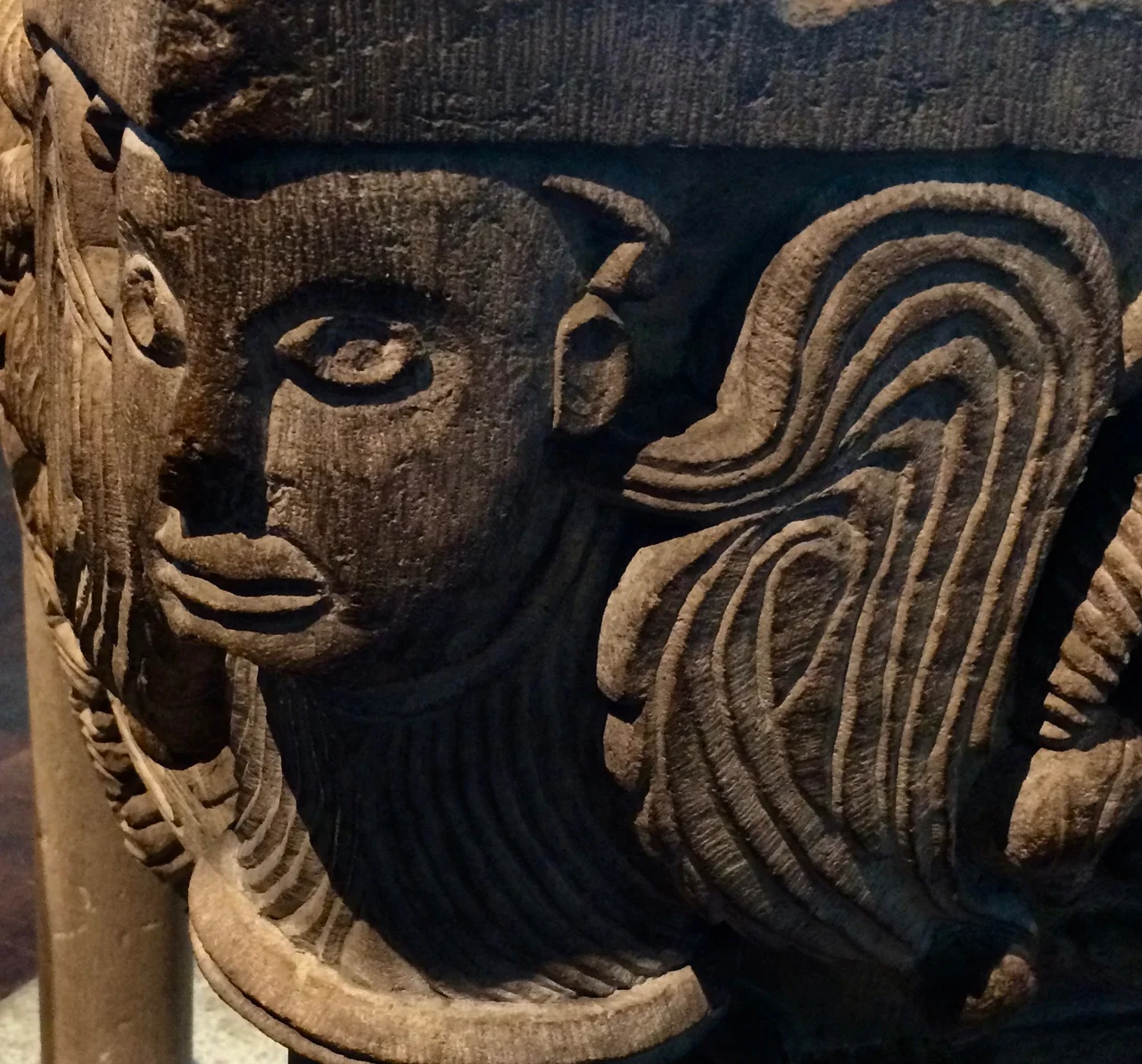
The current church dates from 1469 to 1472, but very little of any building is purely one age. The tower on the north side is the oldest visible element - Norman at the base, fifteenth century above - and until 1699 it carried a 150-foot spire that drew the eye from miles away. The font, common in type but extraordinary in scale, is twelfth century: large, finely carved, more elaborate than any other Cornish font of its kind. In 1491 a craftsman named Matthy More undertook the reseating of the entire church, building a rood screen and pulpit in four years for what was estimated in 1937 as the equivalent of £400. Fragments of his work survive in the bench-ends, the Corporation seats, and the wall panelling. Three late-fifteenth-century misericords, carved seats originally meant to support standing monks during long services, were salvaged from somewhere and rebuilt into the lectern, probably in the eighteenth century. Nobody is entirely sure where they came from.
Prior Vyvyan's Tomb
Of all the monuments inside, the one that stops people most often belongs to Thomas Vyvyan, the second-to-last prior of Bodmin Priory. He lies in effigy on a chest tomb of black Catacleuse stone and grey marble, carved with the careful realism that Cornish stonemasons were perfecting around 1500. Vyvyan was a Cornishman who rose through the church hierarchy until, in 1517, he was made bishop of the titular see of Megara in Greece - a paper title that allowed him to serve as suffragan to the Bishop of Exeter for the archdeaconry of Cornwall. At Rialton, the priory's chief manor, he had already built himself a substantial residence around 1510. Parts of that house still stand. When the Reformation came and his priory was suppressed, his tomb was not destroyed but relocated into the parish church - an unusual mercy in a wave of demolitions.
The Long Restoration
By 1868 the church was in trouble. Robert Jewell Withers, a London architect, was commissioned to survey the building and estimate what restoration would cost. Fund-raising stretched on for sixteen years; the structural work alone came to £1,850, the full project over £3,000. On Christmas Day 1884 the Bishop of Truro arrived to reopen the church for worship. The Royal Cornwall Gazette listed every improvement: three completely new bays in the east end, new and restored windows, two memorial windows for local men recently buried, an oak roof preserved over the south chancel aisle while the rest was renewed in pitch-pine. Staffordshire tiles in the aisles, encaustic tiles in the chancel, a new cedar altar for nearly £80. A new organ was on order from Hele of Plymouth but would not arrive for months, so a powerful American organ filled the gap. Two further Victorian restorations followed, and another in 1930. Today, the church is Grade I listed, and part of it serves as the regimental chapel of the Duke of Cornwall's Light Infantry, dedicated in 1933.
What Remains
The churchyard is extensive and sloped. In its south-eastern corner sit the ruins of the Chapel of St Thomas Becket, a fourteenth-century building reduced to a roofless shell. At the western entrance is St Guron's Well. In the tower, eight bells still hang; the tenor weighs more than seventeen hundredweight. Some fragments of the old priory's stonework, found around the churchyard, are preserved at nearby Priory House. The thieves who took Petroc's bones in 1177 are long forgotten. The ivory casket is still here. So is the saint.
From the Air
Located at 50.471°N, 4.717°W in the town of Bodmin, central Cornwall. Recommended viewing altitude 2,000-3,500 ft AGL. Bodmin sits in a shallow valley on the southern edge of Bodmin Moor; the church tower is the most prominent feature in town. Visual landmarks: the A30 dual carriageway passes 1 nm north; the Camel Trail follows the old railway alignment west towards Wadebridge; Bodmin Moor proper rises 5 nm north-east. Nearest civilian airports: Newquay (EGHQ) 15 nm west, Exeter (EGTE) 50 nm east. Watch for moorland weather drifting south into the valley and reducing visibility.
Nearby Stories
- Gunnislake 1.5 km away
- Tehidy Country Park 4.2 km away
- Caerhays Castle 8.1 km away
- Bude 15 km away
- Hope Cove Lifeboat Station 26 km away
- Appledore Lifeboat Station 29 km away
- Godrevy Lighthouse 34 km away
- Action of 17 November 1917 82 km away