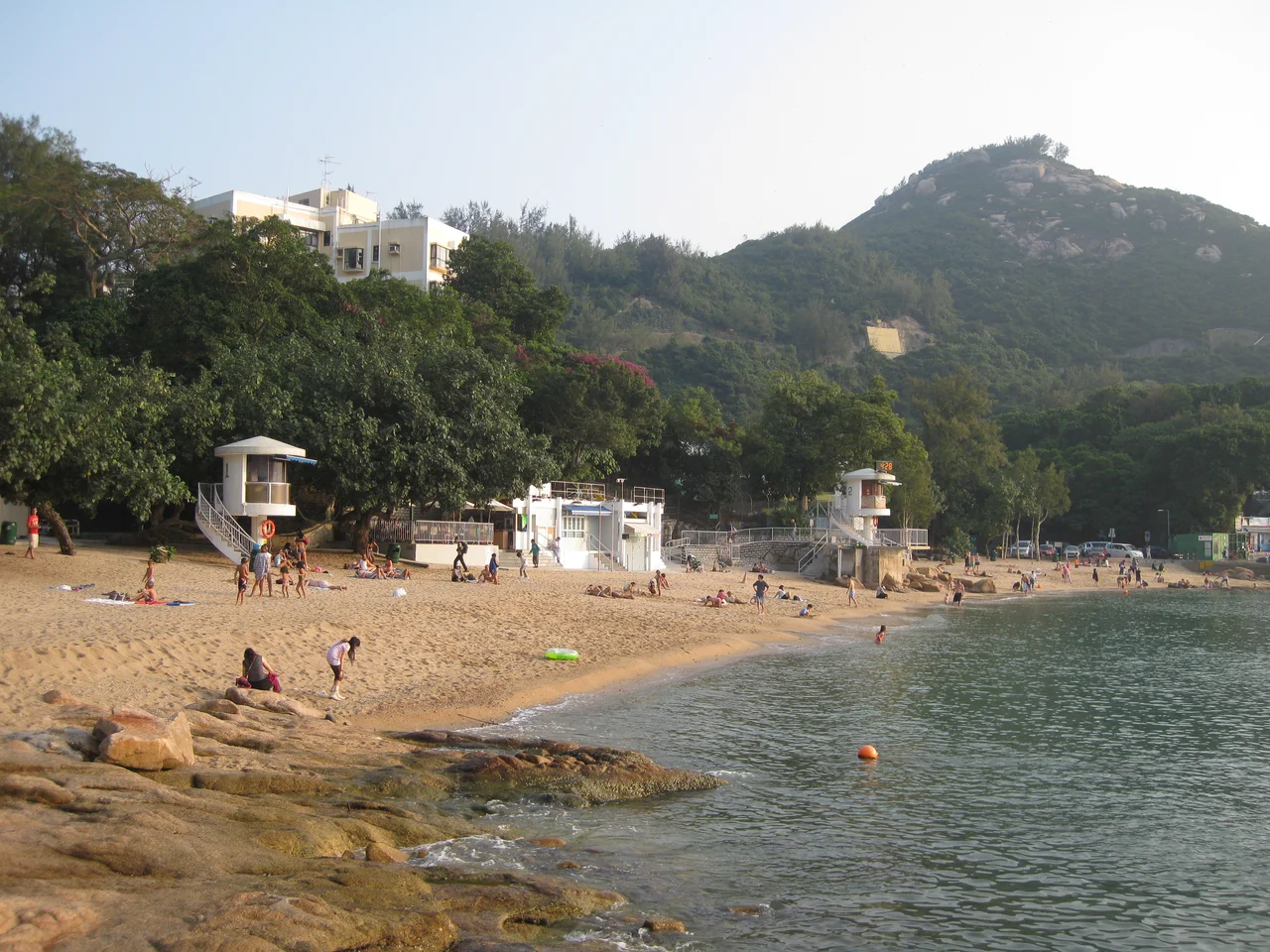

St. Stephen's Beach
The water at St. Stephen's Beach is clear enough, on calm days, to see the sandy bottom through several metres of South China Sea. Barbecue smoke drifts up from the fourteen pits along the shore on weekends. Children wade. Windsurfers launch from the nearby main beach and slice through Stanley Bay. It is, by any measure, a pleasant and well-managed public beach — rated Grade 1 for water quality by Hong Kong's Environmental Protection Department. And yet the ground just above it holds a very different story. The Stanley Military Cemetery sits on the hillside overlooking the beach, 598 war graves terraced into the slope, and a short walk away stands St. Stephen's College, where some of the worst atrocities of the Battle of Hong Kong were committed on Christmas Day, 1941. The beach is beautiful. The beauty does not cancel what happened here.
The Western Shore of Stanley
St. Stephen's Beach occupies the western side of the Stanley Peninsula, separated from Stanley Main Beach by the width of the headland. Where the main beach faces east into a sheltered bay popular with dragon boat racers and windsurfers, St. Stephen's faces west toward the open approaches of the South China Sea — a quieter aspect, slightly more sheltered, slightly less discovered by the tourist buses that deposit visitors at Stanley Market. New beach facilities opened here on 26 August 1966, replacing an old pier that had stood since the colonial era. The current building has changing rooms, showers, a tuck shop, and a water sports centre. Catamaran storage racks line one end. The Leisure and Cultural Services Department manages the beach as it does most of Hong Kong's public shores. On hot afternoons, families from the nearby housing estates at Ma Hang fill the barbecue pits and stay until after dark.
The Hill Above
Walk up the steps from the beach road and you reach the Stanley Military Cemetery, set on a hillside that was reopened for burials during the Japanese occupation when the nearby internment camp's dead needed ground. Of the 598 Second World War burials here, 175 are unidentified — soldiers whose dog tags were lost or whose remains arrived without documentation. Ninety-six are civilian internees, including four children. They were men and women who had come to Hong Kong as traders, teachers, civil servants, and missionaries, and who died in the Stanley Internment Camp of malaria, malnutrition, and the diseases that come when soap and clean water are withheld for years. Commonwealth War Graves Commission headstones mark every grave in the cemetery's characteristic uniform style: name, regiment or unit, date of death, a symbol of faith. The effect — row after row, climbing the hillside above the turquoise water — is something that stays with a visitor.
Christmas Day, 1941
St. Stephen's College, visible from the beach, was being used as a military hospital when Japanese forces entered its grounds on 25 December 1941 — several hours before the formal British surrender that turned that date into what many Hong Kong residents still call Black Christmas. Two doctors, Lt-Colonel Black and Captain Whitney, went out to meet the soldiers and were marched away; they were later found dead and mutilated. Japanese troops then entered the hospital wards and bayoneted British, Canadian, and Indian wounded soldiers who could not defend themselves. A second wave of troops arrived after fighting moved south; they killed two more Canadians and subjected nurses to sustained violence. Approximately 100 people died in the massacre. The college buildings survived. The school reopened after the war. Its oldest building, the School House, was declared a monument in 2011. A chapel was built on the grounds in 1950, with a memorial window above the west door remembering those who suffered here.
A Beach That Holds Both Things
There is no easy resolution between the beach's present pleasures and its wartime weight — nor should there be. The Grade 1 water quality, the barbecue smoke, the Grade I-listed cemetery above, the college below the road: they coexist as Stanley itself does, a place where the ordinary life of the city sits in immediate proximity to events that marked this ground permanently. The military cemetery is open to visitors and is well maintained by the Commonwealth War Graves Commission. It is reached by four flights of steps rising roughly ten metres above the road. The view from the top, looking out over the beach and the South China Sea beyond, is the same view the soldiers in the hospital wards might have had, before Christmas 1941 turned toward what it became.
From the Air
St. Stephen's Beach sits at approximately 22.2133°N, 114.2149°E on the western shore of Stanley Peninsula, southern Hong Kong Island. From the air, the Stanley Peninsula juts distinctly southward from Hong Kong Island's coastline; the beach is on its western (right) side when approaching from the north. Stanley Military Cemetery is visible as a terraced hillside above the beach road. Hong Kong International Airport (VHHH) is approximately 30 km northwest on Lantau Island. Recommend viewing altitude 1,500–2,500 ft for a clear read of the peninsula's shape, the two beaches, and the fort at the southern tip.
Nearby Stories
- Lok Ma Chau Loop 2.3 km away
- Portas do Cerco 2.3 km away
- Kweilin Incident 17 km away
- Wanshan Archipelago Campaign 34 km away
- Nanxiong Formation 115 km away
- Battle of Nanpeng Island 148 km away
- Heyuan 169 km away
- Cape Maobitou 632 km away