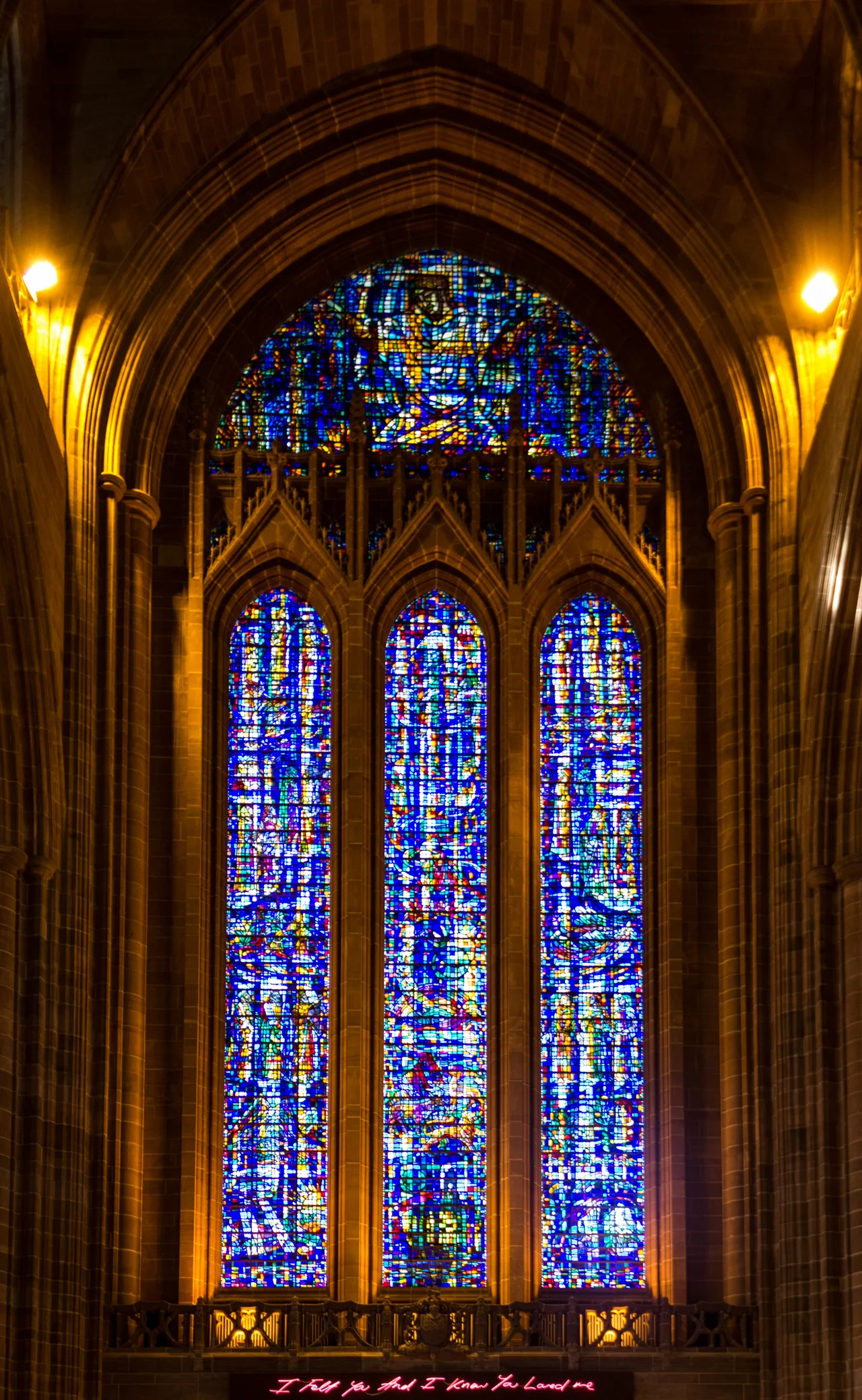

Stained Glass in Liverpool Cathedral
Carl Edwards was finishing windows in Liverpool Cathedral in the 1970s that the previous generation had begun designing in 1907. Seventy years stretched between the first competition and the last installation. World wars, technological revolutions, and shifts in religious art all intervened. The glass that fills the largest Anglican cathedral in Europe is consequently not one collection but several - dark Edwardian work in deep blues and reds in the Lady Chapel, simplified mid-century reinterpretations of windows destroyed by Luftwaffe bombs, and finally the radiantly luminous post-war glass with its almost abstract jewel-tone clarity. The whole survey can be read as a textbook of twentieth-century stained-glass art, all under one Gilbert Scott roof.
A Committee, an Architect, an Agreement
Giles Gilbert Scott won the cathedral design competition in 1903 at the age of 22. The foundation stone was laid on 19 July 1904. The cathedral would not be completed until 1979. From the beginning, Scott understood that the glazing would take generations, and he established a Stained Glass Committee under Sir Frederick Radcliffe to govern the programme through what everyone knew would be a long century. Scott himself insisted on one principle: the windows must not detract from the architecture. The glass would defer to the stone. The committee would choose subjects. The architect would establish how dark or light each window should be. The designers would then realise the work within those constraints. The system held remarkably well through changes of chairman, two world wars, and the deaths of multiple senior figures - including Scott's own in 1960 before he could see his cathedral completed.
The Lady Chapel and the Noble Women
The Lady Chapel was the earliest part of the cathedral built, completed in 1910 before the rest of the structure had even risen above its foundations. The committee held a separate stained-glass competition for it in 1907, won by James Powell and Sons of Whitefriars Glass with designs by John William Brown. Because the chapel was dedicated to the Virgin Mary, Brown's windows celebrate the role women have played in Christianity - a scroll bearing the words of the Magnificat runs through all the windows, with holy women of the British Isles on one side and Prayer Book saints on the other. The chapel was bombed on 6 September 1940 and every window destroyed. James Hogan, also at Powell's, was commissioned to remake them using simplified versions of the originals. After Hogan died in 1948 the work passed to Carl Edwards, whose replacement glass is considerably brighter than the Edwardian originals. The Noble Women windows along the stair from the Lady Chapel were donated by the Girls' Friendly Society and depict women who shaped modern life: the prison reformer Elizabeth Fry, the rescue heroine Grace Darling who rowed out to save the survivors of the SS Forfarshire in 1838, and Kitty Wilkinson - the working-class Liverpool woman who opened the first public wash-house during the cholera epidemic of 1832.
The Te Deum Window
The east end of the cathedral is dominated by Brown's Te Deum window - a massive composition rising above the high altar that depicts the heavenly choir praising God in the language of the ancient hymn. Below the risen Christ at the top, four lancets show the four communities mentioned in the canticle. The apostles - Matthias replacing Judas, Paul and Barnabas joining the original eleven. The goodly fellowship of prophets - Isaiah and Elijah, but also John Wycliffe, Thomas Cranmer, and John Wesley, the reformers and revivalists of English Christianity. The noble army of martyrs from St Stephen onward, including martyrs from Madagascar, Africa, Melanesia, and China - acknowledging the missionary blood that Liverpool's port had carried out into the world. The holy church throughout all the world has perhaps the most surprising figures: King Alfred, Dante, Fra Angelico, J. S. Bach, Isaac Newton, the physician Thomas Linacre, the navigators Christopher Columbus and Francis Drake. Brown's east window argues that civilisation itself is a kind of praise, with its scholars and explorers and artists numbered among the saints.
Bombed and Reborn
When the Luftwaffe came on 6 September 1940, much of the new cathedral's glass shattered. The Lady Chapel lost everything. The War Memorial Chapel window by Brown - which dealt with First World War sacrifice - was destroyed. The south choir aisle Gospel windows were destroyed. Each had to be remade. The committee made a brave choice: rather than reproduce the originals exactly, the new windows would be based on the lost designs but simplified and brightened, with widened mullions and more vivid colour. The bombing forced an evolution. Compare the dark, complex Sapphire and Gold windows on the north choir aisle (by Brown, original, surviving) with the brighter Ruby and Emerald windows opposite (by Hogan, post-bomb replacements). The cathedral now contains both periods side by side. The change reflects not only Luftwaffe damage but also changes in glassmaking technology in the 1930s and 40s - new techniques permitted bolder colours and greater translucency, and the post-war windows take full advantage.
The West Window: Benedicite
Scott died in 1960. The west end of the cathedral was unfinished. Scott's original design had called for a small rose window and an elaborate porch. After his death, two of his colleagues - Frederick Thomas and Roger Pinkney - simplified the west front into a flat composition with a vast single window. Carl Edwards designed the glass. The west window covers 1,600 square feet and takes as its theme the Benedicite - the canticle that calls on all creation to bless God. The risen Christ looks down in glory from a round-headed window at the top. Below, in three lancets each more than 52 feet tall, all creation is depicted united in peace: stars and weather, plants and animals, men and women of every nation. Edwards finished the work in 1979, the cathedral's completion year. Seventy-two years had passed since the first stained-glass competition. Brown and Hogan were both long dead. Scott himself had been gone for nineteen years. The cathedral that all of them had worked toward - in steel and stone and glass and committee meetings - was finally finished.
From the Air
Liverpool Cathedral stands at 53.397°N, 2.973°W on St James's Mount, the highest point in central Liverpool, about half a mile southeast of the Liver Building. Best viewed at 2,000-4,000 ft. Liverpool John Lennon Airport (EGGP) is 5 nm south-southeast. Look for the cathedral's massive central tower - one of the tallest church towers in the world - and the long red Woolton sandstone nave running north-south on its sandstone outcrop. The Anglican cathedral is the southerly of the two great cathedrals; the Catholic Metropolitan Cathedral is half a mile north along Hope Street.
Nearby Stories
- RAF Wrexham 3.3 km away
- Birkdale Palace Hotel 3.7 km away
- Turton Tower 4.1 km away
- Tatton Park 5.6 km away
- Abergele Rail Disaster 9.6 km away
- Diglake Colliery Disaster 13 km away
- Ysbyty Ifan 16 km away
- Celtic Array 62 km away