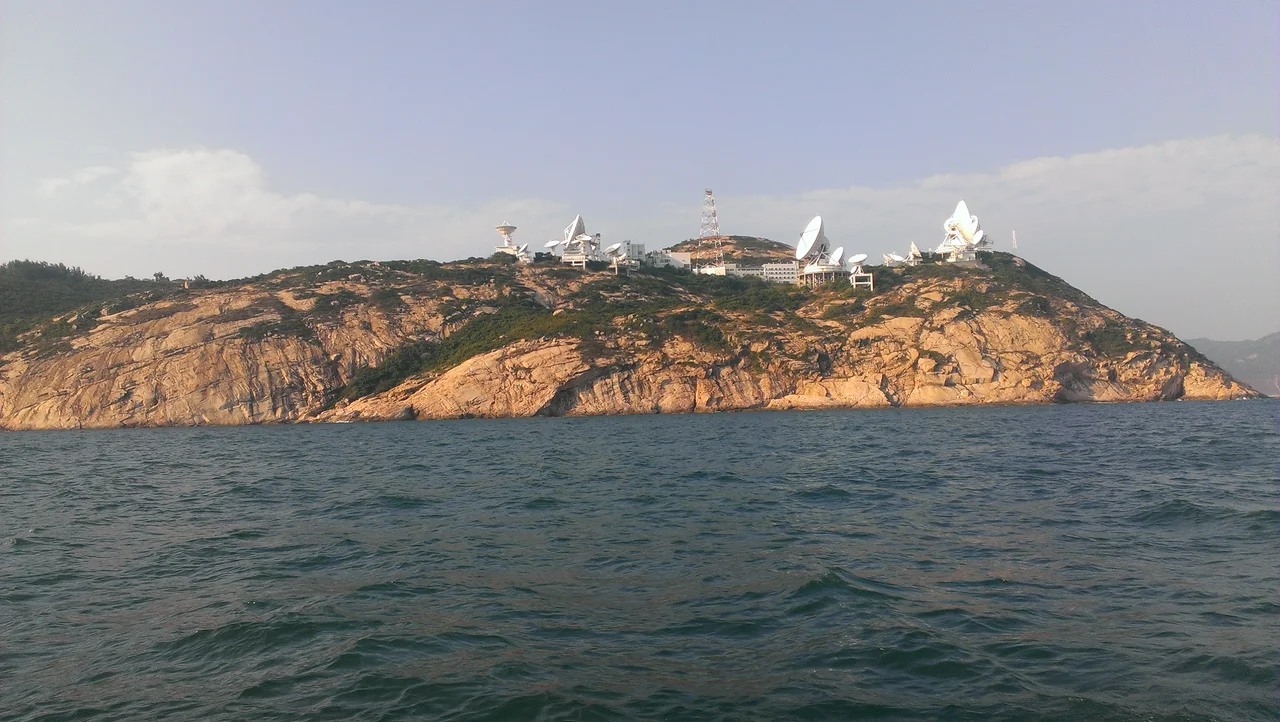

Stanley Fort
Imperial China built a fort here first, recognised the headland's value for maritime defence, then eventually abandoned it. The British came in 1841 and made the same calculation, though they took their time acting on it. The camp they built near the town was demolished in the 1880s — and then, as Japanese forces began moving through China in the 1930s, they built again, this time seriously: a 128-hectare complex of barracks, coastal artillery batteries, and officers' quarters, constructed between 1935 and 1937 at the southern tip of Stanley Peninsula. The present-day Stanley Fort was completed just four years before it fell.
Three Empires, One Headland
The story of Stanley Fort is a compression of Hong Kong's larger history — a piece of ground that successive powers recognised as strategically significant and claimed in turn. Imperial China fortified the peninsula for maritime defence, then withdrew. The British arrived on Hong Kong Island in 1841, established Stanley (then called Chek-chu) as the first capital of the new colony, and built a military camp to defend it. That camp was demolished in the 1880s, and for a generation the ground was quieter. Then came the 1930s: Japanese forces moving through mainland China, British planners drawing up defence schemes within the constraints of the Washington Naval Treaty, and the decision to build a proper fort at the southern end of the peninsula. Stanley Battery and Bluff Head Battery were positioned to protect the southern approaches. The fort that emerged — 128 hectares of barracks, officers' quarters, and gun emplacements — was built between 1935 and 1937. It was operational for four years before Christmas 1941.
Christmas Day, 1941
The Battle of Hong Kong lasted eighteen days. On Christmas Day, with the colony's defence collapsing and fighting pushing south through the island, British and Canadian troops at Stanley Fort mounted a final counterattack against Japanese positions at St. Stephen's College, up the road from the fort. It failed. The fort fell to Japanese forces that same afternoon — surrounded, out of options, the garrison surrendered. The fallen servicemen were buried in Stanley Military Cemetery, near the beach below. Japanese engineers then modified the fort's structures to make them more resistant to bombardment. For three years and eight months, until August 1945, the fort flew a different flag, and the peninsula's civilian population endured the hardships of occupation. The civilians who were not imprisoned in the internment camp nearby lived under conditions defined by shortage, fear, and the proximity of armed authority.
The Long Peace After
In the late 1940s Stanley Fort reverted to British Army use, and for the next half-century it served as a conventional garrison. By the early 1950s the fort housed the 27th Heavy Anti-aircraft Regiment and a workshop run by the Royal Electrical and Mechanical Engineers. It had three-storey barracks, a two-storey NAAFI, medical facilities, a parade ground, and vehicle parks — the full infrastructure of a working military base in the postwar British Empire. During a brief period in the late colonial years, after the army withdrew, the site was put to civilian use as the Kai Chi Children's Centre and the Aberdeen Rehabilitation Centre, an interlude that speaks to how thoroughly Hong Kong recycled its built environment. In 2000 the site was re-listed as Chek Chue Barracks and returned to military function — this time under the People's Liberation Army, the Hong Kong garrison of the Chinese People's Liberation Army Ground Force. The handover of sovereignty in 1997 transferred the fort as it transferred everything else.
What Remains
The fort is not open to the public. The bus terminus at Stanley Fort Gate sits just outside the barracks entrance, and that is as close as most visitors get — a gate, a sentry post, a glimpse of buildings beyond a fence. What can be seen without entering are the five listed heritage structures associated with the fort. Stanley Battery Gun Emplacement is classified Grade I under Hong Kong's Antiquities and Monuments Ordinance, a recognition that the concrete gun positions overlooking the South China Sea carry historical weight beyond their military function. Four other blocks — Blocks 17, 38, 51, and 09 — are classified Grade II. The Hong Kong Earth Station, which was set up within the fort's grounds in 1969, occupies another corner of the site, pointing its dishes skyward from a headland built for pointing guns seaward. The fort remains, in its way, exactly what it has always been: a piece of high ground at the end of a peninsula, held by whoever is currently in charge.
From the Air
Stanley Fort occupies the southern tip of Stanley Peninsula at approximately 22.201°N, 114.218°E, the lowest point of Hong Kong Island's southern coastline. From the air, the peninsula is clearly defined — a narrow tongue of land jutting south, with the fort at its very tip. Coastal gun emplacements and the distinct barracks compound are visible at low altitudes. Hong Kong International Airport (VHHH) is approximately 30 km to the northwest on Lantau Island. Recommended viewing altitude: 1,500–3,000 ft. The South China Sea approach that Stanley Battery once defended is open to the south, with Lamma Island visible to the west.
Nearby Stories
- Lok Ma Chau Loop 2.3 km away
- Portas do Cerco 2.3 km away
- Kweilin Incident 17 km away
- Wanshan Archipelago Campaign 34 km away
- Nanxiong Formation 115 km away
- Battle of Nanpeng Island 148 km away
- Heyuan 169 km away
- Cape Maobitou 632 km away