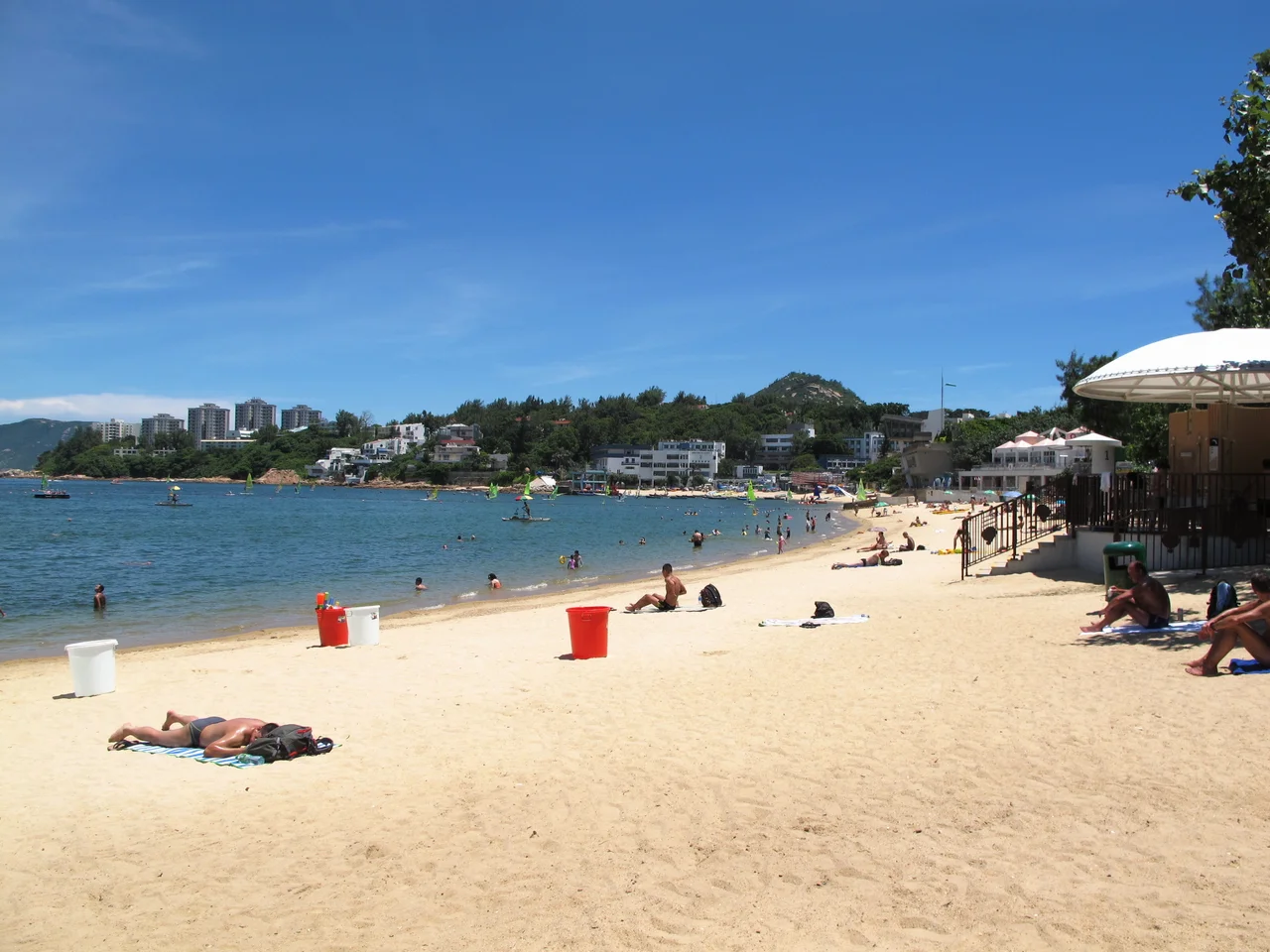

Stanley, Hong Kong
The Cantonese name came first: 赤柱, Chek Chue, Red Pillar. The characters appear on a map drawn sometime between 1577 and 1595, during the Ming dynasty, before any European ship had anchored in the bay. The name may refer to reddish rocks that stand erect when seen from the water, or to the red flowers of the Bombax ceiba trees that once dominated the hillsides, or — according to one Qing dynasty story — to a single cotton tree that survived a typhoon so severe it stripped the bark and left the trunk bare and crimson. The original meaning has been lost. What remains is the name, and the town that grew around it, and the improbable collection of things that coexist here: beaches, prisons, dragon boat races, a wartime internment camp, the southernmost point of Hong Kong Island, and a market that draws tourists from every corner of the world.
Red Pillar, First Capital
When the British occupied Hong Kong Island in 1841, the village of Chek-chu was already the most populous settlement on the island — around 2,000 people, most of them Tanka fishing families who used the shelter of Stanley Bay and Tai Tam Bay to ride out typhoon seasons. The British renamed it Stanley, after Lord Stanley, Colonial Secretary at the time of Hong Kong's cession to the United Kingdom and later Prime Minister, and declared it the colony's first capital before relocating the administrative centre to the newly founded Victoria City. Within Stanley's first decades of British history, the military built a camp at Wong Ma Kok on native land, compensating displaced residents with a row of eight small houses that became known as Pat Kan — Eight Houses. The Tin Hau Temple on Stanley Main Street, built in 1767 to serve fishing families, predates the British era entirely; a bell cast that year still hangs inside. The Old Stanley Police Station, built in 1859, is a declared monument.
The Weight of December 1941
For many visitors, Stanley's wartime history is what resonates most. The Battle of Hong Kong ended at Stanley Fort on Christmas Day 1941, when British and Canadian troops surrendered after a siege that had lasted eighteen days. The same day, soldiers of the Imperial Japanese Army entered St. Stephen's College — which had been converted into a military hospital — and killed wounded British, Canadian, and Indian soldiers and medical personnel in what became known as the St. Stephen's College massacre. Approximately 100 people died. From January 1942 until the Japanese surrender in August 1945, the grounds of the college and Stanley Prison held about 2,800 civilian internees — men, women, and children of non-Chinese Allied nationalities — in conditions of sustained hardship. The Stanley Military Cemetery on the hillside above St. Stephen's Beach holds 598 wartime graves, including those of internees who died of disease and malnutrition, and the 14 people killed when an American aircraft accidentally bombed a camp bungalow in January 1945.
A Town of Contrasts
Modern Stanley wears its contradictions easily, the way old places do when they have had enough time to absorb everything that happened to them. The market on Stanley New Street draws visitors shopping for clothing, souvenirs, and linens in narrow lanes of small stalls. Murray House, a Victorian officers' quarters originally built in 1846 in what is now the Central business district, was dismantled stone by stone and reassembled here during the 2000s — an act of architectural transplantation that is very Hong Kong. The waterfront along Stanley Main Street holds bars and restaurants whose tables face the bay. Behind the amphitheatre in Stanley Plaza stands the Tin Hau Temple, built by Cheung Po Tsai in 1767, one of the oldest temples in Hong Kong. The contrast between the temple's antiquity and the McDonald's fifty metres away is not ironic; it is simply what Stanley is. Pop star Teresa Teng owned a house at 18 Carmel Road and lived there until her death in May 1995 in Chiang Mai, Thailand; her former home was briefly a museum, then demolished.
Prisons, Beaches, Hiking Trails
Stanley is also, not incidentally, home to one of Hong Kong's largest prison complexes. Stanley Prison — maximum security, established in 1937 — anchors a cluster of correctional institutions that includes Pak Sha Wan, Tung Tau, and Ma Hang. The Correctional Services Museum, at the entrance to the complex, is free and open to the public most days. The peninsula's two beaches serve a different constituency: Stanley Main Beach draws windsurfers and dragon boat crews for the annual championships in June; St. Stephen's Beach, on the western shore, is quieter and rates Grade 1 for water quality. Above the town, Rhino Rock — Che Pau Teng — is a rhinoceros-shaped granite outcrop reachable by a short but occasionally disorienting hike that takes a little over an hour. The Wilson Trail, Hong Kong's long-distance hiking route, begins in Stanley and heads north over The Twins and Violet Hill. A sizeable French expat community settled here in the late 2000s. The red taxis that serve Stanley are the same vehicles that run across Hong Kong Island; there is no MTR station, and the buses over the hills are the only connection to the city.
From the Air
Stanley sits at approximately 22.2167°N, 114.2167°E on the southern side of Hong Kong Island, roughly equidistant between the island's eastern and western coasts. The Stanley Peninsula is the most prominent southward extension of Hong Kong Island and is easily identified from altitude — a tapering headland with the town and market on its northern half and the fort at its southern tip. Hong Kong International Airport (VHHH) is on Lantau Island approximately 30 km to the northwest. Recommended viewing altitude: 2,000–4,000 ft for the full peninsula shape; 1,500 ft to distinguish the beaches, fort, and internment camp area.
Nearby Stories
- Lok Ma Chau Loop 2.3 km away
- Portas do Cerco 2.3 km away
- Kweilin Incident 17 km away
- Wanshan Archipelago Campaign 34 km away
- Nanxiong Formation 115 km away
- Battle of Nanpeng Island 148 km away
- Heyuan 169 km away
- Cape Maobitou 632 km away