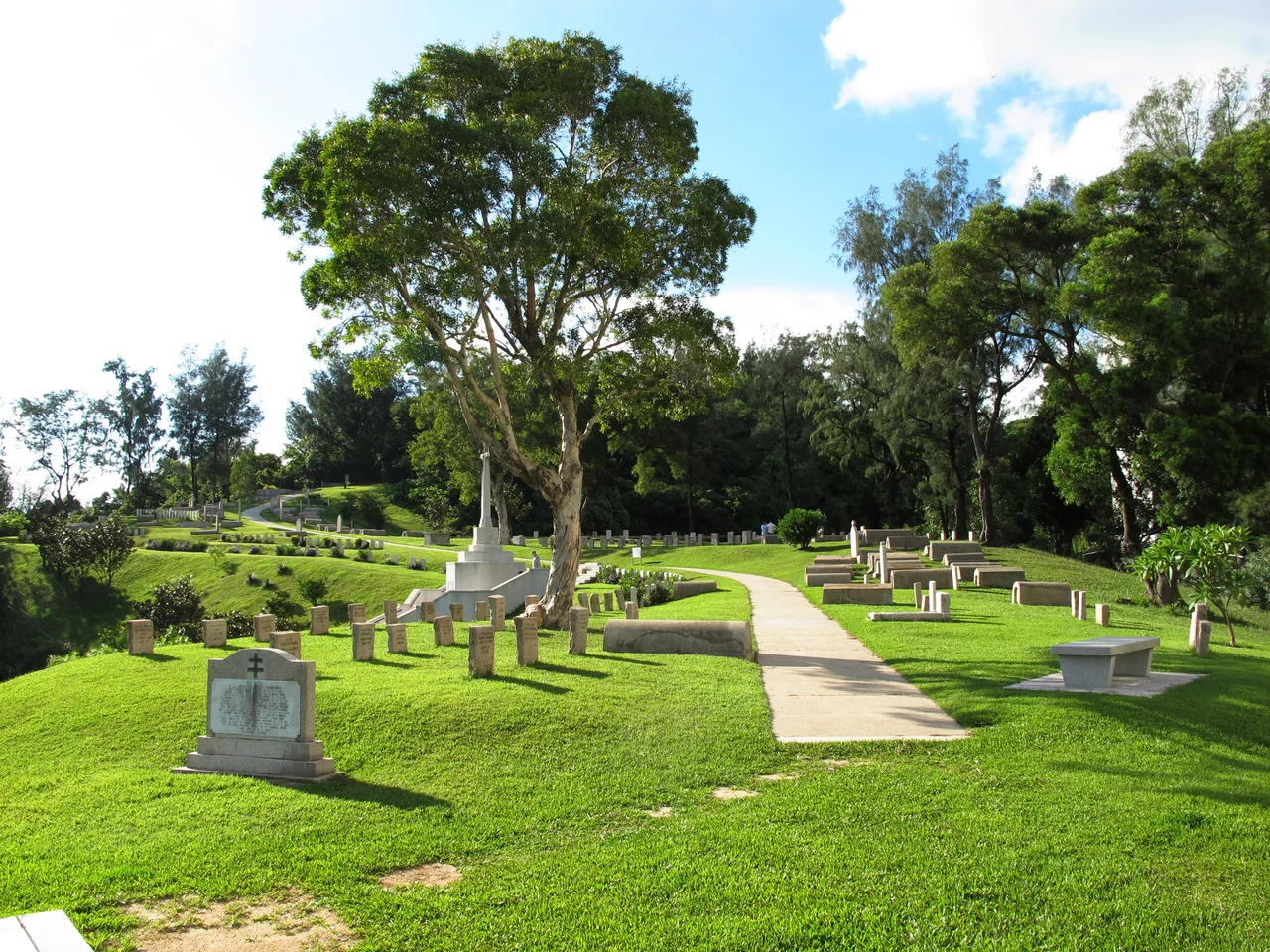

Stanley Military Cemetery
Christmas Day 1941 was not peaceful in Stanley. As Japanese forces pushed south through Hong Kong Island toward the sea, D Company of the Royal Rifles of Canada fought to hold Bungalow C — and the fighting spilled into a cemetery on a steep hillside above St. Stephen's Beach. Men died among the headstones of soldiers who had died before them, some as far back as 1841. That grim detail captures something essential about Stanley Military Cemetery: it has never been separate from the violence of its era. It is the place where Hong Kong's defenders fell, were buried, and are still remembered.
A Hundred Years Before the War
The cemetery began as a colonial burial ground — one of the earliest in Hong Kong, dating to 1841, just months after Britain established its foothold on the island. For twenty-five years, soldiers and their families were interred here on a triangular plot of land that rises sharply from the roadside, approached by a flight of stone steps leading up to a Cross of Sacrifice flanked by steep grassy slopes. Then the burials stopped. For seventy-five years the hillside rested, the early graves slowly greening over, the names on the stones fading in the humid South China air. The cemetery had the feel of a place that history had finished with. It was wrong about that.
Christmas Day, 1941
Japan invaded Hong Kong on 8 December 1941. Seventeen days later, on Christmas afternoon, the British surrendered — but not before fierce resistance at Stanley Village, one of the last points to hold. The Royal Rifles of Canada, elements of the Hong Kong Volunteer Defence Corps, and sections of the Middlesex Regiment had been stationed in the area. When D Company of the Royal Rifles tried to drive Japanese forces from Bungalow C, they fought through the cemetery grounds themselves. Some of the men who died in those final hours of resistance were buried here within days, their graves dug quickly by fellow prisoners. Those graves — raw and improvised, with headstones fashioned from whatever stone their fellow internees could find — are still preserved in their original shape. The informality is the point: it records exactly what it was like to bury the dead under occupation.
The Weight of 598
After the Japanese surrender in 1945, wartime fatalities from across the Stanley area were re-interred here, bringing the total to 598 World War II burials. Of those, 175 are unidentified — a headstone for each, but no name. Ninety-six were civilian internees, including four children. Among the named dead is Eric Moreton, a Methodist missionary who died of wounds suffered while driving an ambulance in Wanchai during the fighting near the Royal Naval Hospital on 26 December 1941. His choice to keep driving through the gunfire was his last. A small number of Canadian soldiers from C Force are here as well — men who arrived in Hong Kong just three weeks before the invasion began, with little time to understand the territory they were being asked to defend.
The George Cross and the Aid Group
Some of those buried or commemorated at Stanley died not in combat but in captivity, for refusing to stop resisting. Captain M.A. Ansari of the 5/7th Rajput Regiment was held at Ma Tau Chung POW Camp after the surrender. From there, he coordinated covertly with the British Army Aid Group, a network that helped prisoners of war escape to China and supplied intelligence to resistance forces operating in Japanese-occupied territory. The Japanese discovered his activities. Ansari was executed and posthumously awarded the George Cross — Britain's highest civilian decoration for bravery, given when no military honour applies. He was not alone: Colonel Lance Newnham of the Middlesex Regiment, Major John Alexander Fraser, Captain Douglas Ford of the Royal Scots, and Flight Lieutenant Hector Gray of the Royal Air Force each received the George Cross for the same reason. Their names are on the stones here.
What the Hillside Holds
There are three commemorations at the cemetery for casualties of the First World War — men from the Hong Kong Volunteer Defence Corps and the Chinese Labour Corps whose graves elsewhere in the territory have since been lost. The cemetery also holds some post-war burials in a separate plot. The larger concentration of World War II military dead is at Sai Wan War Cemetery in Chai Wan, but Stanley holds something Sai Wan does not: the graves of the civilian internees who died in the camp, the unidentified soldiers whose names the war erased, and the physical traces of that improvised, desperate burial under occupation. Walking up the stone steps to the Cross of Sacrifice, the steep grassy slopes dropping away on either side, it is still possible to feel how alone this place must have seemed in December 1941.
From the Air
Stanley Military Cemetery sits at approximately 22.2135°N, 114.2160°E on the southern tip of Hong Kong Island, on a hillside above St. Stephen's Beach near Stanley Village. Flying into Hong Kong International Airport (VHHH) from the east, the Stanley Peninsula is visible as a narrow strip of land extending south into the South China Sea. Recommended viewing altitude for the area is 3,000–5,000 feet. The cemetery itself is a small, triangular green plot on rising ground above the coastal road — look for the white Cross of Sacrifice on the upper terrace. Victoria Peak (552m) is roughly 9km to the northwest. The Repulse Bay coastline lies just west.
Nearby Stories
- Lok Ma Chau Loop 2.3 km away
- Portas do Cerco 2.3 km away
- Kweilin Incident 17 km away
- Wanshan Archipelago Campaign 34 km away
- Nanxiong Formation 115 km away
- Battle of Nanpeng Island 148 km away
- Heyuan 169 km away
- Cape Maobitou 632 km away