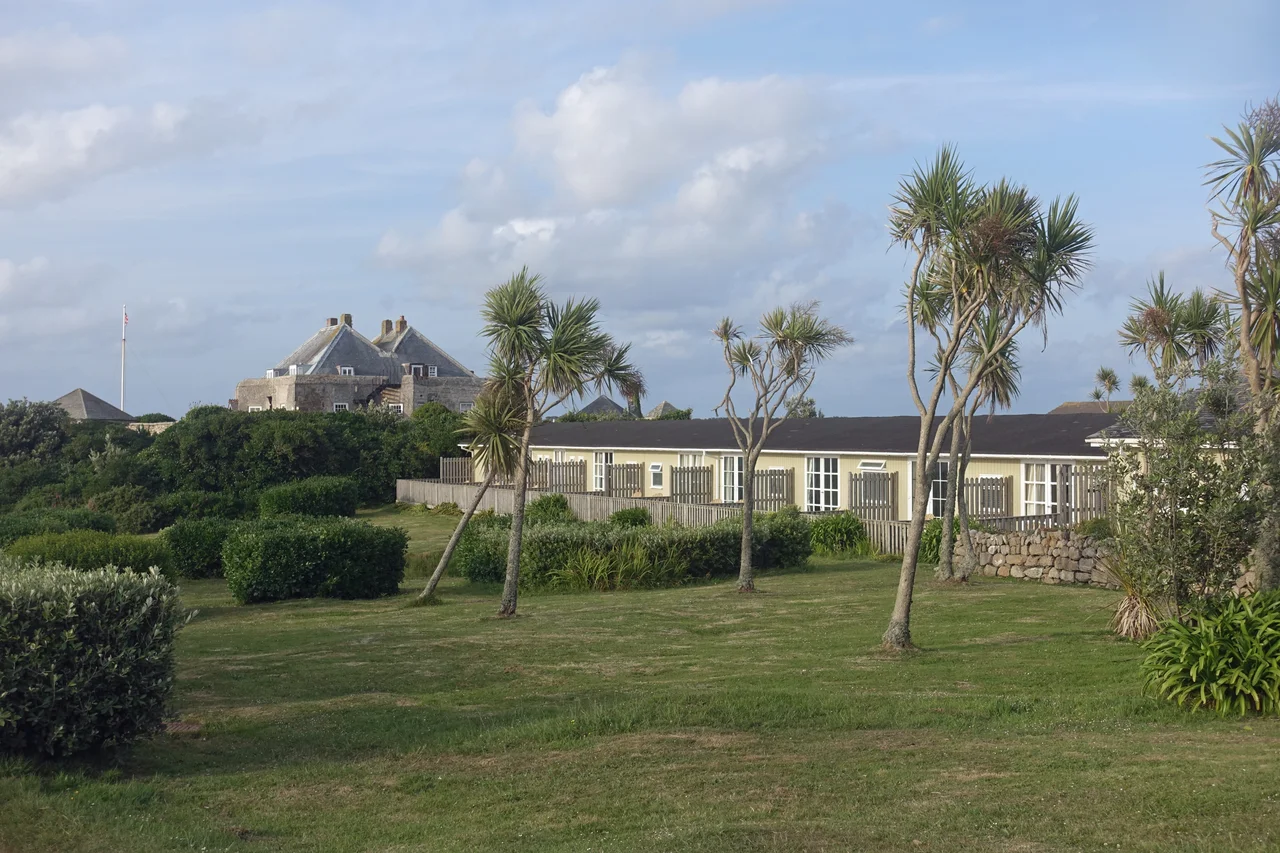

Star Castle, Isles of Scilly
The walls have eight points, like a child's drawing of a star. From the air the shape is unmistakable: a stone star plonked down on the green headland called the Hugh on the western side of St Mary's, with the Atlantic on three sides and Hugh Town tucked into the sandy isthmus behind it. Star Castle was finished in 1593, five years after the Spanish Armada was beaten and English commanders still expected Philip II to send another fleet. He never did. The castle remained, the threat receded, the eight-pointed plan went out of fashion - and today the building is a hotel, where guests sleep inside walls built to watch for invasion ships that never came.
A Queen's Order
In May 1593, five years after the Armada had scattered around Scotland, Queen Elizabeth I gave the order: build a fort on the Scilly Isles, and add two sconces - small lookout works - to watch for any Spanish sail. The Surveyor of the Royal Works, the mapmaker Robert Adams, drew the plan. Francis Godolphin, Captain of the Scilly Isles, oversaw the work on the ground. The site they chose was Hew Hill, the steep granite outcrop on the west side of St Mary's, which commanded the open Atlantic approaches and the only sheltered anchorage on the island. By 1594 the castle was finished, and Adams was dead a year later. The fort he left behind would be the most important defensive position in the islands for nearly two centuries.
The Eight-Pointed Star
Star forts were a sixteenth-century answer to a sixteenth-century problem. Round towers gave cannonballs flat surfaces to bounce off, but they also created blind spots at the base of the wall where attackers could approach unseen. By breaking the walls into a star with re-entrant angles, defenders could rake every approach with crossing fire from neighbouring bastions. Star Castle's eight-pointed plan is unusually pure - most star forts had four, five, or six points, with the points often elongated into spear-shaped bastions. Here the eight points are equilateral, and the geometry is so clean that the shape now appears on the flag of the Council of the Isles of Scilly. The castle is a Grade I listed building, the highest level of protection English law offers, along with three other structures in the fort complex - the bastions and walls, the powder magazine, and the outer walls. They are the only Grade I listings in the whole archipelago.
Abraham Tovey's Garrison
The castle itself was just the keep. Around it spread the Garrison - an outer wall enclosing the whole Hew Hill outcrop, studded with gun batteries at regular intervals so that every angle of approach could be covered. In 1740, Master Gunner Abraham Tovey rebuilt much of this perimeter, including Colonel Boscawen's Battery, in a circular pattern that followed the coastline of The Hoe. By then the threat had shifted: French and Spanish privateers, not invasion fleets, were the worry, and the Scillies sat directly on the southwestern approaches to the Channel. In the eighteenth century the castle was garrisoned by troops from the Corps of Invalids - veteran soldiers no longer fit for field service but still capable of standing watch and working a cannon. The Corps was a Georgian-era solution to what to do with old soldiers, and a remote granite fort with sea on three sides was about as quiet a posting as the Army could provide.
From Fortress to Hotel
By the twentieth century the castle had long since outlived its military purpose. The Garrison still wrapped the hilltop, the batteries still pointed seaward, but the only ships passing now were the Penzance steamer and the inter-island launches. In 1933 the castle was converted into a hotel, and it has been operating as one ever since. Guests check in through the original sixteenth-century gateway, sleep in rooms inside the star's points, and eat dinner in a Great Chamber that still has its original fireplace. The hotel's rooms occupy what was once a barracks; the bar was once a powder magazine. You can walk the Garrison wall after dinner with a glass of wine and look out across the Atlantic at the same horizon Francis Godolphin's lookouts watched in 1593, scanning for Spanish sail that never appeared.
From the Air
Star Castle sits at 49.9154 N, 6.32103 W, on the western headland of St Mary's, Isles of Scilly. From the air the eight-pointed star plan is the single most recognisable feature on the island - even at altitude the geometry resolves clearly when light is low. The castle stands above Hugh Town to the east and overlooks the western Atlantic approaches. Nearest airport is St Mary's (EGHE), one nautical mile east of Hugh Town. The whole Scilly archipelago is unmistakable in clear weather: a cluster of low islands ringed by white sand and turquoise shallows, thirty miles southwest of Land's End. Best viewing altitude 1,500 to 3,000 ft AGL for a clear read of the fortifications. Surrounding Garrison wall traces the contour of Hew Hill.
Nearby Stories
- Penlee Lifeboat Station 5.5 km away
- Black Swan Project 20 km away
- Tater Du Lighthouse 25 km away
- The Brisons 31 km away
- 1979 Fastnet Race 54 km away
- SM U-27 110 km away
- HMS Affray 149 km away
- Tower of Hercules 700 km away