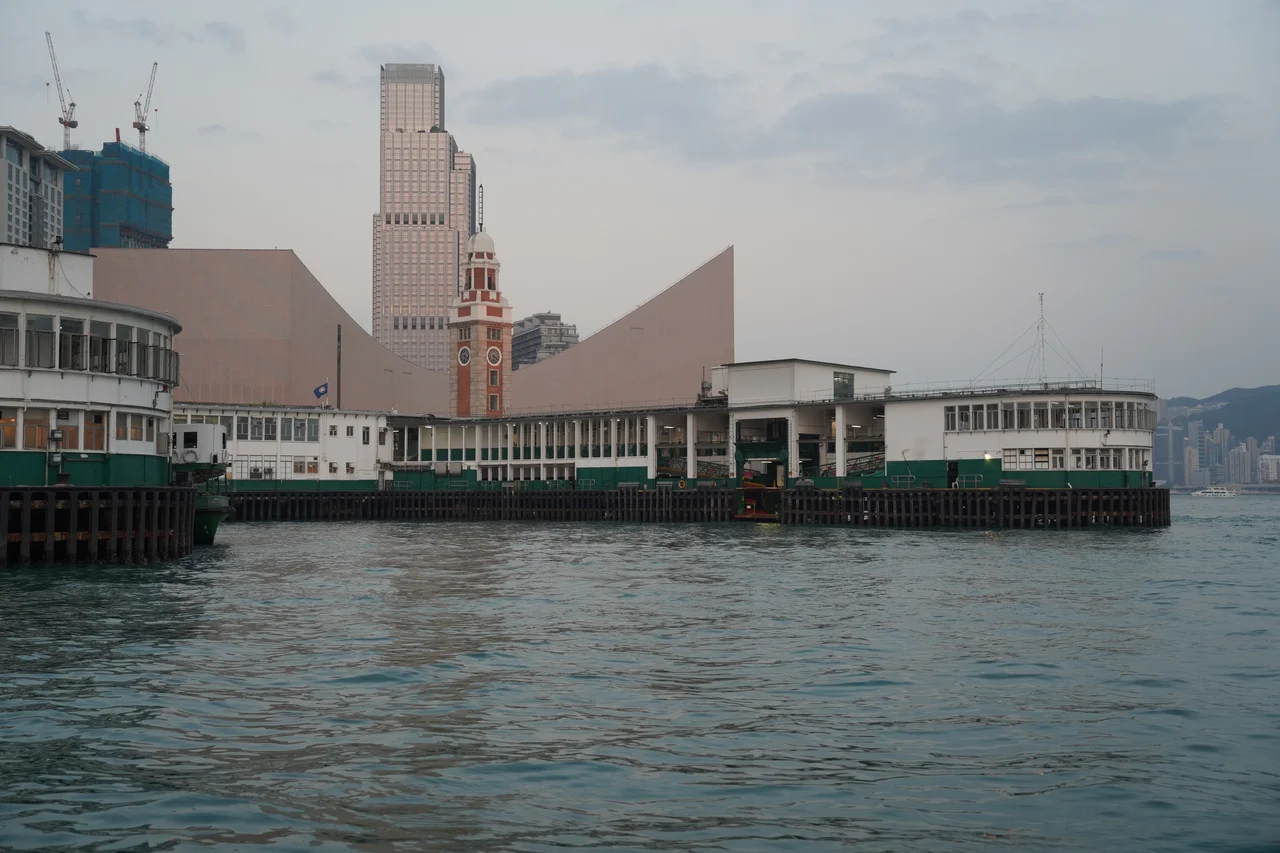

Star Ferry Pier, Tsim Sha Tsui
The view from Tsim Sha Tsui pier faces south across Victoria Harbour toward Hong Kong Island — and it is, by most measures, one of the finest urban views on earth. The skyline opposite changes constantly; towers go up, cranes move, the horizon thickens. The pier itself stays mostly the same. Built in 1957 on reclaimed land at the absolute tip of the Kowloon Peninsula, it has outlasted its counterpart on the Hong Kong Island side, which was demolished in 2006. The Tsim Sha Tsui pier is the survivor, still standing, still boarding passengers on two levels, still watching the harbour that defines the city it serves.
The Pier That a Typhoon Destroyed
The first pier on this site opened in 1906, after land reclamation had extended Salisbury Road south enough to make a waterfront terminal possible. Construction had begun in 1904, and the design was a simple finger pier reaching into the harbour. It lasted less than a year. A typhoon struck in September 1906 and destroyed the structure entirely. The replacement — designed for two ferries, more robustly built — was completed in 1914 and served the crossing through the early decades of the twentieth century. In the early 1950s, construction began on the current structure, a twin-piered terminal completed in 1957. It opened in coordination with the third-generation Edinburgh Place Ferry Pier on the Hong Kong Island side: two Streamline Moderne buildings, one on each shore, completing each other across the water.
Kowloon Point
The Star Ferry franchise identifies the Tsim Sha Tsui terminal by its geographic designation: Kowloon Point. The name is exact. The pier sits at the southernmost accessible tip of the Kowloon Peninsula, which means it is as close to the middle of Victoria Harbour as you can get while still standing on Kowloon ground. The structure is bi-level, like its Hong Kong Island counterpart — upper deck boarding costs slightly more than the lower. The two levels are supported by wood pilings driven into the reclaimed seabed. Unlike the Central pier, there is no clock tower on the Tsim Sha Tsui building itself, though the landmark Clock Tower of the former KCR Kowloon railway station stands a short distance away, easily visible from the pier's upper deck.
The Neighbourhood the Pier Anchors
Step off the Tsim Sha Tsui ferry and the surroundings press in immediately. Star House is directly to the north, with Ocean Terminal and its cruise ship berths beyond. The Hong Kong Cultural Centre — the angular, windowless building that provoked its own architectural controversy when it opened in 1989 — faces the waterfront to the west. The Five Flag Poles between the pier and Star House serve as a casual meeting point, the kind of landmark that exists in every city for people who need somewhere unambiguous to find each other. A bus terminus at the foot of Salisbury Road connects to routes across Kowloon and New Kowloon. Inside the pier itself there are newsstands, a shop selling Star Ferry models and souvenirs, an HSBC branch, and a Hong Kong Tourism Board information counter — the small commerce of a transit point that has been handling arrivals and departures for over a century.
The Crossing from the Kowloon Side
What makes Tsim Sha Tsui pier distinctive is the direction it faces. When you board here and cross to Central, you are crossing from the mainland peninsula — however loosely — toward the island. Kowloon was ceded to Britain in 1860, Hong Kong Island in 1842; the New Territories came in 1898. The ferry has been crossing between these historically distinct territories since 1888. On the upper deck, facing south toward the island, the skyline builds from left to right: the Wan Chai towers, then Central's taller concentration, then the hillside rising steeply behind. At night, the Tsim Sha Tsui waterfront promenade to the east is lit for its nightly Avenue of Stars. The pier sits at the edge of all of it, unchanged by the transformations accumulating in every direction.
From the Air
Star Ferry Pier, Tsim Sha Tsui is located at approximately 22.2940°N, 114.1690°E at the southern tip of the Kowloon Peninsula, directly across Victoria Harbour from Central on Hong Kong Island. Approaching Hong Kong International Airport (VHHH) on Lantau Island from the west, the Kowloon waterfront is prominent on the left side of the final approach corridor. Recommended viewing altitude for the harbour area is 2,000–4,000 feet. The pier is identifiable at the tip of the peninsula, with the Hong Kong Cultural Centre and the distinctive Clock Tower (a standalone historic structure, not attached to the pier) visible immediately to the west. The harbour crossing to Central Pier 7 runs approximately southwest.
Nearby Stories
- Lok Ma Chau Loop 2.3 km away
- Portas do Cerco 2.3 km away
- Kweilin Incident 17 km away
- Wanshan Archipelago Campaign 34 km away
- Nanxiong Formation 115 km away
- Battle of Nanpeng Island 148 km away
- Heyuan 169 km away
- Cape Maobitou 632 km away