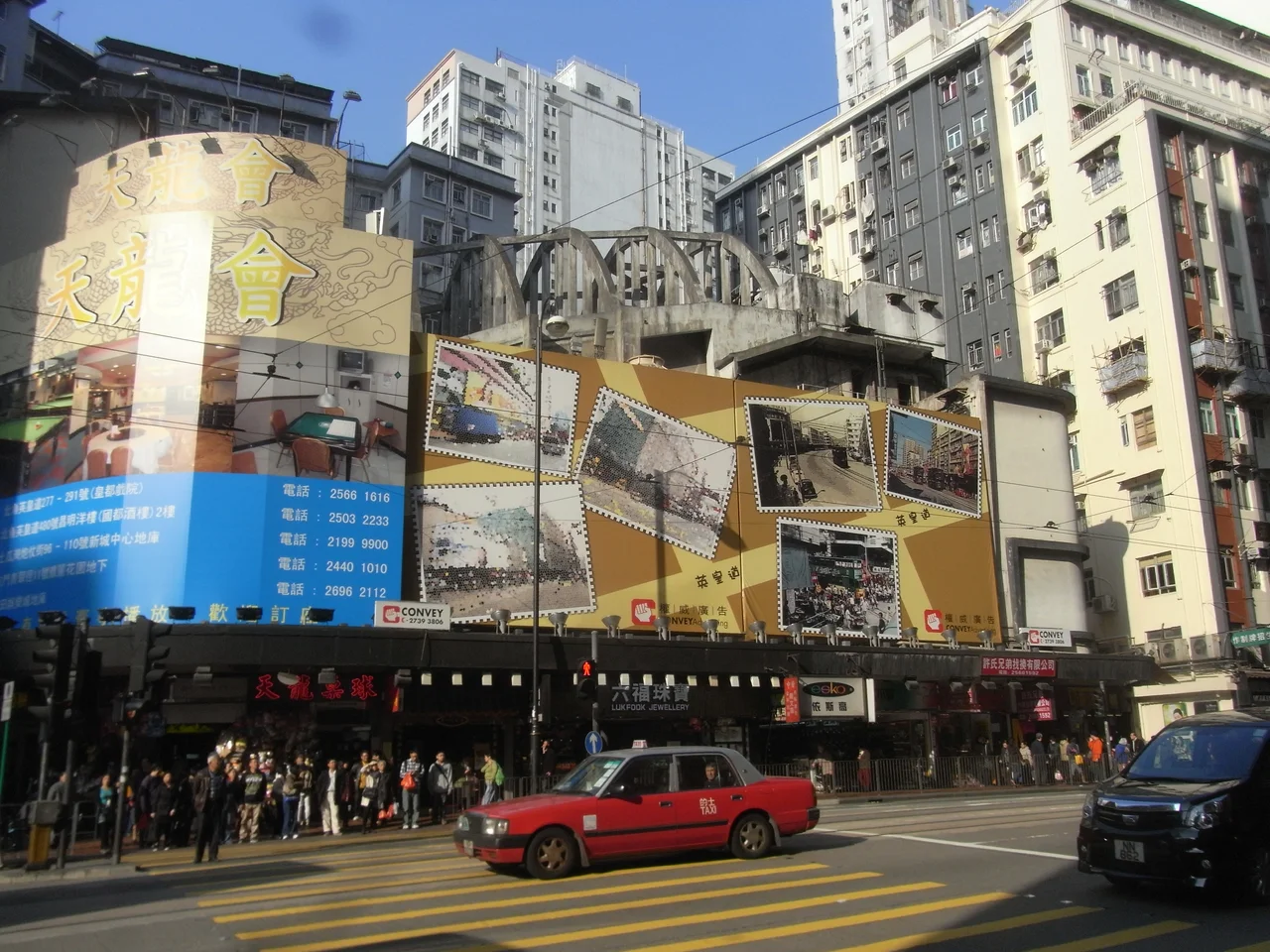

State Theatre (Hong Kong)
The ticket booth at the State Theatre's April 2021 exhibition gave out vintage-style stubs to visitors walking into a former cinema that had not shown a film since 1997. Old seats, movie posters, and the preserved shopfront of the State Hair Salon filled the lobby—curated relics from a building whose demolition had seemed certain just a few years earlier. That the State Theatre was still standing at all was the result of an unlikely chain of events: international conservation pressure, a government advisory board overruling its own staff, and an architect's report containing a candid admission that officials had been guessing about the building's internal structure. Hong Kong's heritage battles rarely end so neatly, but this one did.
Empire Into State
The building that would become the State Theatre opened in December 1952 as the Empire Theatre, designed by architects George W. Grey and Liu Sun-fo. It operated under that name for only five years before closing in 1957. After extensive renovations it reopened in 1959 under its new identity—State Theatre—and ran for nearly four more decades. The name change coincided with a period when North Point, on the northeastern shore of Hong Kong Island, was becoming one of the city's more densely settled districts. The theatre anchored the King's Road streetscape at numbers 277 to 291, a solid mid-century presence among the shops and apartment blocks. When it finally closed in 1997, the year of Hong Kong's handover to China, the symmetry felt almost deliberate—though it was almost certainly coincidence.
The Arches That Saved It
What makes the State Theatre architecturally unusual is its roof: a series of "parabola-like" concrete arches spanning the auditorium, visible above the roofline and described by conservationists as unique among surviving cinemas in Hong Kong. When New World Development began buying out the ground-floor tenants in July 2015—a prelude to demolition and redevelopment—Docomomo International, the international non-profit dedicated to documenting and conserving modern architecture, added the building to its "Heritage in Danger" list in March 2016. The move attracted significant public attention in Hong Kong. Heritage groups including Walk in Hong Kong, Docomomo Hong Kong, and the Conservancy Association issued a joint statement urging the Antiquities Advisory Board to grant the theatre its highest protection. The arches, visible and structurally expressive, gave conservationists a concrete, photogenic argument.
The Board Meeting That Changed Everything
The Antiquities Advisory Board convened on 18 April 2016 to determine the theatre's grade. The government's own Antiquities and Monuments Office had assessed the building's interior as substantially altered, its original function lost, and its heritage value relatively low—a recommendation against Grade I status. During the meeting, however, board members pressed the AMO with follow-up questions. Officials admitted they had not fully examined the internal structural changes and had been making an informed guess. The board overruled the AMO's recommendation and voted to designate the State Theatre a Grade I historic building. It was an unusual outcome: a government body overturning its own specialist advice based partly on the admission that the advice wasn't solid. In March 2017, the designation became official.
Conservation, Compromise, and the Movies
With Grade I status secured, the conversation shifted to what the State Theatre might become. Architects WilkinsonEyre and Purcell were appointed to lead the conservation project; Variety reported in 2021 that the restoration was expected to take five years. Proposals had ranged from an indoor sports facility with rock climbing and zip-lining to a shared community space. The April 2021 exhibition—"Finding your, my, his or her State"—drew visitors with an instinct for nostalgia and gave New World Development a way to shape the narrative before construction work began. The theatre also carries its own minor film history: Bruce Lee's posthumously released 1978 film Game of Death was shot partly here, and director Fruit Chan used it in his 1998 film The Longest Summer. The arches endure; the films remain.
From the Air
The State Theatre sits at approximately 22.290°N, 114.195°E on King's Road in North Point, on the northeastern shore of Hong Kong Island. From the air, North Point's dense mid-rise housing blocks form a distinctive band along the waterfront, with Victoria Harbour immediately to the north. The building is not easily distinguishable from altitude, but the North Point waterfront—including the power station chimney stacks visible for many years—provides orientation. Hong Kong International Airport (VHHH) is located on Lantau Island roughly 35 km to the west. Visual approaches over the harbour from the northeast bring North Point into view at 2,000–4,000 feet. The building is best visited from ground level via North Point MTR station.
Nearby Stories
- Lok Ma Chau Loop 2.3 km away
- Portas do Cerco 2.3 km away
- Kweilin Incident 17 km away
- Wanshan Archipelago Campaign 34 km away
- Nanxiong Formation 115 km away
- Battle of Nanpeng Island 148 km away
- Heyuan 169 km away
- Cape Maobitou 632 km away