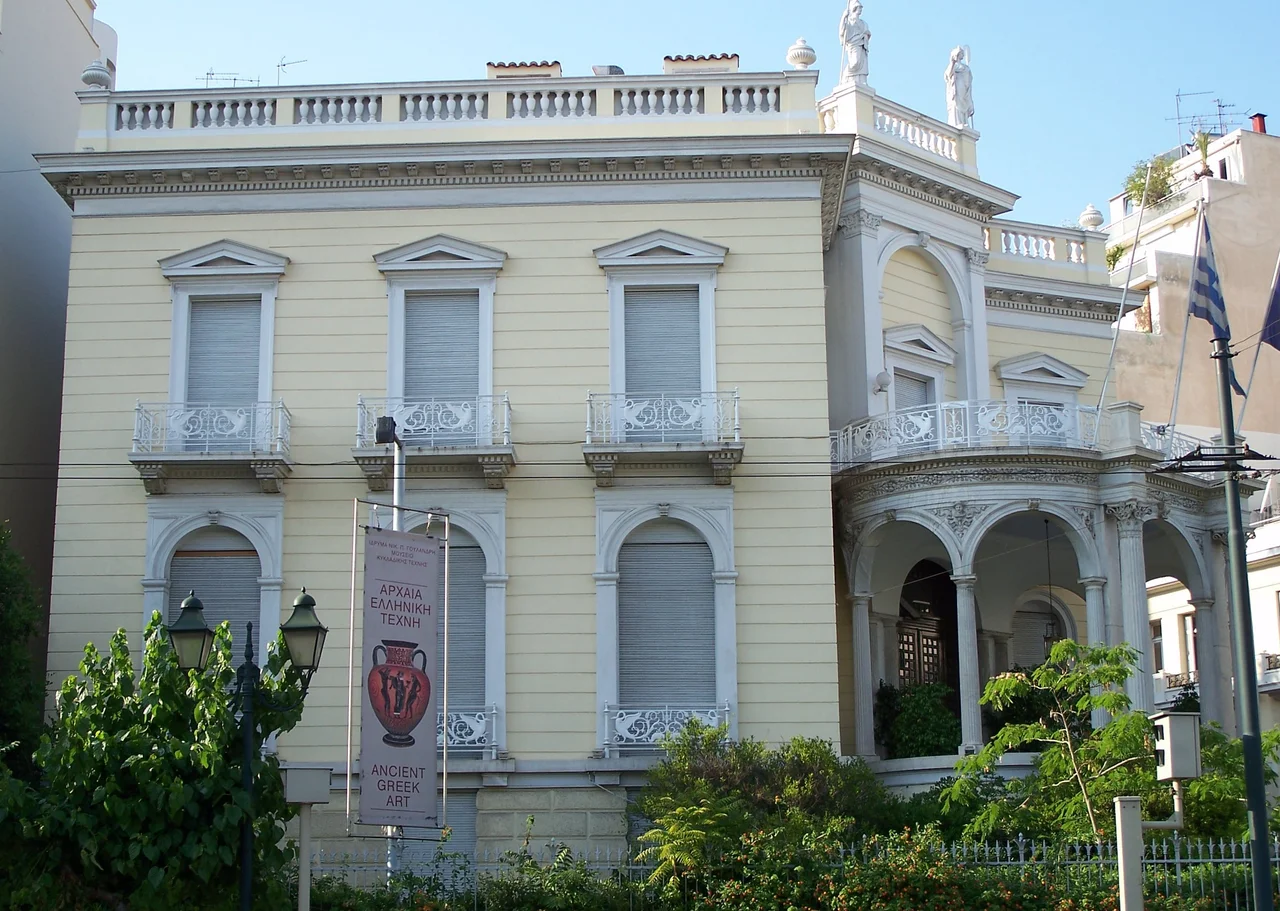

Stathatos Mansion
Walk down Vasilissis Sofias Avenue, the broad boulevard that carries Athens' embassies and ministries past the Benaki Museum toward the National Garden, and one facade stops you. The Stathatos Mansion presents a curved colonnaded entrance unlike anything around it - Tuscan and Corinthian columns supporting a canopy of eight vaults, the whole composition reaching out toward the street like an offered hand. It was built in 1895 as a private home, and in the century and a quarter since it has been almost everything else: an embassy for three different nations, an officers' club, and finally a museum. Few houses in Athens have changed costume so many times while keeping the same elegant bones.
The German Who Built Greek Athens
The mansion is the work of Ernst Ziller, a Saxon-born architect who arrived in Greece and never really left, becoming a naturalized citizen and the most prolific designer of nineteenth-century Athens. Ziller's hand is everywhere in the modern capital - palaces, theaters, the homes of the wealthy - all rendered in the neoclassical idiom that the young Greek state had adopted to link itself visually to its ancient past. In 1895 he designed this villa for Othon and Athina Stathatos, a prosperous family who wanted a home worthy of the city's grandest avenue. The result carries every neoclassical signature: strict symmetry, geometric order, the disciplined use of the ancient Greek and Roman column orders, and a restrained elegance of line. It was a house built to be looked at, and to look like it belonged among temples.
An Entrance Made to Impress
The most studied feature of the building is the entrance itself, the element that ties the mansion's two nearly symmetrical wings into a single confident statement. Its plan is unusual - a rectangle flanked by two semicircles along its long sides, an oval embrace projecting toward the street. Four columns of the plain Tuscan order and four composite columns carry the roof above it, a canopy resolved into eight vaults. Two Corinthian columns, the most ornate of the classical orders, mark the stairs that climb to the covered porch, drawing the eye and the visitor upward. Inside, the wings connect through a cylindrical atrium, a circular light-filled core that organizes the rooms around it. It is architecture as choreography, every column and curve directing how a guest arrives.
A House of Many Flags
A home this prominent rarely stays private, and the Stathatos Mansion did not. In the decades after it was built, it passed from one official tenant to the next, its rooms hosting the business of nations. It first housed the Bulgarian Embassy. In 1945, in the unsettled aftermath of the Second World War, it became a club for British officers. The Canadian Embassy rented it until 1970, after which the Libyan legation occupied it for four years. Each tenant came and went, and the villa absorbed them all - a single elegant address that flew, in turn, the flags of Bulgaria, Britain, Canada, and Libya, a quiet barometer of the alliances and diplomacy passing through twentieth-century Athens.
From Cyclades to the Boulevard
Today the mansion has found its most fitting role. It belongs to the Museum of Cycladic Art - properly the Goulandris Museum of Cycladic Art - the Athens institution devoted to the spare, abstract marble figurines carved in the Cycladic islands some five thousand years ago, the smooth folded-arm forms whose minimalism astonished and influenced modern artists like Brancusi and Modigliani. The Stathatos Mansion serves as the museum's grand annex, its neoclassical halls used for special exhibitions and events, connected to the main building behind it. There is a pleasing symmetry to the arrangement: a house built to evoke the marble grandeur of the ancient Greek world now shelters the work of artists who shaped marble thousands of years before the Parthenon, in the islands scattered across the Aegean to the south.
From the Air
The Stathatos Mansion stands on Vasilissis Sofias Avenue in central Athens at 37.976°N, 23.743°E, roughly a kilometer east of Syntagma Square along the city's embassy corridor. From the air the avenue is a clear diagonal artery lined with green space near the National Garden; the mansion sits among the dense neoclassical and institutional buildings flanking it. The nearest airport is Athens International (LGAV), about 28 km to the east-southeast. Central Athens is controlled airspace - best appreciated at street level rather than from the cockpit.
Nearby Stories
- Great Sand Beach 5 km away
- Battle of Delium 7.7 km away
- Tower of Aliartos 9 km away
- HMHS Britannic 10 km away
- Saronic Gulf 15 km away
- Sousaki Volcano 17 km away
- Sanctuary of Apollo Maleatas 24 km away
- Skyros 66 km away