![Photo: [2] | CC BY-SA 2.0](https://commons.wikimedia.org/wiki/File:Avenue_of_Stars_Hong_Kong_Bruce_Lee_Statue.jpg)
Statue of Bruce Lee (Hong Kong)
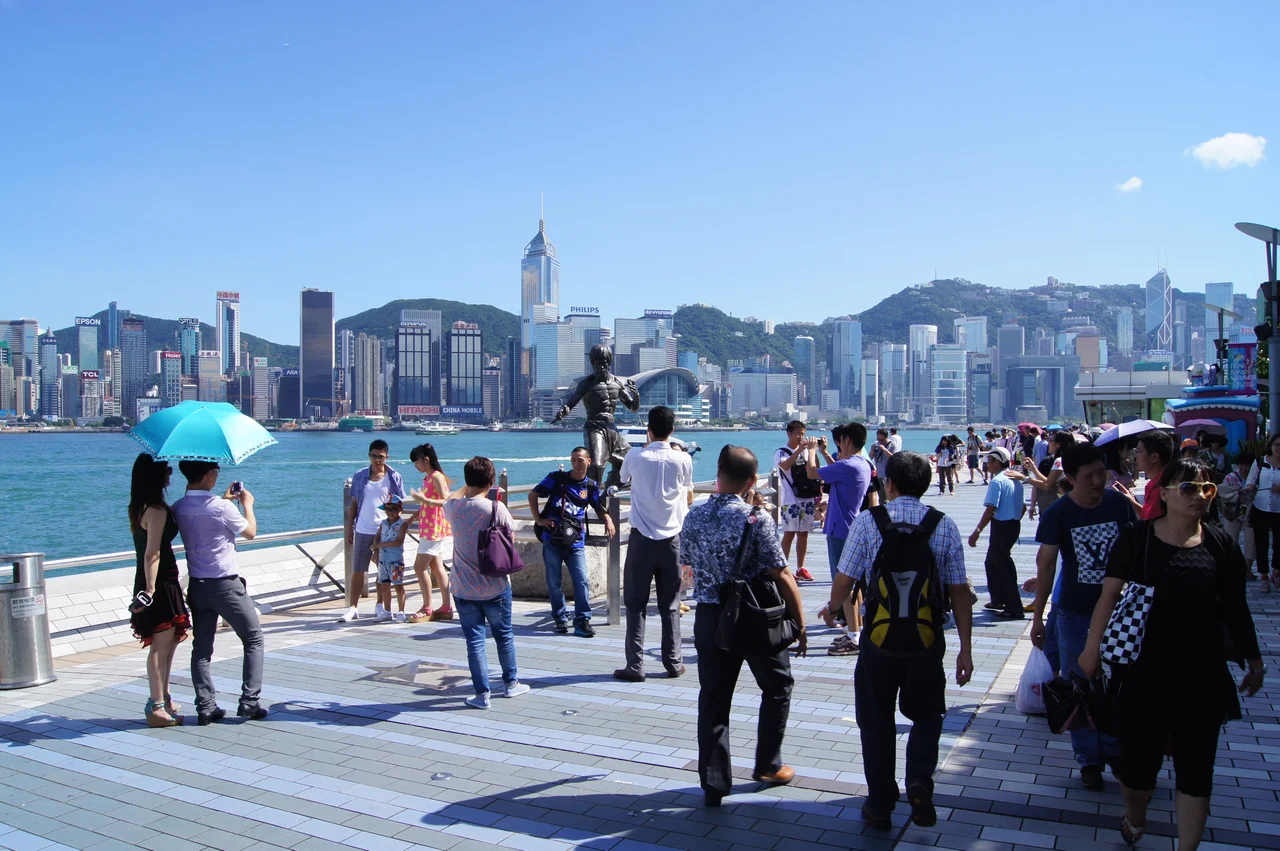
Bruce Lee died on 20 July 1973, thirty-two years old, in Hong Kong—the city where he had grown up, learned to fight, and made the films that would define martial arts cinema for decades. The Hong Kong Bruce Lee Club spent years petitioning the government to honour his memory with a permanent statue. When that campaign stalled, they raised US$100,000 themselves. The result, unveiled on 27 November 2005—what would have been Lee's 65th birthday—stands 2.5 metres tall on the Avenue of Stars along the Tsim Sha Tsui waterfront, its bronze arms raised in the ready-to-strike pose from his 1972 film Fist of Fury. His brother Robert Lee did the honours at the unveiling.
A Fan Club's Campaign
The Hong Kong Bruce Lee Club's effort to secure a permanent memorial was not a quick process. Pleas to the government to recognize Lee's legacy formally went unanswered for years. Rather than wait, the club took the practical route: fundraising. They gathered US$100,000 to commission a bronze sculpture from artist Cao Chong-en, who captured a pose instantly recognizable to anyone who has seen Lee's early 1970s films—weight shifted, arms forward, the compact readiness that made Lee's screen presence so distinctive. Hew Kuan-yau, a member of the club's committee, expressed the intent plainly: "We want the people to know about the legend of Bruce Lee." The statue arrived on the Avenue of Stars as part of Hong Kong's effort to position its waterfront promenade as a celebration of local and regional film culture.
The Man the Bronze Represents
Bruce Lee was born in San Francisco in 1940 and raised in Hong Kong, where he trained in Wing Chun under Ip Man and became a child actor in local films. He moved to the United States as a young man, taught martial arts, and eventually broke through in Hollywood—first as Kato in The Green Hornet television series, then as the star of films produced in Hong Kong: The Big Boss, Fist of Fury, The Way of the Dragon, and Enter the Dragon. His physical precision, philosophical seriousness about martial arts, and charismatic screen presence made him a global figure. He died in Hong Kong before Enter the Dragon was released, and Game of Death was completed posthumously. That a city-funded memorial proved elusive for decades after his death is one of those historical oddities that the fan club's determination eventually corrected.
The Waterfront Setting
The Avenue of Stars stretches along the southern edge of Kowloon, facing Victoria Harbour and the Hong Kong Island skyline. The setting matters. From the promenade, the view takes in the Central and Wan Chai towers on the far shore, the ferry traffic on the harbour, and—on clear nights—the neon and LED light show that Hong Kong has made its signature. The Bruce Lee statue stands among handprints and nameplates of Hong Kong film stars embedded in the pavement, but it is the most immediately three-dimensional presence on the strip. Visitors consistently stop here: for photographs, for the associations, for something harder to name. The statue has appeared as a location marker on multiple seasons of The Amazing Race—American, Norwegian, and Canadian editions—partly because the pose is globally legible, no caption required.
65th Birthday, Bronze Weight
The date of the unveiling—27 November 2005—was chosen deliberately to coincide with what would have been Bruce Lee's 65th birthday. His brother Robert Lee performed the ceremony. The choice of a birthday rather than a death anniversary signals something about the intent: this was meant as a celebration rather than a mourning. Cao Chong-en's sculpture renders Lee in the Fist of Fury fighting stance, a pose from the film in which Lee's character avenges the death of his master against both foreign fighters and corrupt Chinese collaborators—a film with a specific emotional register in Chinese-speaking communities. The statue carries that register lightly, but it is there. What visitors see most immediately is the kinetic energy of the pose: not a man at rest, but a man about to move.
From the Air
The Bruce Lee statue stands at approximately 22.296°N, 114.176°E on the Tsim Sha Tsui waterfront in Kowloon, facing Victoria Harbour. From the air, Tsim Sha Tsui is the southernmost point of the Kowloon Peninsula, identifiable by the clock tower of the former Kowloon Station and the Hong Kong Cultural Centre's distinctive angled roof immediately to the northwest. The Avenue of Stars runs along the waterfront promenade east of the Cultural Centre. Hong Kong International Airport (VHHH) is approximately 30 km to the west-northwest on Lantau Island. Approaching from the west over the harbour, the Kowloon waterfront is visible at 2,000 feet and above. The statue is not distinguishable from altitude but the surrounding waterfront infrastructure provides clear geographic orientation.
Nearby Stories
- Lok Ma Chau Loop 2.3 km away
- Portas do Cerco 2.3 km away
- Kweilin Incident 17 km away
- Wanshan Archipelago Campaign 34 km away
- Nanxiong Formation 115 km away
- Battle of Nanpeng Island 148 km away
- Heyuan 169 km away
- Cape Maobitou 632 km away