_-_801.jpg)
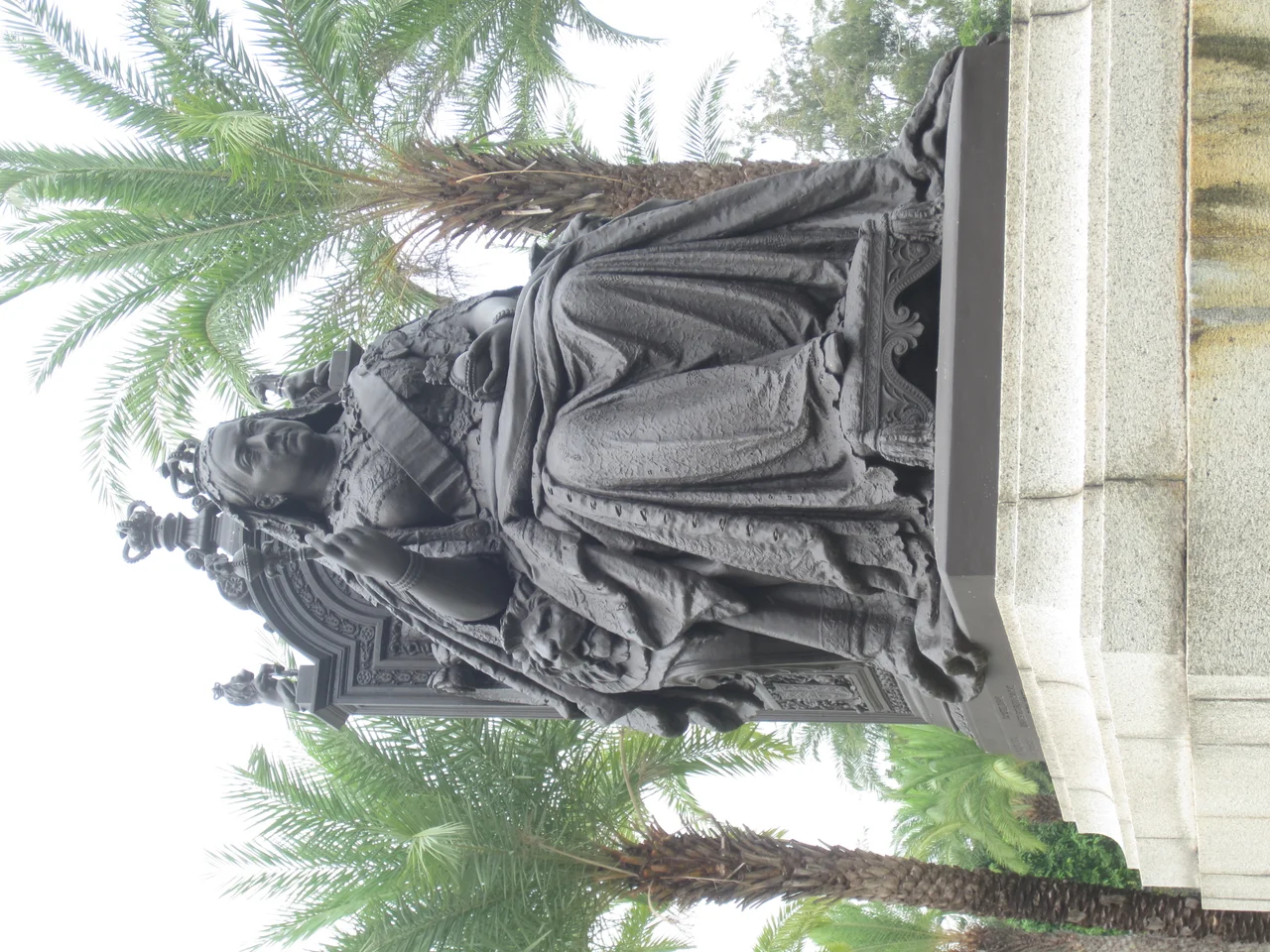
Statue of Queen Victoria, Hong Kong
In 1996, as Hong Kong counted down its final year as a British colony, artist Pun Sing-lui climbed up to the bronze statue of Queen Victoria in Victoria Park and poured red paint over it. Then he smashed its nose with a hammer. Pun, a recent immigrant from mainland China, intended the act as a protest against what he called "dull colonial culture" and a call for "cultural reunification with 'red' China." Critics called it an attack on Hong Kong culture—a reminder that the statue, by then, meant something different to different people. The repair cost HK$150,000. Pun's protest landed in the newspapers; the statue survived, its nose restored, and it stands in the park today.
Cast in Pimlico, Unveiled in Central
The statue of Queen Victoria was created by sculptor Mario Raggi and cast in Pimlico, London—an area known in the Victorian era for its workshops and artisans. It was shipped to Hong Kong and installed at the centre of Statue Square in Central, the colony's main business and civic district. Governor William Robinson unveiled it on 28 May 1896, the day officially designated to mark Queen Victoria's 77th birthday. The occasion also connected the statue to the Queen's Golden Jubilee of 1887, which had originally inspired plans for a central square of royal statues. There was a production error: the original specification had called for marble, but the bronze statue was nearly complete before anyone noticed the discrepancy. The work went ahead in bronze regardless, and the mistake became invisible once the statue took its place of honour on the square.
War and Disappearance
When Japan occupied Hong Kong during World War II, the occupying forces removed the statues from Statue Square and shipped them to Japan to be melted for the war effort. Queen Victoria's statue made that journey alongside the other bronze figures that had accumulated in the square over the decades—statues of Prince Albert, the Duke of Connaught, Edward VII, and others. The war ended. The occupation ended. Queen Victoria's statue came back; the others did not. Why only this one returned has never been fully explained, but the result was that a statue cast in London, installed in Hong Kong, shipped to Japan, and brought back to Hong Kong became the unlikely survivor of an entire colonial sculptural programme. In 1952, after restoration, it was placed not in Statue Square but in Victoria Park in Causeway Bay, near the Causeway Road entrance.
A New Address, a Different Context
Victoria Park is a large public green space in Causeway Bay, one of Hong Kong's most densely populated districts. It hosts Lunar New Year flower markets, sports facilities, weekend gatherings of Filipino domestic workers on their days off, and a steady stream of joggers and families. The statue of Queen Victoria stands near the park's Causeway Road entrance—a Victorian bronze in a thoroughly contemporary urban park, its imperial context mostly stripped away by the setting. Most visitors walk past without stopping. Occasional school groups examine the plaque. The statue is, in this sense, a very different object from what it was when it stood at the centre of Statue Square, presiding over the colony's civic heart. Geography has a way of changing meaning.
Red Paint and Restored Nose
Pun Sing-lui's 1996 attack on the statue was described in Hong Kong newspapers as vandalism out of step with public sentiment. The handover to China was approaching, and Hong Kong's identity politics were complex: many residents who supported the handover also valued the colonial-era built environment as part of Hong Kong's own history. Pun, who had recently arrived from the mainland, framed his action as anti-colonial; many in Hong Kong read it as aggression against their city rather than against empire. The statue was repaired at a cost of HK$150,000, its nose reconstructed and the surface cleaned. The episode became a footnote in the handover period's crowded archive of symbolic acts—but a revealing one, demonstrating how much freight a single bronze figure from Pimlico had accumulated across a century of Hong Kong history.
From the Air
The statue of Queen Victoria stands at approximately 22.281°N, 114.189°E inside Victoria Park in Causeway Bay, on the northern shore of Hong Kong Island. Causeway Bay is one of the densest commercial and residential districts on the island, recognizable from the air by its tightly packed mid-rise and high-rise towers east of the Wan Chai convention centre complex. Victoria Park itself—a rectangular green space—is visible from altitude as one of the few open areas in this part of the island. Hong Kong International Airport (VHHH) is on Lantau Island roughly 35 km to the west. Approaching from the east or northeast over the harbour, the Causeway Bay typhoon shelter and the causeway leading to the Cross-Harbour Tunnel provide orientation at 2,000–4,000 feet.
Nearby Stories
- Lok Ma Chau Loop 2.3 km away
- Portas do Cerco 2.3 km away
- Kweilin Incident 17 km away
- Wanshan Archipelago Campaign 34 km away
- Nanxiong Formation 115 km away
- Battle of Nanpeng Island 148 km away
- Heyuan 169 km away
- Cape Maobitou 632 km away