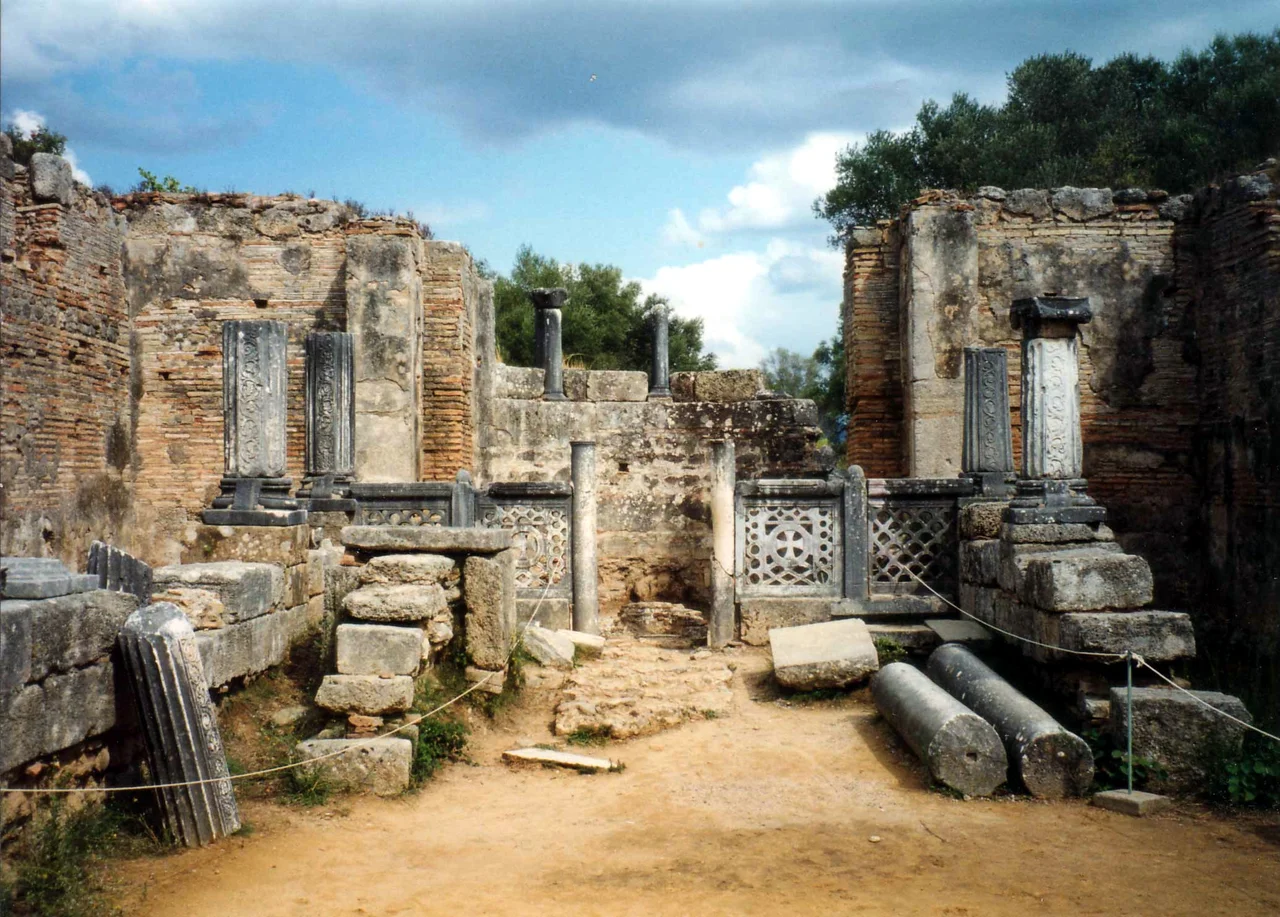

Statue of Zeus at Olympia
The Roman general Lucius Aemilius Paullus had defeated kingdoms and commanded armies. When he entered the Temple of Zeus at Olympia around 167 BC and saw Phidias's statue of the god, he was, according to the historian Livy, 'moved to his soul, as if he had seen the god in person.' Plutarch records that Aemilius later declared Phidias had 'molded the Zeus of Homer.' The orator Dio Chrysostom went further, writing in the 1st century AD that a single glimpse of the statue would make a man forget all his earthly troubles. We have no photographs, no bronze cast, no marble copy to verify these claims. The Statue of Zeus at Olympia — one of the Seven Wonders of the Ancient World — is gone. What survives is a handful of coin images, a detailed description by Pausanias, and the testimony of people who were undone by it.
What Phidias Built
The statue was commissioned in the latter half of the 5th century BC by the Eleans, custodians of the Games, for their newly constructed Temple of Zeus. They hired the sculptor Phidias, who had already made the massive gold-and-ivory Athena Parthenos for the Parthenon in Athens. His Zeus, completed around 435 BC, was a chryselephantine sculpture — ivory plates and gold panels laid over a wooden framework. The technique was the highest artistic achievement of the age, used only for the most important cult images.
Zeus sat enthroned. The statue was approximately 12.4 meters tall — so large it occupied half the width of the temple's interior aisle. Strabo, writing in the 1st century BC, observed that if Zeus arose and stood upright, he would unroof the building. The throne itself was carved from cedarwood and ornamented with ebony, ivory, gold, and precious stones. In his right hand Zeus held a small chryselephantine statue of Nike, the goddess of victory. In his left, a scepter inlaid with many metals supported an eagle. His gilded robe was made from glass panels carved with animals and lilies. Golden sandals rested on a footstool decorated with an Amazonomachy in relief.
Pausanias, who saw the statue in the 2nd century AD, records that it was kept constantly coated with olive oil to protect the ivory from the dampness of the Altis grove. The floor in front of the image was paved with black tiles and surrounded by a raised marble rim to contain the oil.
The Sculptor's Touch
Phidias left traces of himself inside the work. He reportedly carved the inscription Pantarkes kalos — 'Pantarkes is beautiful' — into Zeus's little finger, honoring the winner of the boys' wrestling event at the 86th Olympiad, described in ancient sources as the sculptor's beloved. A relief at the feet of the statue showed the same boy crowning himself.
When the statue was finished, Pausanias tells us, Phidias prayed to Zeus to show by a sign whether the work was to the god's liking. A thunderbolt then struck the floor of the temple at a spot subsequently marked with a bronze jar — left there, as Pausanias says, 'down to the present day.' Whether this was a genuine atmospheric event or a story the temple priests found useful is not recorded.
The approximate date of the statue's creation was confirmed in the 20th century. Excavations from 1954 to 1958 uncovered Phidias's workshop, located west of the Altis enclosure directly opposite the Temple of Zeus — roughly where Pausanias said the statue had been constructed. Archaeologists found tools for working gold and ivory, ivory chippings, precious stones, and terracotta molds — many of the latter used to form the glass panels of the statue's robe. A drinking cup inscribed with the Greek letters meaning 'I belong to Phidias' was found at the site, though some scholars consider the inscription a later addition.
Caligula's Threat, and Worse
The statue's existence became politically complicated almost from the moment Roman power reached Greece. The historian Suetonius records that the Emperor Caligula — reigning from 37 to 41 AD — ordered the heads removed from statues across Greece, including that of Zeus at Olympia, so that his own likeness could be substituted. Caligula was assassinated in 41 AD before the order could be carried out. The statue reportedly marked the occasion with a peal of laughter so loud that the scaffolding erected for the head-removal collapsed and the workmen fled — a story that reflects how much the statue's fate mattered to the people of its time.
In 391 AD, the Christian emperor Theodosius I banned participation in pagan cults and closed the temples. The sanctuary at Olympia fell into disuse. What happened to the statue after that is genuinely unclear. The Byzantine historian Georgios Kedrenos, writing in the 11th century, records a tradition that the statue was carried to Constantinople, where it was destroyed in a fire at the Palace of Lausus in 475 AD. An alternative account holds that it perished with the temple itself, which was severely damaged by fire in 425 AD. The satirist Lucian of Samosata, writing in the 2nd century, already speaks of the statue in terms suggesting it had been damaged or robbed — putting the loss potentially even earlier.
Known Only from Description
No copy of the Statue of Zeus at Olympia survived in marble or bronze. Coin images from nearby Elis and scattered Roman engravings give approximate impressions of the enthroned figure, but none of them were made to scale or capture the detail that made the original overwhelming. We are left entirely dependent on Pausanias's written description and the testimony of writers who struggled to convey what the statue did to the people who saw it.
That gap — between what we can reconstruct intellectually and what the original would have actually meant, standing in a dim temple, twelve meters tall, gilded and ivory-pale, with the god's expression aimed somewhere above your head — is the essential historical problem of the Seven Wonders. All of them are gone. The Zeus of Phidias was perhaps the hardest loss: not a monument to a ruler or a feat of construction, but an attempt to make the divine physically present. Whether it succeeded is a question only the ancients could answer, and they answered it, almost unanimously, in the affirmative.
From the Air
The site of the Temple of Zeus and Phidias's workshop at Olympia lies at approximately 37.638°N, 21.630°E, within the Altis sacred precinct. The nearest major airport is LGRX (Araxos), approximately 40 km to the north-northeast. The workshop of Phidias was located west of the main temple area (outside the Altis enclosure, directly opposite the Temple of Zeus) and was excavated from 1954 to 1958; it is visible as a distinct structure west of the sanctuary grounds. Recommended viewing altitude: 2,000–4,000 feet AGL. Approach from the west over the Alpheios River gives the clearest view of the entire sanctuary enclosure. The large rectangular foundation of the Temple of Zeus is the dominant feature of the site from the air.
Nearby Stories
- Santameri Castle 4.6 km away
- Aristarchos 2.3 m Telescope 4.8 km away
- Lepreum 9.1 km away
- Arcadia (region) 13 km away
- Peloponnese 14 km away
- St. Mark's Roman Catholic Church 20 km away
- Strofades 22 km away
- County Palatine of Cephalonia and Zakynthos 39 km away