
Statue Square
The name Statue Square is, today, almost ironic. Where a dozen bronze kings, queens, dukes, and governors once stood in a gallery of colonial self-congratulation, there is now exactly one freestanding statue: Sir Thomas Jackson, 1st Baronet, chief manager of the Hongkong and Shanghai Banking Corporation, unveiled in 1906. The rest—Queen Victoria, Prince Albert, Edward VII, the Duke of Connaught, George V, Queen Mary—were loaded onto ships by Japanese occupying forces during World War II and sent to Japan to be melted. Only Queen Victoria came back. The square that bears the name of absent statues is, in its way, a monument to how thoroughly a single war reshaped what Hong Kong chose to keep.
Built on the Sea
Statue Square did not exist until the harbour was pushed back. The square was built at the end of the nineteenth century on land reclaimed by the Praya Reclamation Scheme, carved from the shallow margins of Victoria Harbour. The man who conceived the idea of a square of royal statues was Sir Catchick Paul Chater, a Calcutta-born businessman of Armenian descent who had become one of the colony's most influential property developers. He imagined a formal civic space worthy of the empire, and called it—initially—"Royal Square." It gradually acquired the informal name Statue Square as the bronze figures accumulated. Chater donated the statue of the Duke of Connaught himself, erected in 1902. The site was entirely artificial—sea floor turned into paving stone—but it became the symbolic centre of British Hong Kong, ringed by banks, government offices, and the Hong Kong Club.
A Square Full of Royalty
Between the 1890s and the 1920s, Statue Square accumulated an extraordinary density of bronze. Queen Victoria was first, unveiled in 1896. Prince Albert arrived before 1902. Thomas Jackson's statue followed in 1906. The Duke of Connaught's was moved to the waterfront in 1907 to make room for new arrivals: the future King George V (then Prince of Wales), donated by Hongkong Electric director John Bell-Irving and unveiled by the Duke of Connaught on 6 February 1907. Queen Mary's bronze, by sculptor George Edward Wade, was unveiled on 25 November 1909. A statue of Edward VII by the same sculptor completed what had become a dynastic survey in bronze. Sir Henry May, the 15th Governor of Hong Kong, joined them in 1923. On the square's northeastern edge, a replica of the Cenotaph in Whitehall was unveiled the same year—Empire Day, 24 May 1923—by Governor Reginald Edward Stubbs.
What the Occupation Removed
When Japan occupied Hong Kong in December 1941, the territory would remain under occupation for nearly four years. The occupying forces systematically removed metal objects to support Japan's wartime industrial needs, and the statues of Statue Square were among them. Nearly every bronze figure was loaded out and shipped to Japan. After the war, the search for the missing statues produced one return: Queen Victoria's statue came back to Hong Kong in 1952 and was placed in Victoria Park. Sir Thomas Jackson's statue also survived, having apparently escaped removal. The HSBC lions—the two bronze lions guarding the bank's headquarters on the square's southern edge—likewise remained. Why these objects were spared while others were not is not clearly documented. The statues of Prince Albert, Edward VII, George V, Queen Mary, Henry May, and others were never found.
The Square as It Is
Today Statue Square is split by Chater Road into a northern and southern section. The HSBC headquarters—the celebrated Norman Foster building completed in 1985—rises along the southern side. The Court of Final Appeal Building anchors the eastern edge of the southern section; a 2.7-metre blindfolded figure of Themis, Greek goddess of justice, stands atop its pediment and faces the square. On Sundays, the open paving of Statue Square and the surrounding streets become a gathering place for tens of thousands of Filipino domestic workers on their weekly days off—a use of the space that the colonial planners never anticipated and that has become one of the city's most distinctive social rituals. Sir Thomas Jackson stands in the middle of it all, facing the Court of Final Appeal, an HSBC banker presiding over what was meant to be a gallery of kings.
Buildings That Outlasted Their Names
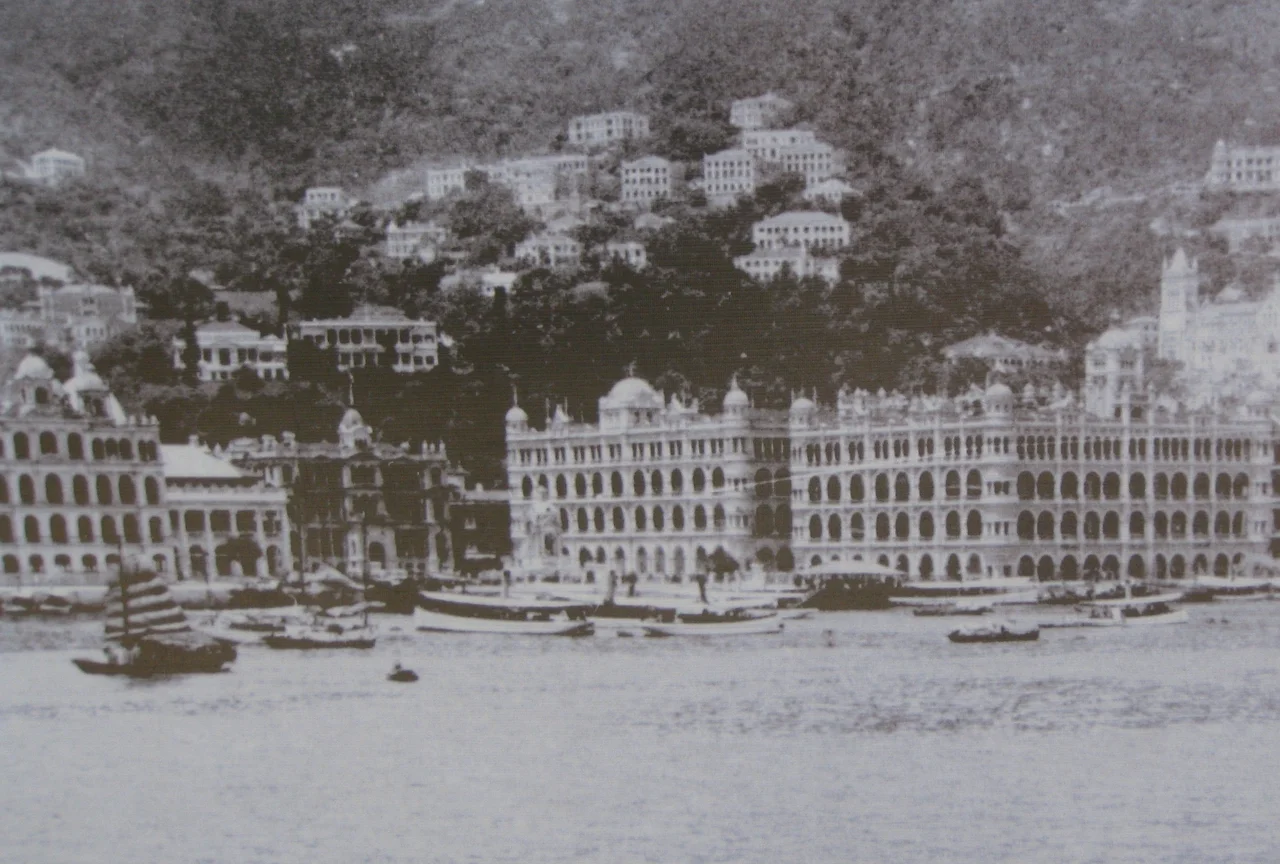
The western edge of Statue Square once hosted a sequence of royally named buildings—Prince's Building, Queen's Building, King's Building, St. George's Building, Alexandra Building—that defined the skyline for most of the twentieth century. All have been replaced. The current Prince's Building dates to 1965; the Mandarin Oriental hotel stands where Queen's Building stood until 1961; Chater House occupies part of the King's Building footprint. The names persist as addresses, stripped of their original structures. To the north, the square was once bordered directly by Victoria Harbour, before land reclamation pushed the waterline back and created Edinburgh Place between the square and the water. The Star Ferry pier that once stood at Edinburgh Place was relocated in 2007. The square has been reshaped so many times—by reclamation, by demolition, by war—that its current form is essentially a palimpsest, each layer legible only to those who know where to look.
From the Air
Statue Square sits at approximately 22.282°N, 114.160°E in the Central district of Hong Kong Island, on the northern shore facing Victoria Harbour. From the air, Central is the most recognizable part of the Hong Kong skyline: the HSBC headquarters, the glass-and-steel Bank of China Tower, and the twin towers of the International Finance Centre form a dense cluster near the waterfront. Statue Square itself is the low-rise open space immediately north of the HSBC building, visible as a gap in the tower density. Hong Kong International Airport (VHHH) is on Lantau Island roughly 35 km to the west-northwest. Approaching from the west at 3,000–5,000 feet over the harbour, the Central skyline is unmistakable; the square is directly below the main cluster of glass towers. The Central MTR station Exit K provides direct surface access to the square.
Nearby Stories
- Lok Ma Chau Loop 2.3 km away
- Portas do Cerco 2.3 km away
- Kweilin Incident 17 km away
- Wanshan Archipelago Campaign 34 km away
- Nanxiong Formation 115 km away
- Battle of Nanpeng Island 148 km away
- Heyuan 169 km away
- Cape Maobitou 632 km away