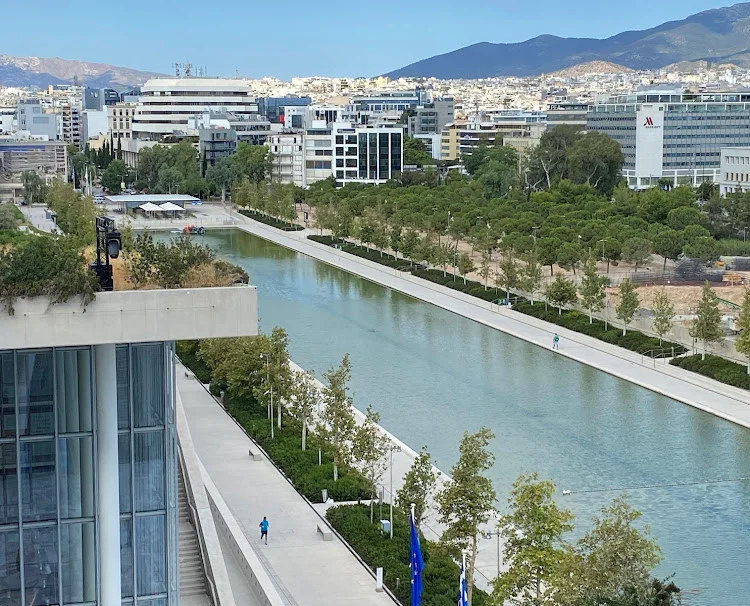

Stavros Niarchos Foundation Cultural Center
Stavros Niarchos made his fortune in shipping. He was one of the great Greek shipping magnates of the twentieth century, a figure of mythological scale in the postwar world of tankers and bulk carriers. When the foundation bearing his name decided to make a transformative donation to Greece, it did not choose a hospital or a school or an airport. It chose a cultural center. And when it chose an architect to design that cultural center, it did not choose a Greek architect building in a classical vein. It chose Renzo Piano, the Italian master of light and structure, and asked him to create something that Athens had never seen before.
A Gift Twenty Years in the Making
The Stavros Niarchos Foundation began planning a major donation to Greece in 1998. The initial concept was simpler: separate donations to the National Library and the National Opera, two institutions that had long outgrown their facilities and suffered from chronic underfunding. By 2006, the foundation had decided that bringing both institutions together into a single unified complex would generate something greater than the sum of its parts. The site chosen after discussions with the Greek state was the former Faliro Hippodrome — a horse-racing track on the coast southwest of Athens, tucked between the city and Faliro Bay on the Saronic Gulf. In 2008 Renzo Piano was selected as architect. Construction began in 2012. The $861 million project was completed in 2016 and formally donated to the Greek state in 2017.
Piano's Hill
Renzo Piano envisioned the Stavros Niarchos Foundation Cultural Center as something that emerged from the earth rather than being imposed upon it. His concept was an artificial hill rising gently from the coastal plain, with the roofs of the National Library and the National Opera appearing to grow from its slope — the library lower, the opera at the summit. The library roof is planted with indigenous Greek species; the opera roof culminates in a photovoltaic canopy, 100 meters by 100 meters, generating roughly 2 gigawatt-hours of electricity per year. Piano described the canopy as 'a cloud hovering over the highest point of the hill.' The roof structure is suspended with dampers engineered to increase its resilience during extreme weather events. The building's integration of landscape, light, and solar energy reflects Piano's career-long interest in architecture that responds to its natural and cultural context.
Library and Opera Under One Roof
The two institutions the complex houses are very different, but they share a certain condition: they are the principal guardians of Greece's intellectual and artistic heritage. The National Library of Greece holds millions of volumes and manuscripts in its collections, many of great historical importance. The Greek National Opera performs in a house designed for 1,400 people in the main auditorium, with a smaller 400-seat black box theatre for experimental and contemporary work. Before the SNFCC, both institutions operated in spaces that were inadequate and, in the library's case, genuinely deteriorating. The move to Faliro Bay gave both organizations facilities comparable to the great cultural institutions of Western Europe — and placed them in a building that won the RIBA Award for International Excellence 2018, having been the only Greek entry among 62 buildings from 30 countries shortlisted for the prize.
Obama's Speech and the Park's Promise
In November 2016, shortly after the complex opened, former US President Barack Obama visited Athens and chose the SNFCC as the venue for a major address on democracy — a speech in the country where democracy was invented, delivered inside a building that might be described as democracy's gift to itself, funded by private philanthropy and donated to the public state. The Stavros Niarchos Park surrounding the complex is open and free to all. Outdoor cinema screenings, concerts, and public events draw large crowds from across Athens. On the waterfront side, the adjacent Faliro Delta is being redeveloped as a coastal park called Aenaon, with completion expected in 2028. An Athens Metro extension to serve the SNFCC was also announced in 2021, which would make the complex significantly more accessible from the city center.
The Niarchos Legacy
Stavros Niarchos died in 1996. His foundation, established during his lifetime, has distributed billions of dollars in grants to education, health, arts, and culture around the world. The SNFCC is its largest single project — and arguably its most visible. There is something apt about the fact that it sits near the sea, in a port city, on a bay that has been a center of maritime commerce since antiquity. The shipping fortune that Niarchos accumulated from the same Aegean waters that Themistocles once commanded has been converted into concert halls, reading rooms, and a park where Athenians walk in the evening light. Money flows in, culture flows out. The exchange has worked well enough that Piano's cloud canopy now catches the sun above Faliro Bay, generating power, sheltering the arts, and pointing at something about what cities can become when the wealth they generate is redirected toward the people who live in them.
From the Air
The Stavros Niarchos Foundation Cultural Center is located at 37.94°N, 23.69°E in the Kallithea municipality, approximately 4 km south of central Athens on the Faliro Bay coastline. From altitude, the complex is recognizable by its distinctive artificial hill profile and the large photovoltaic canopy above the opera house — one of the largest solar installations on any cultural building in Europe. The green-planted roof and the open park grounds are visible against the dense urban fabric surrounding them. Athens International Airport (LGAV / Eleftherios Venizelos) lies about 25 km to the east. On approach to LGAV from the southwest, the SNFCC site is visible to the left — the coast of Faliro Bay curving away toward Piraeus, with the Acropolis prominent on its hill approximately 4 km to the north. Optimal viewing is at 3,000–6,000 feet with good visibility, which Athens typically offers in spring and autumn.
Nearby Stories
- Parnitha 3.4 km away
- Kea (island) 7.3 km away
- Sanctuary of Apollo Maleatas 11 km away
- Sousaki Volcano 12 km away
- Battle of Leuctra 14 km away
- Great Sand Beach 18 km away
- Agios Georgios (island) 23 km away
- Skyros 84 km away