
Stevenston
On 8 September 2007, somewhere between 1,500 and 1,700 tons of nitrocellulose, stored in an open area at the Nobel site at Ardeer, caught fire. There was little property damage. No serious injuries. The town that lives next door to one of the largest explosives works in British history had grown used to that kind of news. Stevenston, the eastern third of Ayrshire's Three Towns, sits where dune sand meets industrial chemistry, where the Firth of Clyde meets the leftover infrastructure of two centuries of dangerous work. A pleasant beach. A nature reserve. A factory making nitrocellulose. The combinations are oddly characteristic.
Bonnie Lesley and the Bonds of the Past
The town takes its name from Stephan Loccard, a twelfth-century landholder whose father had received a grant from Richard de Morville, Lord of Cunninghame and Constable of Scotland, around 1170. Stevenston first appears in a charter around 1240. Castle Hill at Hullerhirst may once have been a small stone tower. Flint tools have been pulled from the sands of Ardeer for generations. To the north stands the ruin of Kerelaw Castle, with eight hundred years of history behind its broken walls. Stevenston's most lyrical link is to Robert Burns. Mayville House was the birthplace in 1768 of Lesley Baillie, the woman Burns met in 1792 and described to a friend as the most beautiful, most elegant woman in the world. She inspired the love poems in which he calls her Bonnie Lesley. A memorial to her stands between Sinclair Street and Glencairn Street. Another nearby site held darker weight: Kerelaw House was once home to the family of Kenneth Campbell, the Saltcoats-born pilot awarded the Victoria Cross posthumously for an attack on the Gneisenau in 1941. The house was demolished in the early 1970s.
The First Commercial Canal in Scotland
The Stevenston Canal, cut in 1772, was the first commercial canal Scotland ever built. It was two miles long, twelve feet wide, four feet deep, lockless, and followed the line of an old sea channel from when Ardeer was an island. Branches reached out to the coalpits, and barges carried coal toward the coast, with the slag heaped along the banks as a windbreak against the constantly blowing sand. The pits were largely exhausted by the end of the nineteenth century; the last, Ardeer East, closed in 1926. The Master Gott, a drainage cut that the Revd Patrick Warner had laid out after returning from exile in Holland following the Battle of Bothwell Bridge, is now thought to be the canal's last visible vestige. There was also a quarry at Stevenston Stone, a fine white sandstone that travelled to Dublin and Belfast before the workings were allowed to flood in 1920. Parkend Quarry produced Osmond Stone, a heat-resistant whinstone used in oven linings. The hamlet of Piperheugh, now vanished, was famed for making trumps or Jew's harps, an oddly musical footnote to an industrial landscape.
Nobel, ICI, and the Long Shadow of Explosives
In the twentieth century, Stevenston became one of Britain's principal explosives towns. Nobel Industries, later absorbed into ICI, employed thousands at Ardeer making chemicals and high explosives. A nylon plant arrived in the 1960s; a nitric acid plant followed. The closure of these facilities, alongside the slow withdrawal of ICI from the town, had what the source article calls a devastating long-term effect. The site has since passed to Inabata, a Japanese trading firm, and operates as Nobel Enterprises, with the energetic-technologies side now under Chemring. Nitrocellulose manufacture continues. On the border of the Nobel plant stands Africa House, the South African Pavilion from the 1938 Empire Exhibition in Bellahouston Park. It was rebuilt at Ardeer after the exhibition closed and used for years as a staff restaurant; it is now derelict and fire-damaged. The earlier Stevenston Ironworks, five Glengarnock blast furnaces erected on the foreshore in 1849, attempted to build their own quay by dumping slag into the sea. Three hundred yards in, they realised no ship could safely dock against the winter storms. The remains are still called the old pier, or slag point. The works closed in 1931.
Sand, Beach, and the People Who Stayed
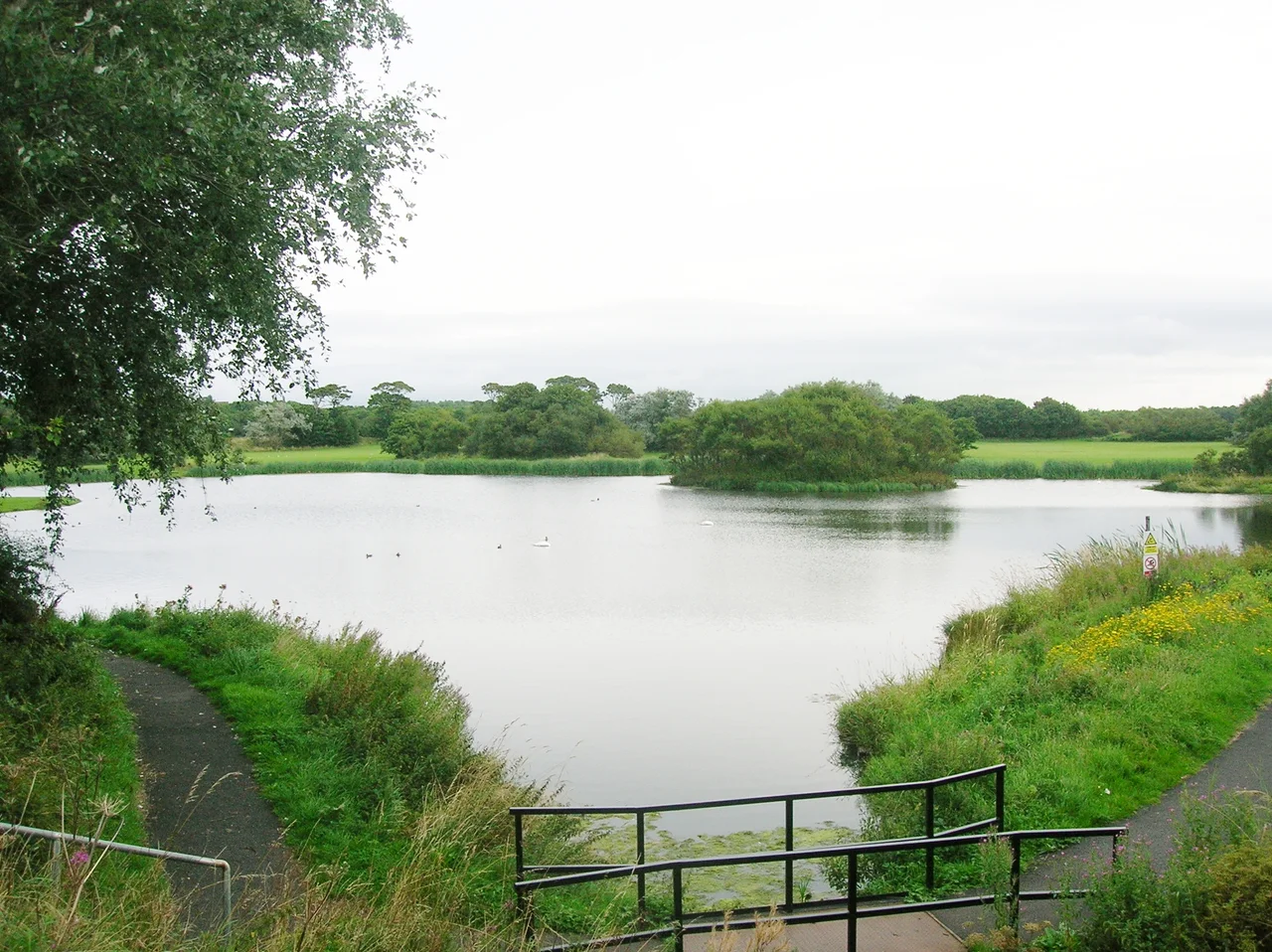
Stevenston has its consolations. Stevenston Beach Local Nature Reserve and the Ardeer Quarry parklands are open to walkers and bird-watchers at all hours, patrolled by the North Ayrshire Council Ranger Service. The dunes are some of the finest on the Firth of Clyde coast. The footballer Gordon Smith was born in nearby Kilwinning and grew up here; so was Des Browne, the former Secretary of State for Defence and Secretary of State for Scotland. The American footballer Andy Auld, the professional wrestler and Two Doors Down actor Grado, are all from Stevenston. So is the sandstone, the canal, the explosives, and the memory of Bonnie Lesley walking past the house where she was born.
From the Air
Located at 55.633 degrees North, 4.767 degrees West, on the west coast of North Ayrshire, sandwiched between Saltcoats and Kilwinning. Glasgow Prestwick (EGPK) lies about sixteen miles south; Glasgow International (EGPF) is about twenty-four miles northeast. From the air the long line of dunes along Ardeer Sands and the industrial footprint of the former Nobel plant are the obvious features. The A78 trunk road runs immediately east of town.
Nearby Stories
- Battle of Drumclog 2.2 km away
- Culzean Castle 3.3 km away
- Greenock 5.9 km away
- Lochranza 7.9 km away
- Battle of Kilsyth 16 km away
- Loch Fyne 19 km away
- Dunaverty Castle 25 km away
- Moniaive 27 km away