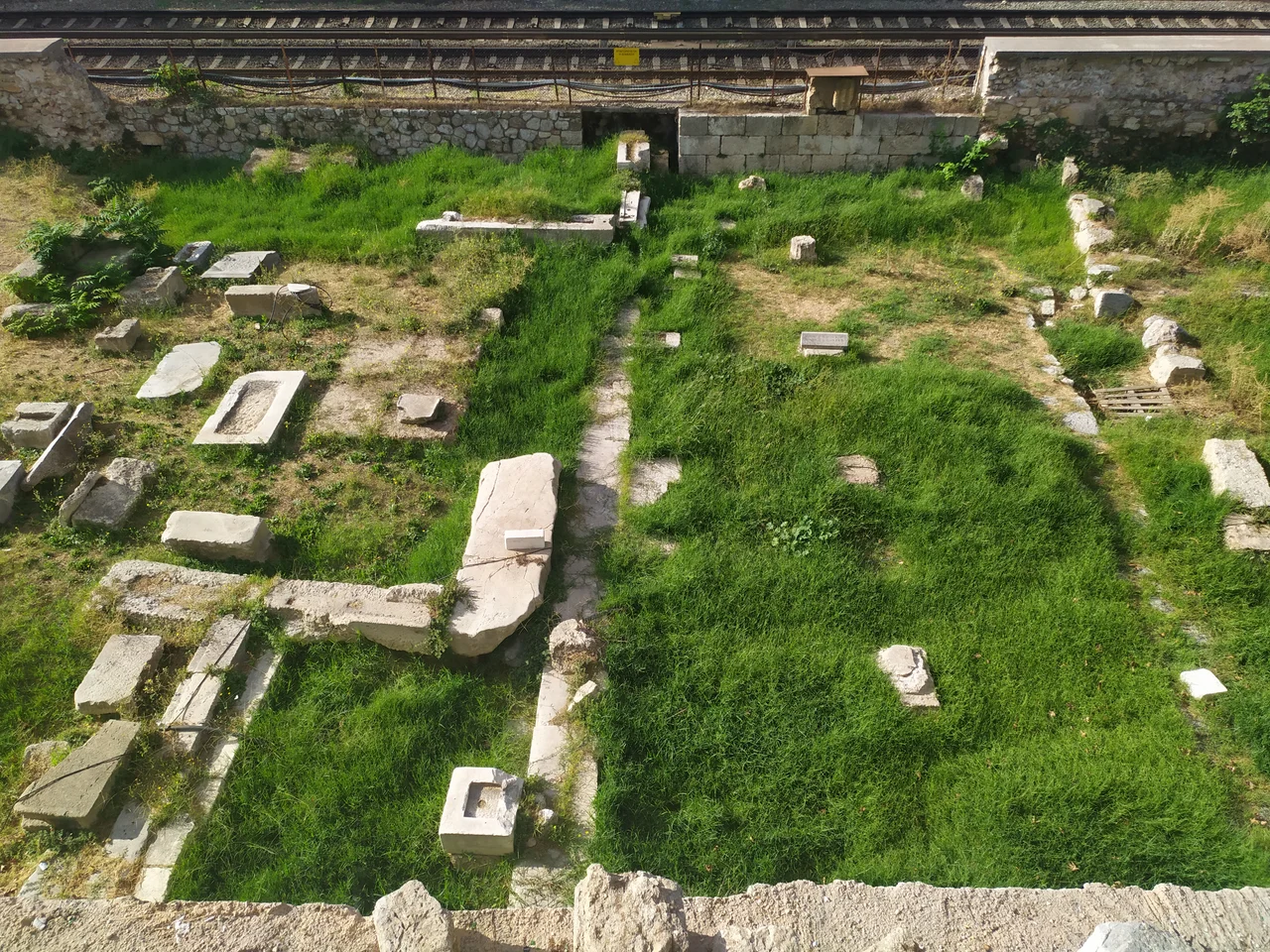

Stoa Basileios
In 399 BC, an aging philosopher walked to the northwest corner of the Athenian Agora to read the formal accusation against him. A young poet named Meletus had charged Socrates with impiety, and because such religious cases fell to a particular magistrate, the summons led to one particular building - the Stoa Basileios, the Royal Stoa. It is one of the smallest stoas the Greek world ever built, barely eighteen meters long, easy to overlook among the Agora's grander ruins. But few small buildings have carried such weight. This was the office where Athens kept its laws, swore in its rulers, and, on that day, set in motion the trial that would end with a cup of hemlock.
The Smallest Important Building in Athens
The Royal Stoa was modest by design and ancient by age. Built in the mid-sixth century BC, it measures only 17.72 meters long and 7.18 meters wide, making it among the smallest known Greek stoas. Its columns were not marble but soft yellow poros stone coated in stucco; eight of them ran along the eastern front, facing the open square. The clues to its age are in the workmanship - the modest scale, the polygonal masonry of the back wall, the Z-shaped metal clamps binding the stones, all features of the Archaic period. The building sat just one meter north of the Stoa of Zeus, in a quarter the Athenians called "the Herms" for the many stone pillars topped with sculpted heads set up there. Fragments of nineteen of those herms have been recovered from the ground around it.
The Stone and the Oath
On the steps of the stoa, between two of the columns, lies a worn block of tan limestone. This is almost certainly "the stone" - ho lithos - named by ancient writers from Aristotle to Plutarch. Athens' nine annual archons climbed onto it to swear their oaths of office, as did public arbitrators and witnesses in trials. There is a quiet irony in its origins: the block appears to be a reused lintel from a Mycenaean tomb, a piece of architecture more than a thousand years old already when the Athenians repurposed it as the foundation stone of their oaths. The building's whole purpose orbited law. The ancient legal codes of Draco and Solon, inscribed on rotating wooden pillars, were probably moved here in the 460s BC. When Athens revised those laws at the century's end, freshly cut copies were set up in porches added to the stoa's ends.
The Seat of the King Archon
Despite the name, no king worked here. The "royal" official was the archon basileus - the King Archon - a magistrate who inherited the religious duties once held by Athens' ancient kings after the monarchy itself had vanished into the democracy. He organized festivals, performed sacrifices on the city's behalf, and heard the opening indictments in lawsuits touching the gods. The Areopagos council, which judged murder and matters of religion, sometimes convened in the stoa as well; on those days a rope was strung up to keep the curious from interrupting. Because impiety was the King Archon's business, it was to this small building that Socrates came. Plato set his dialogue Euthyphro on the very spot - a conversation about the nature of piety, staged in front of the stoa, as Socrates waited to face a charge about exactly that.
Burned, Buried, and Found Again
The stoa endured for almost nine centuries. Roman soldiers under Sulla badly burned it during the sack of Athens in 86 BC; the Athenians repaired it carefully, hiding the scorch marks beneath fresh stucco, and it stood until the Herulian raid of 267 AD. Then it vanished. In the nineteenth century, builders laying the Athens-to-Piraeus railway destroyed its south wall without knowing what they had cut through. The rest lay buried beneath houses until 1969, when the Greek government expropriated the neighborhood and handed the ground to the American School of Classical Studies. They uncovered the Royal Stoa in 1970, with funding from the Ford Foundation. A later dig, in 1974, turned up something unexpectedly human: a lead tablet inscribed with a letter from an enslaved man named Lesis - one of the few surviving traces of literacy among the enslaved people who lived and worked in this city of laws.
From the Air
The Stoa Basileios occupies the northwest corner of the Ancient Agora at 37.976°N, 23.722°E, just north of the Athens metro line that severed its south wall in the 1800s. From the air it reads as a small rectangular footprint at the Agora's edge, dwarfed by the reconstructed Stoa of Attalos to the southeast and the Temple of Hephaestus on the rise to the west. The nearest airport is Athens International (LGAV), roughly 30 km to the east-southeast. Central Athens is controlled airspace; best viewed at low altitude in clear conditions.
Nearby Stories
- Great Sand Beach 5 km away
- Battle of Delium 7.7 km away
- Tower of Aliartos 9 km away
- HMHS Britannic 10 km away
- Saronic Gulf 15 km away
- Sousaki Volcano 17 km away
- Sanctuary of Apollo Maleatas 24 km away
- Skyros 66 km away