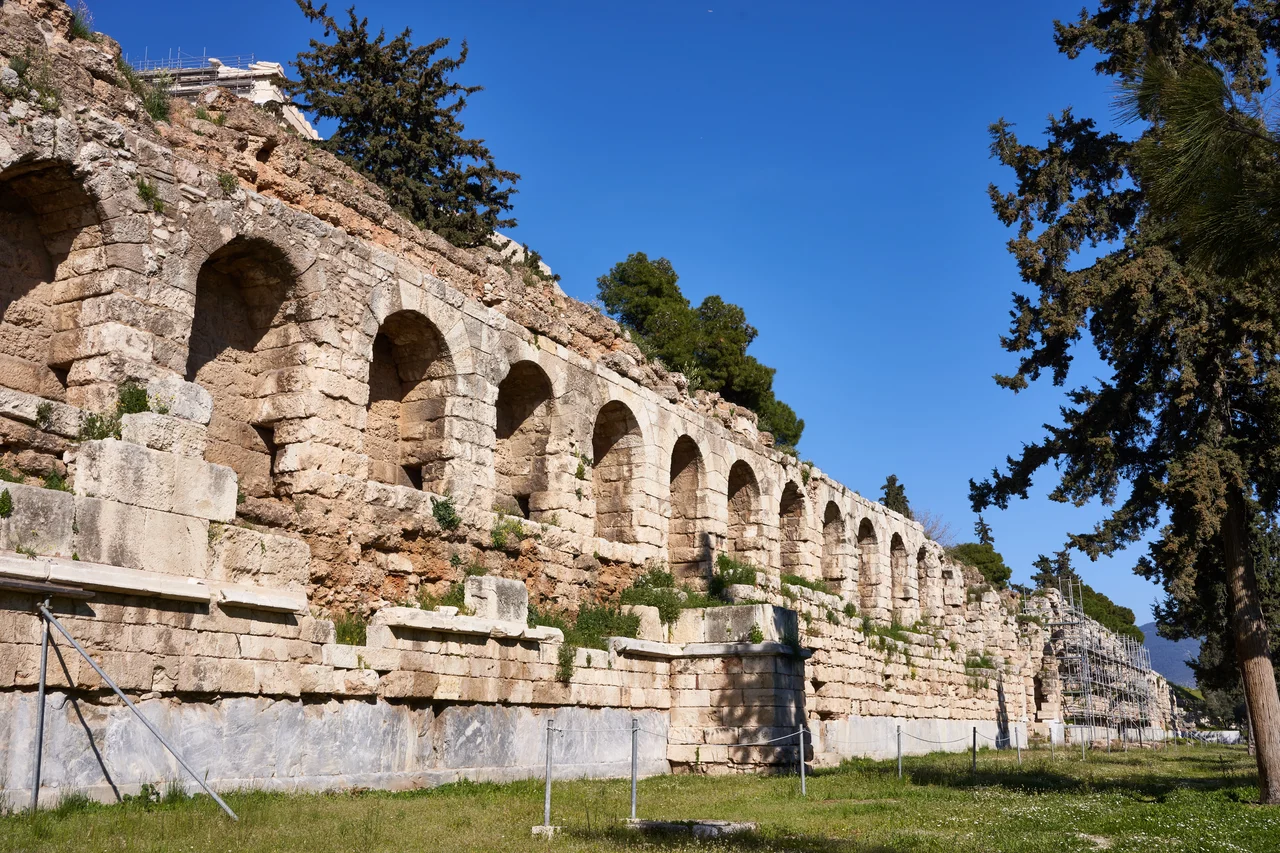

Stoa of Eumenes
The columns were carved hundreds of miles away. Around 160 BC, Eumenes II, king of Pergamon, paid for a long marble colonnade on the south slope of the Athenian Acropolis, and the marble he chose came from his own islands, the kind used to build his capital and found almost nowhere else in Athens. Architects cut and shaped most of the pieces in Pergamon, then loaded them onto ships bound for Greece. The Stoa of Eumenes was, in a literal sense, a gift that arrived by sea.
A Shelter Between Two Theatres
The stoa had one practical job. It ran for 163 metres along the slope, linking the Theatre of Dionysus at one end with the area that would later hold the Odeon of Herodes Atticus. The Roman writer Vitruvius explained the logic of such buildings: a stoa beside a theatre gave spectators somewhere to shelter when the weather turned, and somewhere to store stage props between performances. Athens has hot summers and sharp winter rains, and an open-air theatre offers no refuge. Eumenes gave the city a roofed promenade, two storeys tall and nearly eighteen metres wide, where a crowd could wait out a storm or simply stroll in the shade between acts.
Imported Splendor
This was Hellenistic architecture as diplomacy. The ground floor carried sixty-four Doric columns on its facade, with a second inner row of thirty-two Ionic columns down the spine of the building. Upstairs, the interior columns wore the rarer Pergamene capitals, a style native to Eumenes' kingdom rather than to Athens. The whole design was closely echoed a decade later by the Stoa of Attalos across the Agora, built by Eumenes' own brother, Attalos II. Two royal brothers, two grand porches, both stamping the family name onto the most prestigious city in the Greek world. A gift like this bought goodwill, prestige, and a permanent reminder of who had paid for it.
Engineering the Slope
Building on a hillside is harder than building on flat ground, and the Stoa of Eumenes demanded serious engineering. To hold the terrace in place, the builders raised an arched retaining wall along the northern edge of the site, and it is this wall, made of breccia and limestone and faced with marble from Hymettus and Pentelicus, that still dominates the ruins today. A broad terrace, thirty-two metres wide at its eastern end, opened in front of the colonnade. Spectators climbing up from the lower seats of the theatre could enter the ground floor directly through the western passage, stepping out of the sun and into the cool of the marble gallery.
Stone Recycled
The stoa stayed in use for roughly four centuries. In the second century AD it was joined by a staircase to the new Odeon of Herodes Atticus next door, knitting the south slope into a single monumental complex. Then, in the third century AD, the building was destroyed, and Athens did what cities under threat have always done: it broke the ruin apart for raw material. The stones went into the Valerian Wall, a hasty defensive barrier thrown up against invaders. A thousand years later, in the thirteenth century, the old retaining wall was folded into the medieval Rizokastro fortification ringing the Acropolis. A king's gift became, in the end, a quarry.
Reading the Ruin
When the Archaeological Society of Athens uncovered the site in 1877 and 1878, they found the great arched wall still standing where the colonnade had leaned against it. Today the ancient floor level has been restored, and many pillars of the lower colonnade stand once more on their foundations. It is an easy monument to walk past on the way up to the Acropolis, overshadowed by the famous theatres on either side. But pause at the long northern wall and remember its origin: marble quarried on distant islands, shaped by foreign hands, and sent across the Aegean so that Athenians, more than two thousand years ago, could keep dry.
From the Air
The Stoa of Eumenes runs along the south slope of the Acropolis of Athens, near 37.971°N, 23.726°E, between the Theatre of Dionysus and the Odeon of Herodes Atticus. Athens International Airport (LGAV) lies roughly 30 km to the east. From the air, the Acropolis rock is the obvious anchor; the stoa's long retaining wall traces the hillside just below the southern cliff. Clear midday light brings out the pale marble against the slope. View at low altitude for the best read of the ruins.
Nearby Stories
- Great Sand Beach 5 km away
- Battle of Delium 7.7 km away
- Tower of Aliartos 9 km away
- HMHS Britannic 10 km away
- Saronic Gulf 15 km away
- Sousaki Volcano 17 km away
- Sanctuary of Apollo Maleatas 24 km away
- Skyros 66 km away