.jpg)
Stoa Poikile
An entire philosophy is named after a building you cannot see. Walk to the northwest corner of the Ancient Agora of Athens today and you will find a few worn steps and a stub of foundation wall behind a railing. Yet this was the Stoa Poikile, the "Painted Porch," and around 300 BC a shipwrecked merchant from Cyprus named Zeno began holding forth beneath its colonnade. His students were called, simply, the people of the stoa. We still call them Stoics.
The Painted Porch
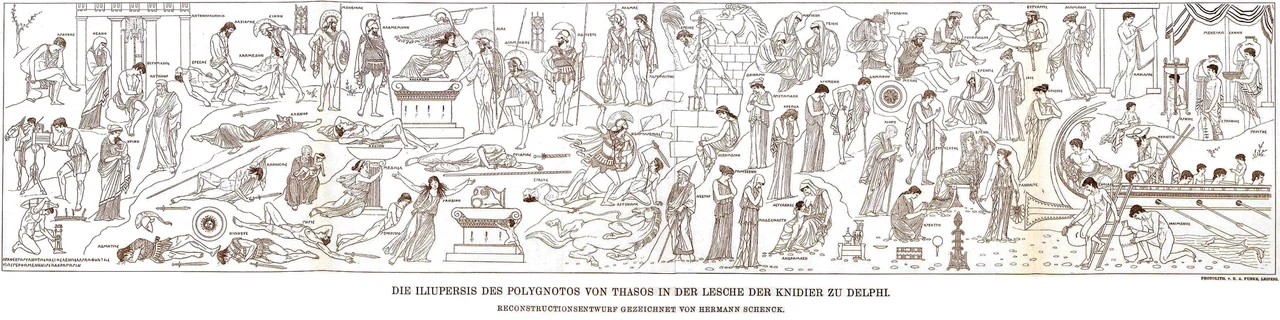
The stoa was a covered walkway, raised around 460 BC and originally named for its builder, Peisianax, a brother-in-law of the statesman Kimon. It earned its lasting nickname from what hung inside. Four great paintings on wooden panels lined the back wall, the work of Polygnotus, Micon, and probably Panaenus, a younger relative of the sculptor Phidias. Polygnotus, the story goes, painted his portion for free. The panels mixed myth and history without apology: a sack of Troy, an Amazon battle, and the one Athenians came to see, the Battle of Marathon, where their fathers had thrown back the Persians. None of these paintings survive. We know them only through ancient writers who could not stop describing them.
Marathon on the Wall
The Marathon panel was the most famous picture in Athens. Demosthenes and Aeschines invoked it in speeches as proof of ancestral courage, the way later orators might point to a flag. It showed the moment a small Athenian force held against an empire, and for generations of citizens it was less a painting than a mirror. The travel writer Pausanias studied it in the second century AD and recorded its figures in careful detail, which is why we know it existed at all. Sometime around 396 AD a Roman governor stripped the panels from the wall and carried them off. They have never been found. What endured was not the image but the idea behind it, that a city could be defined by how it stood its ground.
Where Stoicism Began
Zeno of Citium arrived in Athens after a shipwreck cost him his cargo, and he chose this public porch over a walled academy. Plato had taught behind garden walls; Aristotle worked at the city's edge. Zeno set up at the crossroads of Athenian commerce and gossip, where beggars sat on the steps and crowds passed on the Panathenaic Way. He taught here from about 300 BC until his death around 262 BC, often pacing as he spoke. Because he had no founder's name to give his school, it took the name of the place. A second-century comedian was already mocking "trifling arguments from the Poikile," the surest sign that the porch had become shorthand for philosophy itself.
A Stage for Everything
The stoa was never only a school. War trophies hung here, bronze shields stripped from Spartans captured at Sphacteria in 425 BC, still on display six centuries later. The space served as a law court and a venue for arbitrations. According to Diogenes Laertius, the oligarchic Thirty Tyrants used it in connection with the deaths of 1,500 Athenian citizens in 403 BC, a dark turn in a place we remember for calm reflection. By the Roman era it had grown lighter again, hosting sword swallowers and acrobats the novelist Apuleius watched perform. The same steps that wore smooth under philosophers' feet also held jugglers, judges, and the destitute, all under one painted roof.
What Remains
The building survived the Herulian sack of 267 AD, then went quiet. By the sixth century AD it was being quarried for stone, the fate of most ancient Athenian glory. For centuries its exact location was lost. Only in 1981 did American excavators digging at 13 Hadrianou Street uncover the foundations and confirm that this corner of the Agora was indeed the Painted Porch. The site is modest, a fraction of the original exposed beneath the modern street. But stand at the railing and consider what was taught a few feet away: that you cannot control the storm, only how you meet it. The man who said so learned it, fittingly, from a shipwreck.
From the Air
The Stoa Poikile lies at the northwest corner of the Ancient Agora of Athens, near 37.976°N, 23.723°E, just below the Acropolis. Athens International Airport (LGAV) sits about 30 km east. Approaching from the east, the Acropolis limestone outcrop is the unmistakable landmark; the Agora ruins spread on its northwest flank. Best appreciated at low altitude on a clear day, when the green of the excavated Agora stands out against the dense city grid.
Nearby Stories
- Great Sand Beach 5 km away
- Battle of Delium 7.7 km away
- Tower of Aliartos 9 km away
- HMHS Britannic 10 km away
- Saronic Gulf 15 km away
- Sousaki Volcano 17 km away
- Sanctuary of Apollo Maleatas 24 km away
- Skyros 66 km away