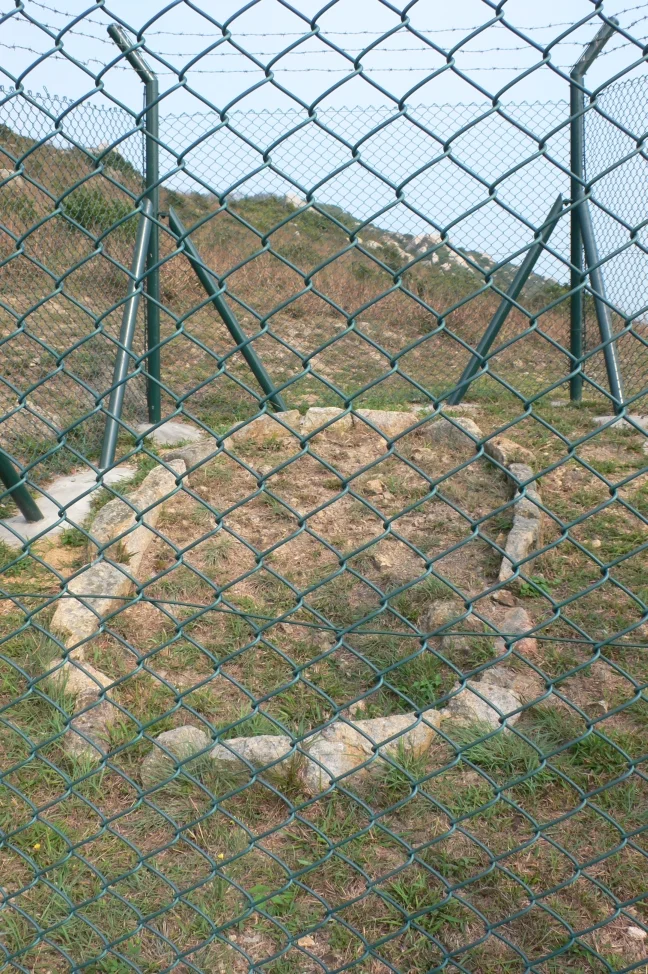

Stone Circles of Hong Kong
Hong Kong is not the first place that comes to mind when stone circles enter the conversation. Stonehenge dominates the imagination; the Scottish islands, Ireland, Brittany — these are the landscapes we associate with ancient rings of standing stones. But on a slope above the South China Sea on Lamma Island, twenty-eight large stones lie buried in the earth in two overlapping circles, placed there by people who lived on this coast during the Neolithic period, long before the idea of Hong Kong existed. A second stone circle waits on Lantau Island, at Fan Lau. Together they are a quiet reminder that the impulse to arrange stones in a circle — for reasons that remain unclear — was not confined to any one part of the ancient world.
The Discovery on Lamma
The Lo Ah Tsai Stone Circle came to outside attention in 1956, when K.M.A. Barnett, then District Commissioner of the New Territories, found it on the northern part of Lamma Island. The site sits on a slope about 100 metres above sea level, and the stones — twenty-eight of them — are not standing upright in the dramatic Stonehenge manner, but lying buried in the earth, arranged in two overlapping circles. Whether they were always positioned this way, or whether time and soil movement brought them down, is part of what subsequent researchers have tried to understand. The Hong Kong University Archaeological Team investigated the site in three separate seasons: 1959, 1963, and 1982. Each investigation added to the record without fully resolving the site's purpose or exact age.
Fan Lau: Lantau's Ancient Circle
The Fan Lau Stone Circle on Lantau Island was discovered in 1980. It sits 40 metres above sea level near Fan Lau, the southwestern tip of Lantau, where the Pearl River estuary meets the open South China Sea — a place with views in every direction and, one imagines, considerable wind. The Antiquities and Monuments Office of Hong Kong recognizes the Fan Lau Stone Circle as a declared monument, giving it formal protection as part of the territory's cultural heritage. The site's position above a prominent coastal headland suggests it may have held significance as a landmark or gathering point for communities living along these shores. Whether it was used for ceremony, astronomy, territorial marking, or something else entirely remains a matter of scholarly speculation.
Reading a Shallow Record
Hong Kong's Neolithic and Bronze Age past is rich but incompletely understood. The territory's warm, humid climate is hard on organic materials, meaning that many artifacts that might help date and explain sites like these have not survived. What remains — stone tools, pottery sherds, rock carvings, and the stone circles themselves — points to communities that were engaged with their landscape in purposeful, structured ways. The stone circles at Lo Ah Tsai and Fan Lau belong to this pattern. They required organized labor to construct. The stones were selected and arranged deliberately. Something motivated the people who built them. That motivation is exactly what the archaeological record has not yet made clear, and perhaps never will — which is part of what makes these quiet hillside sites so compelling to stand near.
Stones That Outlasted Everything Else
The communities that built these circles left no writing, no temples that survived, no stories passed down under their own names. What they left are the stones themselves. On Lamma, those twenty-eight stones have been lying in the earth longer than the city thirty kilometers to the northeast has existed. Hong Kong grew from a fishing village into one of the world's densest urban environments in roughly 150 years. The stone circles are perhaps four thousand years older than that transformation. Standing on the slope above the sea at Lo Ah Tsai or at the Fan Lau headland, the contrast between what the modern harbor has become and what these hilltop rings quietly represent is worth a moment's pause.
From the Air
The stone circle sites sit at coordinates approximately 22.20°N, 113.85°E, covering two locations: Lo Ah Tsai on northern Lamma Island and Fan Lau at the southwestern tip of Lantau Island. Fan Lau is the more visually identifiable from altitude — it occupies a prominent headland where Lantau's coast turns sharply, about 7 km west of Tai O village. Recommended viewing altitude: 2,000–4,000 ft for a broad view of Lantau's southwestern coast and Lamma Island to the east. The stone circles themselves are not visible from the air. Nearest airports: VHHH (Hong Kong International, northern Lantau, approximately 20 km northeast of Fan Lau) and VMMC (Macau International, approximately 40 km to the west). Lo Ah Tsai on Lamma Island is visible as the island directly south of Ap Lei Chau and east of Cheung Chau.
Nearby Stories
- Tai Tau Chau (Southern District) 0.7 km away
- Lai Chi Wo 3 km away
- Wanshan Archipelago Campaign 3.2 km away
- Pearl River Delta 3.7 km away
- Battle of Yamen 13 km away
- Jiangmen 15 km away
- Hong Kong 12 32 km away
- Battle of Nanpeng Island 114 km away