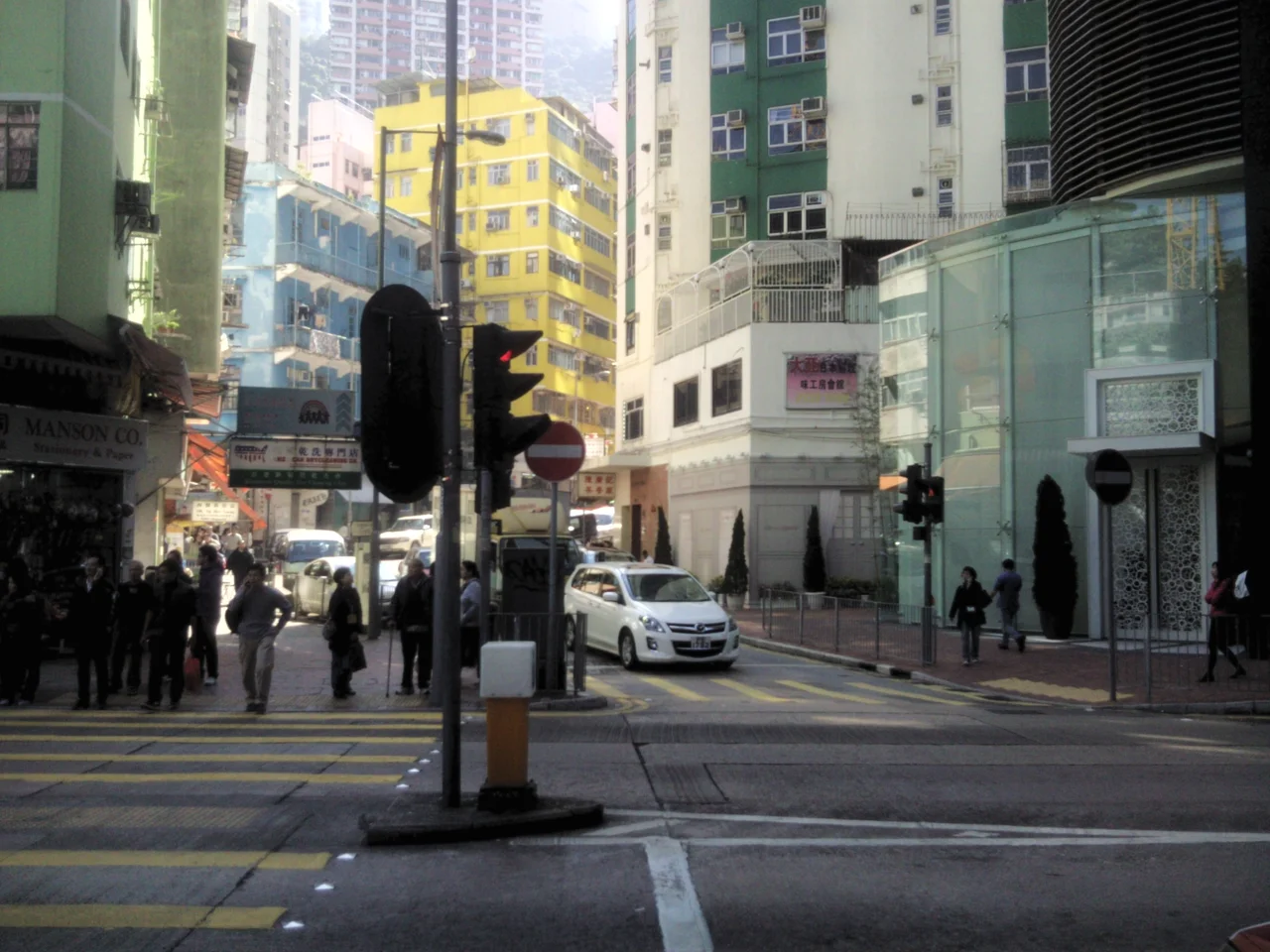

Stone Nullah Lane
There used to be a stream running down the middle of this street. Not a decorative channel or a civic fountain — an actual flowing nullah, a water channel fed by rainfall on Victoria Peak that carried water down the hillside and emptied into Victoria Harbour somewhere near where Wan Chai Road meets the waterfront. People washed their laundry in it. In 1959, the city covered it over, burying the stream underground, where it still flows today. The lane kept the name. Stone Nullah Lane is only a few hundred meters long, but it contains more compressed history than streets ten times its length.
The Stream That Gave the Street Its Name
The word nullah comes from the Hindi word for a seasonal watercourse or drain — one of many terms that filtered into Hong Kong English during the British colonial period. The nullah on this street was made of stone or concrete and carried water originating from the hills above Kennedy Road, flowing through what was then Hong Kong Island's waterfront neighborhood. Victoria Harbour once lapped much closer than it does today: decades of land reclamation have pushed the shoreline far to the north, so the streets that once bordered water now sit well inland. The nullah ran through the lane's center openly until 1959, when it was relocated underground as part of broader urban infrastructure work. The stream from The Peak still flows beneath the surface, an invisible geographic thread linking the mountain to the harbour.
The Blue House and Its New Orleans Balconies
The most immediately striking building on Stone Nullah Lane is the one everyone calls the Blue House — though it was not always blue. Built in 1922, the structure rises four storeys and features cast-iron balconies, a design detail that has prompted more than a few visitors to compare the building to architecture in New Orleans. It has had several lives. The site previously hosted a Chinese medical hospital before the current building was constructed in 1922; the tenement then housed kung fu studios, Chinese clinics, and a free school for neighborhood children, and now includes a heritage museum as part of a conservation project led by the Hong Kong Housing Society. The building's current shade — a vivid sky blue — came about when renovation crews in the 1990s used surplus blue paint from the Water Supplies Department, an accidental choice that has since become the building's defining characteristic. Today the Blue House is a Grade I historic building and one of the last remaining examples of pre-war Chinese tenement architecture in Hong Kong.
Pak Tai and the Temple Built in 1863
A short distance from the Blue House, the Wan Chai Pak Tai Temple stands as one of the oldest places of worship on Hong Kong Island. Built in 1863 from grey brick and granite, the temple is dedicated to Pak Tai, a Taoist deity associated with the sea and the protection of fishermen — an appropriate figure to honor in a district that once looked directly onto the harbour. The statue of Pak Tai inside the temple dates back even further: to 1604, predating the temple structure by more than two and a half centuries. It was brought here from elsewhere and installed when the building was completed. The temple is the oldest in Wan Chai District and is reportedly the largest Pak Tai temple on Hong Kong Island. On the days of the Cheung Chau Bun Festival, the statue is traditionally carried in procession.
Charity, Community, and the Long Arc of Wan Chai
Stone Nullah Lane has also been home to St. James' Settlement since 1949, a charitable organisation founded to serve impoverished children living in squatter areas around the neighborhood. In the postwar years, Wan Chai was a district of makeshift housing, informal economies, and families navigating extreme poverty in an already densely packed city. The settlement extended its services over the decades, eventually reaching needy people across Hong Kong. It remains active today, one of the quiet anchors of the lane's community life. Wan Chai itself has changed enormously — from a waterfront district of labourers and fishermen, through the bar-lined streets of the postwar American military-rest period, into the mixed residential and commercial neighborhood it is today. Stone Nullah Lane sits in the older stratum of that story, preserved in part precisely because the buildings here were too worn-down for developers to covet, until conservation efforts recognized what was worth keeping.
From the Air
Stone Nullah Lane lies at approximately 22.2738°N, 114.1739°E in the Wan Chai district of Hong Kong Island, near the junction with Queen's Road East. Approaching from the northeast at 1,500–2,000 feet, the dense mid-rise fabric of Wan Chai is visible below, with Victoria Harbour and the Tsim Sha Tsui skyline to the north. The lane itself is too narrow to be individually identified from altitude, but the broader Wan Chai district — flanked by Causeway Bay to the east and Central to the west — is easily recognized by its concentration of high-rise towers. Hong Kong International Airport (VHHH) lies approximately 27 nautical miles to the west on Lantau Island. Victoria Peak rises to the southwest.
Nearby Stories
- Lok Ma Chau Loop 2.3 km away
- Portas do Cerco 2.3 km away
- Kweilin Incident 17 km away
- Wanshan Archipelago Campaign 34 km away
- Nanxiong Formation 115 km away
- Battle of Nanpeng Island 148 km away
- Heyuan 169 km away
- Cape Maobitou 632 km away