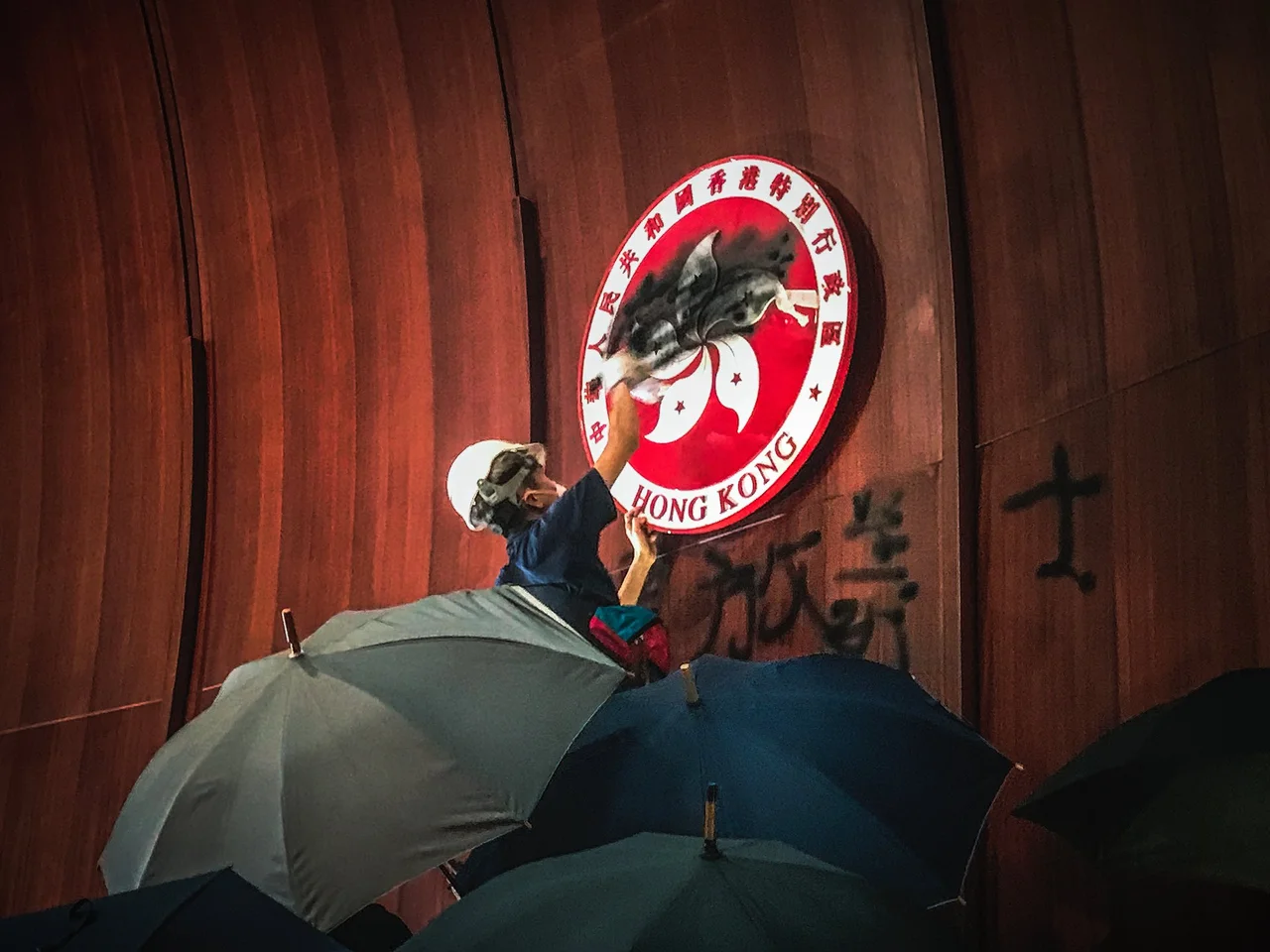

Storming of the Legislative Council Complex
The date was chosen deliberately. The first of July marks the anniversary of Hong Kong's handover from Britain to China in 1997, and it is traditionally a day for both official commemoration and public demonstration. In 2019, hundreds of thousands of people marched through the streets — by some organizers' estimates, 550,000, the largest July 1 march on record. But it was what happened later that night, at the glass-and-steel Legislative Council Complex in Admiralty, that marked a turning point in the city's summer of protest. Hundreds of demonstrators broke through the building's doors and entered the chamber. They would hold it for hours.
What Brought Them There
The immediate cause was the Fugitive Offenders amendment bill, a proposed law that would have allowed people in Hong Kong to be extradited to mainland China to face trial there. Critics feared the bill would expose residents — including activists, journalists, and ordinary citizens — to a legal system that offered fewer protections than Hong Kong's. Mass protests had begun in June, with an enormous march on 9 June drawing crowds that organizers estimated in the millions. The government's response — a pause in the bill's progress rather than an outright withdrawal — did not satisfy protesters. By July 1, a significant number of people in the streets had concluded that the usual forms of demonstration were insufficient. Some began preparing to do something more direct.
The Night the Glass Broke
At around 9 PM, after hours of effort, the front-line demonstrators broke through the building's thick glass doors and pried open its metal security curtains. Police, who had been present throughout the day, retreated rather than engage in confrontation as the protesters entered. Inside the chamber, the demonstrators spray-painted slogans on the walls, covered or defaced official portraits, and draped the chamber with protest banners. More than 60 glass doors and panes were broken throughout the complex. One protester removed his mask to make a statement to the cameras inside the chamber — a deliberate act in a protest movement that relied on anonymity to protect participants. He said later: "Hongkongers have nothing left to lose. Hongkongers cannot afford to lose any more." The occupation lasted several hours before protesters withdrew.
The Meaning of the Moment
What made the evening unusual was not only what happened inside the building but how it was received. Earlier protest movements in Hong Kong — including the 2014 Umbrella Revolution — had seen demonstrators sharply condemned, including by pro-democracy voices, when they moved toward property damage or confrontation with authorities. In 2019, the response was different. As the New York Times correspondent Austin Ramzy observed, the voices of restraint were quickly drowned out. Protesters and their supporters became more, not less, unified following the events of July 1. The storming reinforced rather than fractured the movement. Historians and observers have described it as a watershed moment — a point after which the nature of the protests, the relationship between demonstrators and authorities, and the stakes for everyone involved had visibly shifted.
Consequences and Arrests
Arrests followed in the weeks and months afterward. On 3 July, police arrested one person for forced entry into the complex. On 30 September, activist Ventus Lau and actor Gregory Wong were arrested on charges of conspiracy to criminal damage and entering the precincts of the Chamber. Lawmaker Cheng Chung-tai was arrested the same day on similar charges. A member of the pro-democracy group Demosisto was arrested at Hong Kong International Airport in January 2020. In March 2024, Hong Kong Free Press reported that twelve people received prison sentences ranging from four and a half years to six years and ten months in connection with the July 1 storming. The Legislative Council Complex itself has since moved to a new facility in Tamar — the same Admiralty precinct where, in the summer of 2019, demonstrators stood in the chamber of Hong Kong's legislature and wrote on its walls.
From the Air
The Legislative Council Complex (at the time of the 2019 events) was located at approximately 22.2811°N, 114.1661°E in the Admiralty district of Hong Kong Island, on the northern waterfront between Central and Wan Chai. From the air at 1,500–2,000 feet, the Tamar precinct — a distinctive complex of government buildings and open space along the harbour — is clearly visible. Victoria Harbour stretches to the north, with the Tsim Sha Tsui skyline across the water. The Admiralty MTR station and Hong Kong Park are immediately to the south. Hong Kong International Airport (VHHH) lies approximately 25 nautical miles to the west-southwest on Lantau Island.
Nearby Stories
- Lok Ma Chau Loop 2.3 km away
- Portas do Cerco 2.3 km away
- Kweilin Incident 17 km away
- Wanshan Archipelago Campaign 34 km away
- Nanxiong Formation 115 km away
- Battle of Nanpeng Island 148 km away
- Heyuan 169 km away
- Cape Maobitou 632 km away