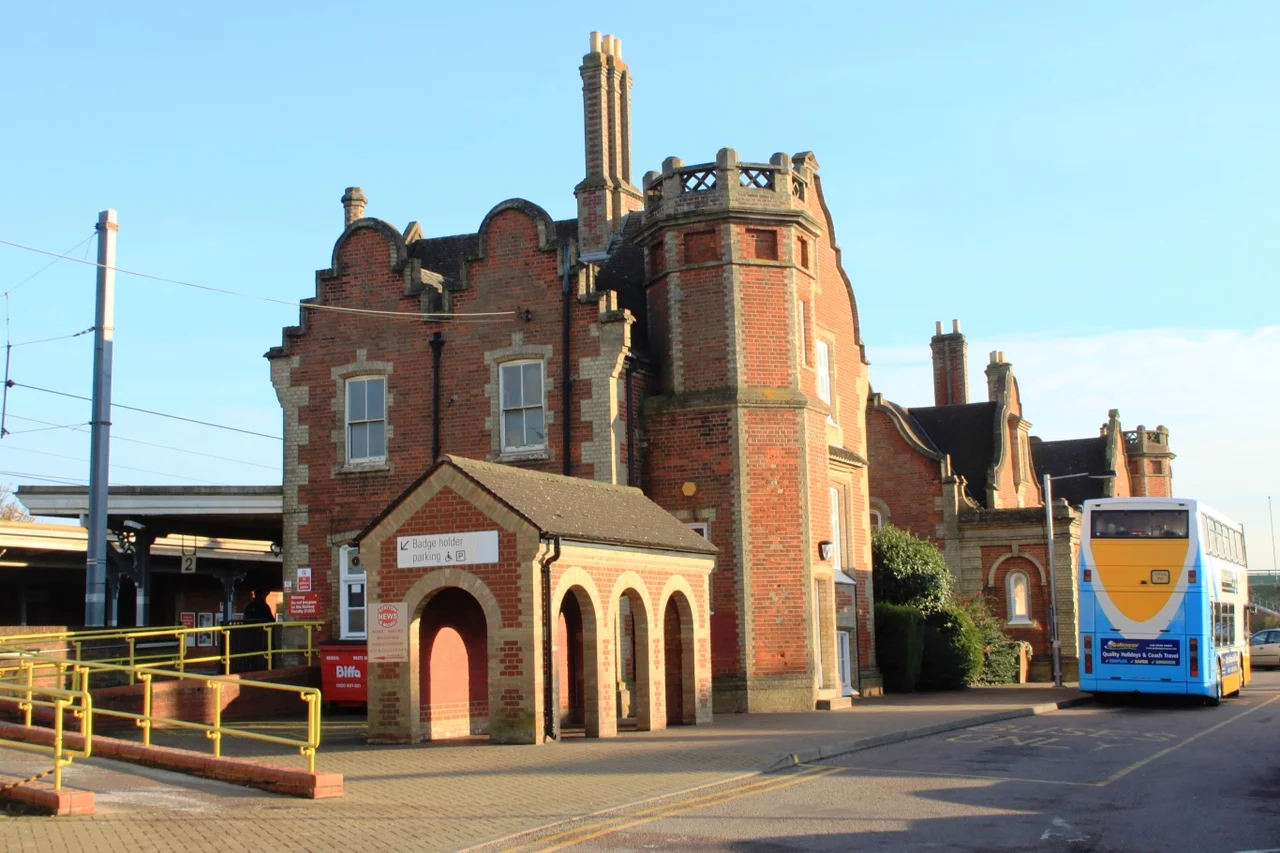

Stowmarket
On 11 August 1871, the local gun cotton factory at Stowmarket exploded. Twenty-eight people died and seventy-five were injured. Gun cotton, otherwise known as nitrocellulose, was the new generation of military explosive that had just begun to displace black powder, and like many genuinely useful chemicals it was also genuinely lethal to make. The site of the explosion is now a paint factory, which is a quietly Suffolk way of dealing with industrial trauma: change the chemistry, keep the location, do not put up a big sign. Stowmarket has spent a long time being a working town that things happen to, rather than a museum of the things that happened.
The Principal Place
The name comes from the Old English word stow, meaning 'principal place'. Edward III granted Stowmarket a market charter in 1347 and a market is still held twice a week, on Thursday and Saturday. The town sits on the A14 trunk road between Bury St Edmunds and Ipswich, on the Great Eastern Main Line between Diss and Needham Market, and along the River Gipping, which is joined here by the River Rat. The population has gone from around 6,000 in 1981 to around 21,000 in 2021, with more growth planned. Stowmarket is now the largest town in the Mid Suffolk district. The poet John Milton visited regularly because his tutor, the Scottish theologian Dr Thomas Young, became vicar of Stowmarket in 1628. A tree in the grounds of the old vicarage - now the town council offices - is believed to be an offshoot of one of the many trees Milton planted there. They call it Milton's Tree.
The Astronomers
Stowmarket has a strange astronomical history for a market town. On 8 June 1918, the first UK observation of nova V603 Aquilae - the brightest nova of the twentieth century, briefly outshining every star in the sky except Sirius - was made from Stowmarket by A. Grace Cook, a remarkable amateur astronomer. History repeated itself on 13 December 1934 when J. P. M. Prentice, also an amateur, also from Stowmarket, discovered DQ Herculis, another bright nova that would become one of the most studied objects in stellar physics. To produce two amateur nova discoverers from the same East Anglian market town within sixteen years is statistically improbable and a small monument to the British tradition of serious amateur science conducted from suburban gardens.
The Solitary Bomber
Just before midday on Friday 31 January 1941, a solitary German bomber appeared over Stowmarket and strafed a large area of the town before dropping bombs onto the High Street. Eyewitness accounts disagreed on the model of aircraft. The bombs destroyed the Stowmarket Congregational Chapel, a Victorian Gothic building that had stood since the nineteenth century. There was one fatality: Mrs Rhoda Farrow, who had just returned from seeing her son Ronald and his fiancee off at the railway station. The proportions of that incident are very Second World War: an enormous destructive act, a single named civilian death, and a chapel reduced to rubble in the time it takes to walk from the station to the High Street. A single bomber, a single name, one lost building, and the town carried on.
Milton, Milton's Tree, John Peel
The fourteenth-century Church of St Peter and St Mary stands in the Decorated Gothic style at the centre of the town, with the sixteenth-century former vicarage and Milton's Tree beside it. Haughley Park, a large red-brick country house built around 1620 for the Sulyard family, sits a short distance west. In 1967 the Museum of East Anglian Life opened on a 70-acre site near the town centre; it has since been renamed The Food Museum and concentrates on the food and farming heritage of the region. The Karnser, a raised pavement in Station Road West next to the church, takes its name from the East Anglian dialect word caunsey, meaning a causeway. And in 2012, the former corn exchange was refurbished into the John Peel Centre for Creative Arts: a music venue, art gallery, and theatre named after the legendary BBC Radio 1 DJ who lived in the nearby village of Great Finborough until his death in 2004.
Royal Visits and Saturday Mornings
Queen Elizabeth II visited Stowmarket twice: first in July 1961, and again on 17 July 2002 during the Golden Jubilee celebrations, when she and Prince Philip visited the market, met stall holders, and unveiled a new town sign. The town runs an annual carnival that has been going for more than sixty years, with a procession through the streets ending in the Recreation Ground. There is a parkrun every Saturday morning at Chilton Fields and a junior parkrun on Sundays. The Regal Theatre on the high street has been showing films and hosting concerts for over fifty years. Stowmarket is a town that, having put aside its explosive industries, has become quite comfortable as a place where people live, get on the train to Ipswich or London Liverpool Street, and come home to a market town that knows exactly how to be one.
From the Air
Stowmarket sits at 52.19°N, 1.00°E, on the A14 trunk road in central Suffolk, midway between Bury St Edmunds and Ipswich. The Great Eastern Main Line runs through the town and Stowmarket railway station is a prominent landmark. The 14th-century Church of St Peter and St Mary with its Decorated Gothic tower is visible from a wide area. RAF Wattisham (EGUW, Army Air Corps Apaches) is approximately 4 nm south-southwest and is the nearest official weather station, often used as Stowmarket's proxy. Ipswich (EGSF Conington is far west; EGSH Norwich Airport 35 nm north-northeast) is the nearest civilian airport.
Nearby Stories
- Ely Cathedral 6.2 km away
- Aldeburgh Festival 8 km away
- Bungay Castle 8.4 km away
- Thetford Castle 9.1 km away
- White House Farm murders 12 km away
- RAF Bottisham 12 km away
- North Weald Airfield 20 km away
- Broadstairs 55 km away