
Strawberry Field
The garden party started with brass instruments warming up behind the hedge. Aunt Mimi remembered the way her nephew would jump up when the first notes drifted across the back gardens of Menlove Avenue. Mimi, come on, John would shout. We're going to be late. The Salvation Army band played at the children's home up the road every summer, and the boy would run from his aunt's house at 251 Menlove Avenue, around the corner onto Beaconsfield Road, and through a hedge at the back of the home's grounds where he had worked out a secret way in. Strawberry Field had a garden with mossy walls, twisted oak trees, sandstone paths, and forty children he sometimes played with. It was where he hid. Two decades later, in November 1966, he wrote the song that turned the name into worldwide pilgrimage.
George Warren's Gothic Mansion
The earliest record of the house dates from 1870, when it belonged to a Liverpool shipping magnate named George Warren. It was a Gothic Revival mansion - turreted, gabled, set in twelve acres of formal gardens and woodland on the southern edge of Woolton. The 1891 Ordnance Survey map labels the entire estate as Strawberry Fields in the plural, after the wild strawberries said to have grown on the slope below the house. By the 1905 survey the name had contracted to the singular, Strawberry Field, and stayed that way. The house passed through several wealthy Liverpool merchants. The widow of one of them sold the estate to the Salvation Army in 1934. On 7 July 1936, Lady Bates opened it as a children's home for girls, in the presence of General Evangeline Booth - daughter of the Salvation Army's founders William and Catherine Booth, and herself the international commander of the movement. The home took up to 40 girls initially. Boys under five were added in the 1950s. Older boys came later still.
Lennon Behind the Hedge
John Lennon grew up at 251 Menlove Avenue, the small semi-detached suburban house where his Aunt Mimi raised him after his mother could not. Beaconsfield Road was a side street off Menlove Avenue. The boy could walk the few hundred yards to the back wall of Strawberry Field in five minutes. He climbed over the wall. He hid in the dense vegetation. He played in the grounds with the resident children when no adults were watching. Above all, he came for the summer garden party - the one day each year when the Salvation Army band played in the garden and the public were welcome. Aunt Mimi remembered the urgency he felt about not missing it. The phrase Strawberry Fields - which he later kept as plural for the song title even though the home was singular - became, for him, shorthand for a place he could be unselfconscious and unwatched. It is no accident that his lyric describes it as a place where nothing is real and where there is nothing to get hung about. The song is not about a children's home. It is about a child's interior life.
Recording an Impossible Song
In November and December 1966 the Beatles spent some 55 hours over five weeks recording Strawberry Fields Forever at Abbey Road. Lennon had brought a slow, melancholy demo into the studio. The first version recorded was gentle and acoustic. Lennon kept changing his mind. By the end, two completely different recordings existed - in different keys, at different tempos, with different instrumentation including swarmandal and cellos - and Lennon asked producer George Martin to splice them together. Martin pointed out that they were in different keys and at different speeds. Lennon shrugged: you can fix that, can't you, George. Martin and engineer Geoff Emerick spent days slowing one tape and speeding up the other until the keys aligned approximately at one minute exactly. The splice was made. The song became the strangest piece of music a pop group had yet released. It came out in February 1967 as a double A-side with Penny Lane - another song about Lennon's Liverpool childhood - and was the first single from the Sgt Pepper sessions to reach the public.
The Gates Become a Shrine
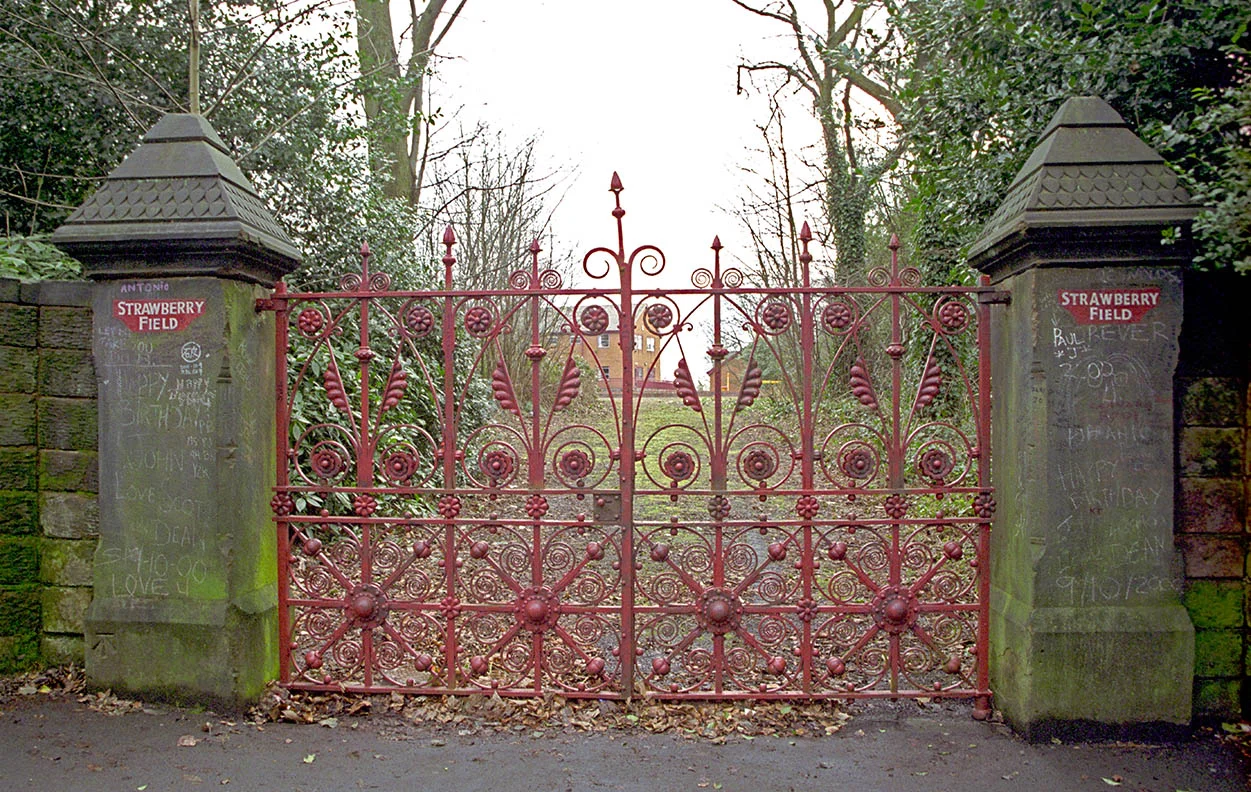
By the late 1960s and certainly through the 1970s, the home's red wrought-iron entrance gates on Beaconsfield Road - bearing the painted name STRAWBERRY FIELD - had become a Beatles pilgrimage site. Fans came from every country, scratched names into the paint, left flowers, posed for photographs. The Salvation Army repainted the gates regularly to keep them legible. The original Gothic mansion suffered structural problems - dry rot, mainly - and in 1973 it was demolished and replaced with three purpose-built family units, each housing about twelve children. The driveway was moved further west, leaving the famous gates standing at a disused entrance. On 11 May 2000, two men in a transit van turned up in the early hours and stole the gates. They sold them to an unsuspecting antiques dealer who, when he realised what he had bought, returned them to the police. They are now displayed inside the grounds for safekeeping. Replicas hang at the gateposts in their place since May 2011.
Opening to the Public
The Salvation Army closed Strawberry Field as a children's home in January 2005 - changing child-protection legislation and changing approaches to care had made smaller fostering placements preferable to residential homes. The site was used for a few years as a church and prayer centre. Then in September 2019, after years of fundraising and planning, the Salvation Army opened Strawberry Field to the public for the first time in its history. A visitor exhibition - introduced by Paul McCartney - tells the story of the Salvation Army's work at the home, of Lennon's childhood, and of the writing and recording of Strawberry Fields Forever. John's half-sister Julia Baird provides the media-guide commentary; she is the honorary president of the venture. Critically, the complex also contains a working training centre called Steps to Work, which provides paid hospitality training to young adults with learning disabilities. The cafe staff include Steps graduates. In May 2023 a bandstand donated by Orange Amps founder Cliff Cooper was opened in the gardens, featuring an Imagine mosaic floor referencing the Central Park memorial in New York. The gates Lennon climbed past as a child are now on display indoors. The hedge he hid in is gone. The strawberry fields, plural and otherwise, live on through one of the strangest songs popular music has produced.
From the Air
Strawberry Field is on Beaconsfield Road in Woolton, south Liverpool, at 53.380°N, 2.884°W. Best viewed at 1,500-3,000 ft. Liverpool John Lennon Airport (EGGP) is 2 nm south. Look for the wooded grounds of the Salvation Army property a half-mile north-northeast of the airport, in suburban south Liverpool. The site is roughly half a mile northeast of 251 Menlove Avenue (Mendips), where Lennon grew up - the two are linked by Beaconsfield Road. The Liverpool Cathedral and Beatles statue are 5 nm further north.
Nearby Stories
- RAF Wrexham 3.3 km away
- Birkdale Palace Hotel 3.7 km away
- Turton Tower 4.1 km away
- Tatton Park 5.6 km away
- Abergele Rail Disaster 9.6 km away
- Diglake Colliery Disaster 13 km away
- Ysbyty Ifan 16 km away
- Celtic Array 62 km away