
Irish Defence Forces
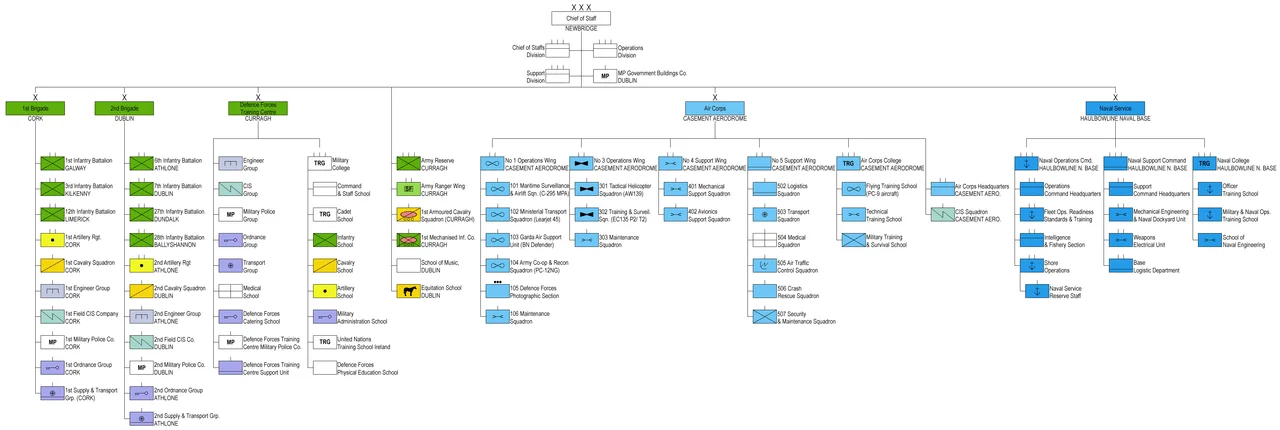
Ireland has roughly nine thousand soldiers, sailors and aircrew. That is the total active strength of the Irish Defence Forces - smaller than some American police departments and an order of magnitude below most European militaries. The state has been formally neutral since 1939, has not been at war with anyone since 1923, and does not belong to any military alliance. What it does have is one of the longest continuous UN peacekeeping records in the world, an exclusive economic zone the size of Spain to patrol, and a defence structure that fits on a single org chart. The chart is unusual. The southern half of the country is run from a barracks named for the man who signed the treaty that created Ireland and who was shot dead three weeks later.
The Chief and the Three Divisions
At the top of the structure is the Chief of Staff, a three-star general rank with authority over the management of the entire Defence Forces, working out of Newbridge in County Kildare. Three divisions report to the Chief of Staff. The Chief of Staff's Division handles strategic planning and public relations under an Assistant Chief of Staff. The Operations Division - led by the Deputy Chief of Staff Operations - runs intelligence (J2), planning and operations (J3 and J5), combat support, communications and information services (J6), and training (J7). The Support Division - under the Deputy Chief of Staff Support - manages human resources (J1), logistics (J4), legal services, engineers, ordnance, medical, military police, and the chaplaincy. The Military Judge sits alongside, the small judicial branch of military justice. None of this is unusual for a small army's headquarters. What is unusual is how small the army it commands actually is.
Two Brigades, Two Halves of Ireland
The Army is divided into two brigades that split the country in half. The 1st Brigade is headquartered at Collins Barracks in Cork - named for Michael Collins, the IRA commander and Free State minister assassinated in 1922 at Beal na Blath in West Cork. The brigade covers the southern counties: Carlow, Clare, Cork, Galway, Kerry, Kilkenny, Laois, Limerick, Offaly, Tipperary, Waterford, and Wexford. Its units are scattered: 1st Infantry Battalion in Galway, 3rd Infantry in Kilkenny, 12th Infantry in Limerick, plus a 1st Artillery Regiment in Cork with L118/119 105mm light guns and 120mm mortars, a 1st Cavalry Squadron with Mowag Piranha armoured vehicles, and engineer, supply, ordnance, communications and military police groups all based in Cork. The 2nd Brigade is headquartered at Cathal Brugha Barracks in Dublin - named for the republican leader killed in the Civil War in 1922 - and covers the northern counties: Cavan, Donegal, Dublin, Kildare, Leitrim, Longford, Louth, Mayo, Meath, Monaghan, Roscommon, Sligo, Westmeath, and Wicklow.
Special Forces and Ranger Wing
The Army Ranger Wing, based at the Defence Forces Training Centre on the Curragh in Kildare, is Ireland's special operations force. Trained in counter-terrorism, hostage rescue, maritime interdiction and deep reconnaissance, the Wing has deployed on UN missions in Chad, Liberia, Lebanon and elsewhere. The Curragh is also home to the 1st Mechanised Infantry Company and the 1st Armoured Cavalry Squadron, plus the Defence Forces' main training schools - Command and Staff School, Cadet School, Infantry School, Artillery School, Cavalry School, the Communications and Information Services School, the Military Engineering School, and the United Nations Training School Ireland (UNTSI), which prepares Irish and foreign personnel for UN peacekeeping deployments. The Defence Forces School of Music, the Equitation School (still horseback - Ireland punches above its weight in international showjumping) and three regimental bands round out the cultural side of the institution.
The Air Corps at Baldonnel
The Irish Air Corps operates out of Casement Aerodrome at Baldonnel in west Dublin - named for Roger Casement, the diplomat hanged in 1916 for his role in the Easter Rising arms-smuggling attempt. It is a small service: two C-295 maritime patrol aircraft for the 101 Squadron, one Learjet 45 ministerial transport (being replaced by a Dassault Falcon 6X in 2025), one Britten-Norman Defender for the Garda Air Support Unit (being replaced by a DHC-6 Twin Otter), four Pilatus PC-12 reconnaissance aircraft for the 104 Squadron, and helicopters: six AgustaWestland AW139s in the 301 Tactical Helicopter Squadron and four EC135s for training and Garda Air Support. The Air Corps shares pilots with the HSE National Ambulance Service for the Emergency Aeromedical Service. The Air Corps College trains pilots and technicians on eight Pilatus PC-9M trainers, plus aircraft technicians at the Technical Training School and basic military and SERE (Survival, Evasion, Resistance and Escape) training at the Military Training and Survival School.
The Sea Service at Haulbowline
The Naval Service is headed by a brigadier general from Naval Headquarters at Haulbowline in Cork Harbour - the deepwater island that was a Royal Navy base until 1938. Two commands handle the daily work: Naval Operations Command runs ships at sea, the Vessel Monitoring System, the Fishery Protection System (called Lirguard), shore operations and harbour mastering; Naval Support Command handles ship procurement, maintenance, repair, provisions, fuel, ordnance, food, personnel and transport. The Naval College at Haulbowline trains every officer and rating - Officer Training School, Military and Naval Operational Training School, School of Naval Engineering. The Naval Service Reserve has units in Dublin, Waterford, Cork and Limerick. The patrol fleet is small but the Atlantic is large; every ship in commission is constantly working fishery protection, search and rescue, sovereignty patrol or drug interdiction. The whole service answers to Newbridge, where the Chief of Staff sits at the top of a chart that, for all its formal complexity, describes a defence force of roughly nine thousand people defending one of Europe's longest coastlines.
From the Air
The Irish Defence Forces are distributed across Ireland, with the 1st Brigade headquartered at Collins Barracks in Cork (approximately 51.90 N, 8.48 W), the 2nd Brigade at Cathal Brugha Barracks in Dublin (approximately 53.33 N, 6.27 W), the Defence Forces Training Centre at the Curragh in County Kildare (approximately 53.13 N, 7.07 W, between Newbridge and Kildare town), the Air Corps at Casement Aerodrome / Baldonnel (EIME, 53.30 N, 6.45 W), and the Naval Service at Haulbowline in Cork Harbour (51.84 N, 8.30 W). Key civilian airports nearby include Dublin (EIDW) for Baldonnel and Cathal Brugha, Cork (EICK) for Haulbowline and Collins Barracks, and Casement Aerodrome itself is an active military airfield.
Nearby Stories
- Walter Siepmann 6.3 km away
- Gaeltacht na nDéise 11 km away
- Fermoy 12 km away
- Canovee 14 km away
- Rathcoole Ambush 16 km away
- SS Folia (1907) 20 km away
- Cloghan Castle, Lough Hyne 35 km away
- SM U-27 91 km away