
Subotiv
Reach into your pocket in Ukraine and you may be holding Subotiv without knowing it. The white stone church on the back of the five-hryvnia banknote stands here, on the right bank of the Tiasmyn River, in a village most travelers have never heard of. It is a modest place today, a scatter of houses and gardens seven kilometers from the town of Chyhyryn, threaded by a single country road and the slow water that gave the village its name. But this quiet ground was once the family seat of the man who founded the Cossack Hetmanate, the leader Ukrainians still argue over and revere in equal measure. The church on the banknote guards what may be the last physical trace of him, and the village itself is one of the oldest continuously inhabited corners of central Ukraine.
The Hetman's Ground
Bohdan Khmelnytsky, born around 1595, made his name as a military commander and became Hetman of the Zaporizhian Host, leading the great Cossack uprising that reshaped Eastern Europe in the mid-seventeenth century. Subotiv was his family's estate, the ground he called home between campaigns. In 1653 he ordered the building of St. Elijah Church here, a compact stone structure that has outlasted empires and armies. When Khmelnytsky died in 1657, he was buried in the very church he had raised. His tomb turned an ordinary village chapel into something closer to a national shrine, a place where the story of Cossack independence has a physical address and a set of walls you can touch.
Layers Beneath the Soil
Long before any Hetman, people lived on this bend of the Tiasmyn. Archaeologists have traced settlement here to the Bronze Age, then found the marks of early Slavic communities and, later, the reach of Kyivan Rus. The village's name carries its own contested memory. One old story links Subotiv to a sacred fire of oak wood, a subotka, said to have burned before the pagan god Perun. Another traces it to subod, a word for the place where two streams braid together into one. Both explanations describe something true about the spot: a crossing of waters and of eras, where the archaic past keeps surfacing under the ordinary present.
Painted Into Memory
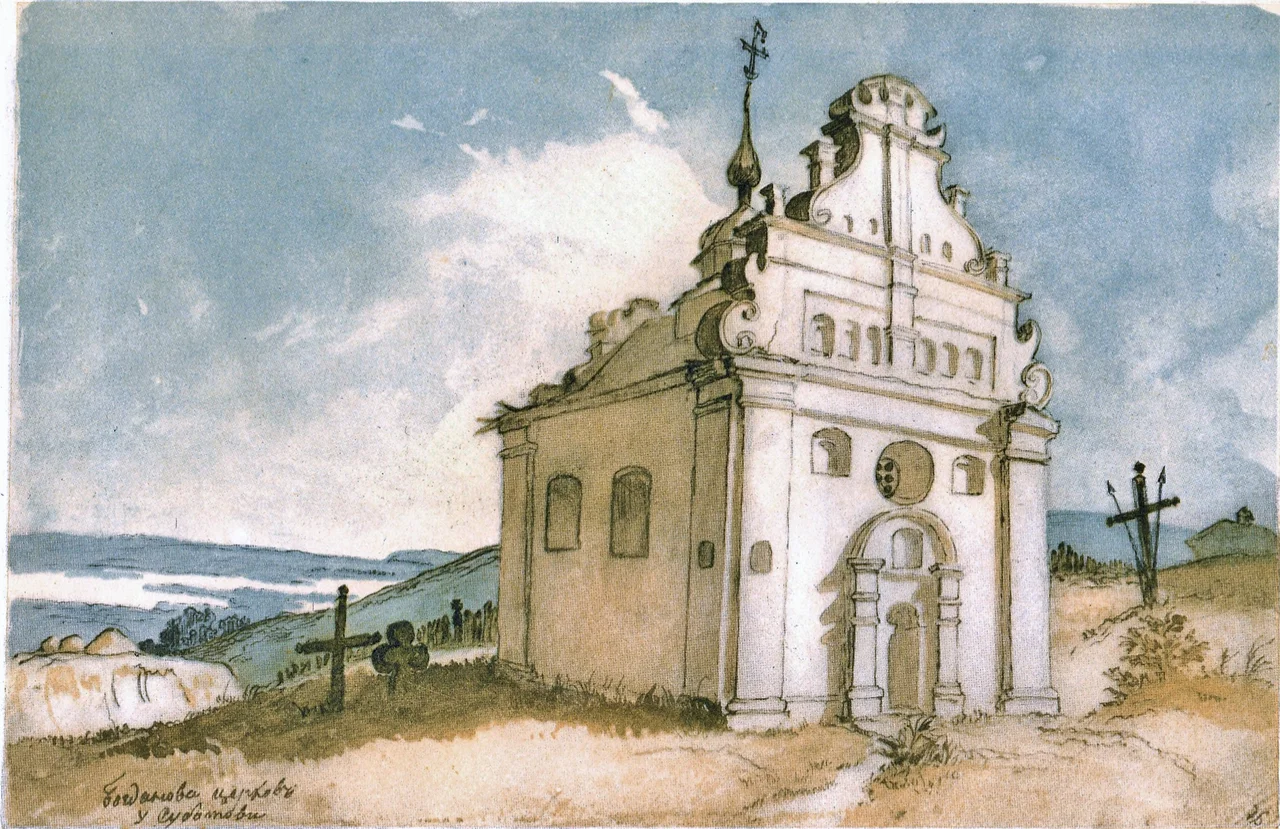
In 1845 the poet and artist Taras Shevchenko, Ukraine's national bard, came to Subotiv and painted the church in watercolor, setting Bohdan's chapel down in soft washes of paper and pigment. That single image did as much as any monument to fix the place in the country's imagination. A century and a half later, when independent Ukraine designed its five-hryvnia note, the church returned to the surface of daily life, printed and reprinted, passed hand to hand in shops and markets across the country. Few buildings are so small and so widely seen. Fewer still hold a founder's grave inside walls that a nation's greatest poet chose to preserve in paint.
The River and the Road
Geography made Subotiv what it was. The village sits on the Tiasmyn, a tributary that feeds the great Dnieper, the artery that has carried trade, armies, and settlement across Ukraine for a thousand years. From here it is a short ride to Chyhyryn, which briefly served as the capital of the Cossack Hetmanate, so Subotiv lay at the very heart of an emerging state rather than at its edge. Today the distances read like a quiet inventory of an inland village: seven kilometers to Chyhyryn, twenty-one to the river port at Adamivka, thirty-eight to the nearest railway. The war and the centuries have both passed through this landscape, yet the church still stands above the water, small and stubborn, holding its place in the country's memory.
From the Air
Subotiv sits at 49.10 degrees north, 32.56 degrees east, on the right bank of the Tiasmyn River just seven kilometers from Chyhyryn in central Ukraine. From altitude, look for the river's meander and the small white St. Elijah Church near the village edge; the larger town of Chyhyryn lies to the southeast. The nearest sizable airfield is at Kropyvnytskyi to the southwest.
Nearby Stories
- Battle of Kurukov Lake (1625) 15 km away
- Melgunov Kurgan 19 km away
- Cherkasy 34 km away
- Khutir Nadiia 43 km away
- Kaniv Nature Reserve 50 km away
- Battle of Zhovti Vody 57 km away
- Battle of Korsun-Cherkassy 61 km away
- Velyki Sorochyntsi 96 km away