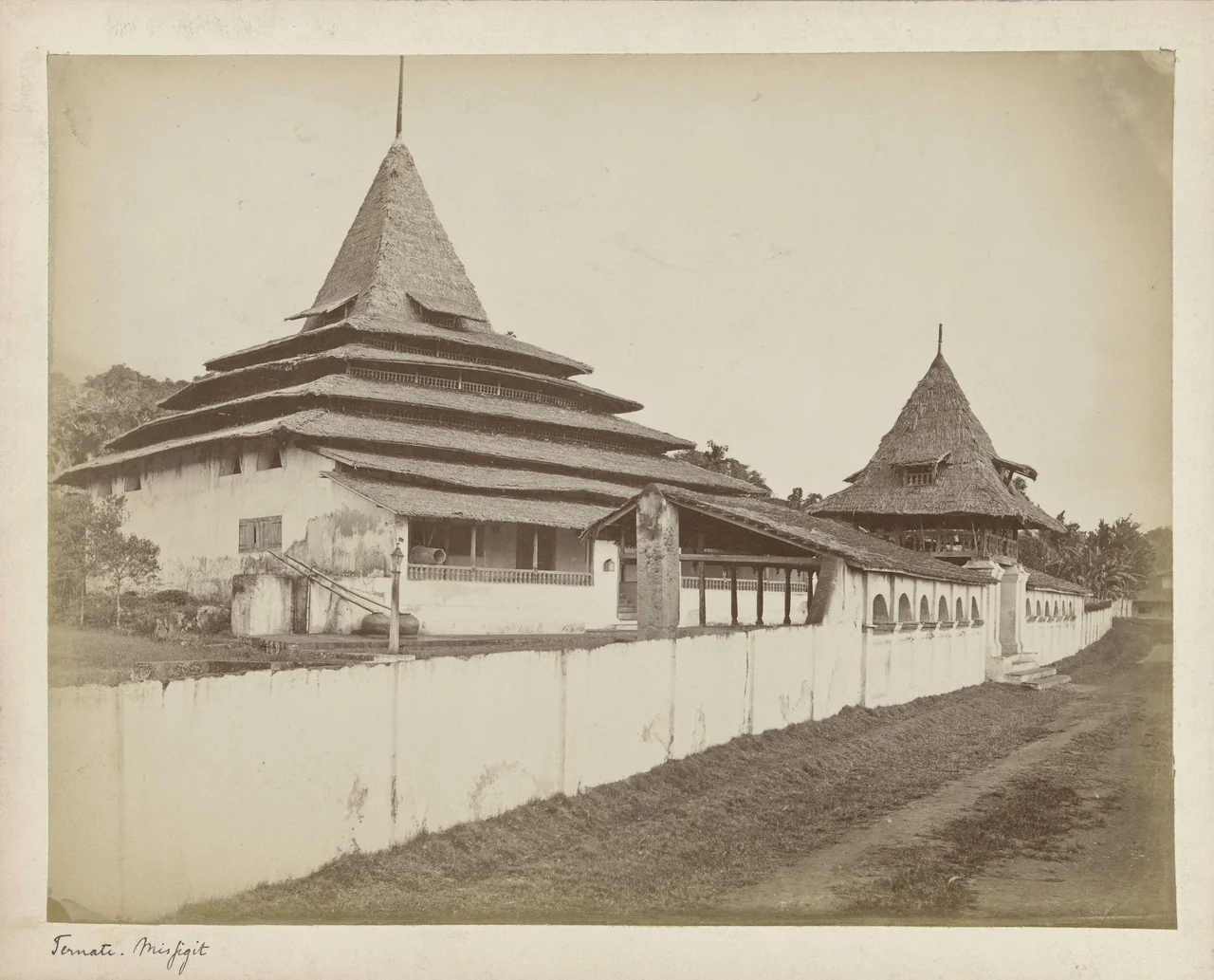

Sultan of Ternate Mosque
On the sixteenth night of Ramadan, the Sultan of Ternate still rides to prayer in a palanquin. The ceremony is called Kolano Uci Sabea, and it ends the same way it has for centuries: the Sultan and his queen ascending to a room above the shrine of their ancestors, praying, then emerging to greet the people of Ternate. The mosque where this happens -- the Sultan of Ternate Mosque, also known as the Old Mosque of Ternate -- has stood on the eastern side of Ternate Island since around 1606. Behind it, Mount Gamalama rises to 1,715 meters, the active volcano that forms the island's spine and the mosque's permanent backdrop.
Five Tiers Toward Heaven
The mosque follows the vernacular tradition of Indonesian mosque architecture, shaped by the Javanese style that spread across the archipelago with Islam. Its most striking feature is the five-tiered roof of the main prayer hall -- originally thatched with sago palm, now covered in corrugated steel after successive restorations. Four central posts called saka guru support the structure, supplemented by twelve additional pillars. The uppermost tier pitches steeply, with four ventilation hatches that draw tropical air through the building. At its peak, a pole represents the Arabic letter alif, symbolizing Allah. The mosque complex is enclosed by a wall, its western gateway topped with a two-tiered roof and a small elevated space once used to call the faithful to prayer, serving the function of a minaret without the tower.
A Sultanate's Sacred Ground
The current building was likely constructed by Sultan Hamzah, the ninth sultan, around 1606. Scholars believe it replaced an earlier 16th-century mosque from the period when the Sultanate of Ternate was at the height of its power, exerting influence from Sulawesi to Mindanao. The exact founding date remains debated, but the mosque's deep roots in the sultanate's history are not. As the largest mosque in Ternate City and the royal mosque of the Ternate Sultanate, it was never simply a place of worship. It was the spiritual center of a maritime empire built on cloves.
Rules and Rituals
The Sultan of Ternate Mosque maintains traditions that set it apart from other Indonesian mosques. Only men may enter, a rule enforced to preserve the building's sanctity. Sarongs are prohibited inside -- worshippers must wear trousers and a headscarf or cap. The most distinctive tradition is the Malam Qunut, the qunut ritual on the sixteenth night of Ramadan. During this ceremony, the Sultan and his family arrive at the mosque by palanquin to perform the tarawih prayer, guided by the Bobato Akhirat, the Sultanate's council of religious matters. After prayers, the royal procession returns to the kedaton -- the palace -- where the Sultan and his queen, the Boki, enter a special chamber above the ancestral shrine. What happens next is intimate and ancient: a prayer for the ancestors, followed by the Sultan and his queen stepping out to meet the people of Ternate.
Persistence in Corrugated Steel
The mosque has been restored multiple times, each renovation stripping away some original material while preserving the essential form. The sago thatch gave way to corrugated steel. Parts of the surrounding wall and auxiliary buildings have been demolished. Yet the five-tiered silhouette remains, and the saka guru posts still carry the weight of the roof as they have for four centuries. In a region shaped by volcanic eruptions, colonial invasions, and sectarian conflict, the Sultan of Ternate Mosque endures as a physical link to the era when this small volcanic island commanded the spice trade of the eastern archipelago.
From the Air
Located at 0.80°N, 127.39°E on the eastern coast of Ternate Island. The mosque sits at the base of Mount Gamalama (1,715 m), the dominant volcanic cone visible from all approaches. Sultan Babullah Airport (ICAO: WAMN) is on the island. Best viewed from the east on approach over the Halmahera Sea. The five-tiered roof structure is distinctive but small -- easier to identify by its position in Soa Sio village on the coastal road.
Nearby Stories
- Makian 23 km away
- Aketajawe-Lolobata National Park 35 km away
- Mount Ibu 52 km away
- North Halmahera Regency 105 km away
- The Ocean's Hidden Crossroads 136 km away
- Bitung 196 km away
- The Sea That Swallows Itself 197 km away
- Tangkoko Batuangus Nature Reserve 208 km away