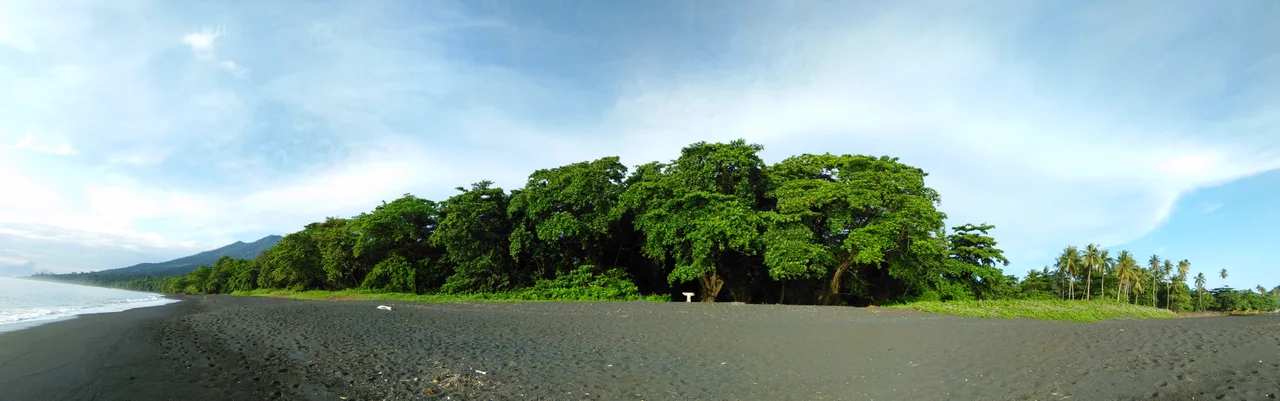

Tangkoko Batuangus Nature Reserve
Wait long enough after dark in the lowland rainforest of Tangkoko, and a pair of enormous eyes will find you first. The spectral tarsier weighs barely 100 grams, fits in a human palm, and has eyes so large relative to its skull that they cannot rotate in their sockets. Instead, the tarsier turns its entire head, owl-like, scanning for insects with a gaze that seems to belong to a creature ten times its size. Tangkoko Batuangus Nature Reserve, 70 kilometers from Manado on the northeastern tip of Sulawesi, protects these improbable primates along with hundreds of other species found nowhere else on Earth.
An Island's Worth of Endemics
Sulawesi is an evolutionary laboratory. Isolated for millions of years, the island developed species that exist on no other landmass. Tangkoko distills that uniqueness into 8,718 hectares of protected forest. The reserve harbors at least 127 mammal species, 233 bird species, and 104 reptile and amphibian species. Of these, 79 mammals, 103 birds, and 29 reptiles and amphibians are endemic to Sulawesi. The lowland rainforest canopy is dominated by trees of the Palaquium genus, the fragrant ylang-ylang tree Cananga odorata, and the towering Dracontomelon dao. Beneath them moves a cast of characters that no other forest on the planet can assemble.
The Macaques of Tangkoko
The Celebes crested macaque is the reserve's most visible resident and its most endangered. With jet-black fur, a distinctive mohawk-like crest, and an expressive face capable of producing a grin that became the subject of an international copyright dispute, these macaques live in social troops that range through the forest floor and lower canopy. Roughly 5,500 remain on all of Sulawesi. Tangkoko holds one of the most studied populations, with long-term surveys tracking their numbers since the 1970s. The threats are persistent: habitat loss from logging, and hunting by local communities who have traditionally consumed macaque meat.
Layers of Protection
Conservation at Tangkoko came in stages. The first protected area was established at Mount Tongkoko, the volcanic peak that anchors the reserve. The Duasaudara area was added in 1978, followed by the Batuangus and Batuputih zones in 1981, bringing the total to 8,718 hectares. Visitation is restricted to the Batuputih area, where guided walks at dawn and dusk offer the best chances of seeing tarsiers, macaques, Sulawesi bear cuscus, and the smaller Sulawesi dwarf cuscus. The restriction is deliberate: the rest of the reserve remains undisturbed, a buffer for species that cannot tolerate human presence.
The Poaching Pressure
A 2005 survey of three villages surrounding the reserve revealed an uncomfortable truth. While rats were the most frequently hunted species, locals still trapped macaques and cuscus for both household consumption and sale at regional markets. The bushmeat trade operates in the gap between conservation law and economic necessity: for families with few cash income options, a macaque represents protein and market value. International attention, including the celebrity of the monkey selfie photograph, has raised awareness, but the underlying pressures of poverty and proximity remain. The reserve's future depends as much on providing alternative livelihoods to neighboring villages as on patrolling its borders.
A Forest Worth the Detour
Tangkoko sits roughly an hour's drive from Bitung and two hours from Manado, making it one of the most accessible tropical rainforest reserves in eastern Indonesia. That accessibility is both its strength and its vulnerability. Wildlife-watching tourism has become a significant draw for North Sulawesi, bringing foreign exchange and creating jobs for local guides. The challenge is managing visitation so that the animals tourists come to see are not driven deeper into the forest by the tourists themselves. At dusk, when the tarsiers emerge and the macaques settle into sleeping trees, Tangkoko briefly becomes what it was before any of this mattered: just a forest, doing what forests do.
From the Air
Located at 1.518N, 125.186E at the northeastern tip of Sulawesi, adjacent to the coast. Sam Ratulangi International Airport (ICAO: WAMM) in Manado is approximately 70 km west. The reserve is visible as a forested coastal strip at the base of Mount Tongkoko (1,149 m) and Mount Duasaudara. Look for the transition from dense forest to the coastline along the Molucca Sea. Bitung city is visible to the southwest. Best viewed at 3,000-8,000 ft. Tropical climate with consistent rainfall and frequent afternoon cloud buildup.
Nearby Stories
- Maesa Tompaso Racecourse 5.5 km away
- Bunaken 15 km away
- Bangka Island (North Sulawesi) 21 km away
- Battle of Kendari 53 km away
- USS Shark (SS-174) 157 km away
- Fort Kastela 170 km away
- Japanese Minelayer Tsugaru 241 km away
- Indonesia-Malaysia Border 614 km away