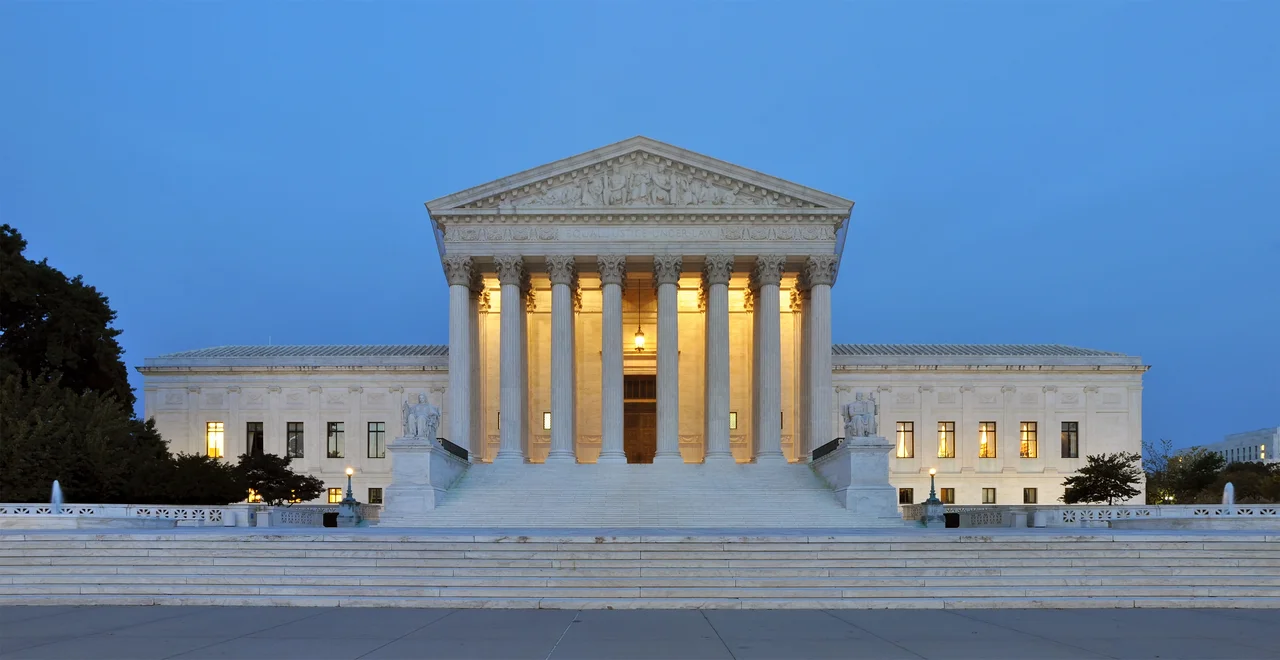

Supreme Court of the United States
On February 2, 1790, the Supreme Court of the United States held its first session in the Royal Exchange building at the corner of Broad and Water Streets in lower Manhattan. The court had six justices, no cases, and no permanent home. The early sessions were devoted to procedural housekeeping. The first decision did not arrive until 1791. For the next 145 years - longer than the lifetime of nearly every American then living - the court would meet in borrowed quarters: the Royal Exchange, Philadelphia's City Hall, a basement room in the Capitol, the old Senate chamber upstairs. Not until 1935 did the court move into the Cass Gilbert marble temple at One First Street NE that most Americans today imagine when they hear the words Supreme Court. The building came late. The institution that filled it had already shaped the United States more than almost any other.
The Marshall Inheritance
Article III of the Constitution sketches the federal judiciary in fewer than 400 words. The framers compromised in Philadelphia in 1787 by leaving the details to Congress, vesting judicial power in 'one supreme Court' and 'such inferior Courts as the Congress may from time to time ordain and establish.' The Judiciary Act of 1789 filled in the structure: six justices, a chief, judicial districts grouped into circuits. George Washington nominated John Jay as the first chief justice, and the early Court was so insubstantial that Jay resigned in 1795 to become governor of New York and turned down a second appointment in 1801 on the grounds that the institution had not 'acquired the energy, weight, and dignity which were essential to its affording due support to the National Government.' His successor, the Virginia federalist John Marshall, changed that. Across his thirty-four years as chief justice (1801-1835), Marshall established judicial review (Marbury v. Madison, 1803), the federal government's implied powers (McCulloch v. Maryland, 1819), and federal supremacy over interstate commerce (Gibbons v. Ogden, 1824). He also ended the British practice of each justice issuing his opinion separately and made the court speak with one voice through a single opinion of the court. The Supreme Court that today decides 60-80 cases a year is essentially Marshall's institution.
Dred Scott and the Civil War
The Court's prestige collapsed in 1857 when Roger Taney's majority opinion in Dred Scott v. Sandford ruled that Black Americans, free or enslaved, could not be citizens and that Congress had no power to prohibit slavery in the territories. Dred Scott helped push the country to civil war and the destruction of the institution it tried to protect. The Fourteenth Amendment in 1868 directly repudiated the citizenship holding. The Court did not regain its full footing until late in the nineteenth century, and even then its record was mixed. In 1896, Plessy v. Ferguson upheld 'separate but equal' segregation; Justice John Marshall Harlan's lone dissent - the Great Dissent - argued that the Constitution 'is color-blind, and neither knows nor tolerates classes among citizens.' Harlan was right. It took the Court fifty-eight years to admit it, in Brown v. Board of Education on May 17, 1954.
Cass Gilbert's Temple
For 146 years the Court had nowhere of its own to sit. From 1810 to 1860 it met in a basement chamber below the Senate. After the Senate moved upstairs, the Court took over the old Senate Chamber. Chief Justice William Howard Taft, who had been president before becoming chief justice in 1921, lobbied Congress for a dedicated building, and in 1929 Congress agreed. The architect was Cass Gilbert, whose Woolworth Building in New York had been the tallest in the world. Gilbert designed a Beaux-Arts marble temple with a colonnaded portico, modeled on a Roman peristyle, with the inscription EQUAL JUSTICE UNDER LAW above the entrance. Construction began in 1932; the Court moved in on October 7, 1935. Gilbert never saw the finished building - he died in 1934. The building cost $9.7 million, came in under budget, and its courtroom remains the only place in the country where every word spoken is heard by exactly nine people who have the power to make it law.
The Court of the Twentieth Century
The Hughes, Stone, and Vinson courts (1930-1953) initially struck down much of Franklin Roosevelt's New Deal and then, after Roosevelt's failed 1937 court-packing plan, reversed course. The Court upheld the internment of Japanese Americans in Korematsu in 1944 - a decision the Court formally disavowed seventy-four years later in Trump v. Hawaii. The Warren Court (1953-1969) issued the most consequential expansion of constitutional rights in American history: Brown ended legal segregation, Reynolds v. Sims required equal-population legislative districts, Gideon v. Wainwright established the right to appointed counsel, Mapp v. Ohio applied the exclusionary rule against the states, Miranda v. Arizona required police warnings, and Griswold v. Connecticut recognized a constitutional right to privacy that Roe v. Wade in 1973 extended to abortion. The Burger Court (1969-1986), Rehnquist Court (1986-2005), and Roberts Court (2005-present) have moved gradually rightward. The Roberts Court's Dobbs v. Jackson Women's Health Organization in 2022 overruled Roe outright; its Bruen ruling expanded Second Amendment rights; its Citizens United decision in 2010 reshaped campaign finance law.
Nine Lives
Today the court has nine justices - the number set by the Judiciary Act of 1869 and unchanged since. Chief Justice John Roberts has presided since 2005. Clarence Thomas, appointed by George H.W. Bush in 1991, is the senior associate justice and the longest-tenured. Sonia Sotomayor (2009), the first Hispanic justice; Elena Kagan (2010); Samuel Alito (2006); Neil Gorsuch (2017); Brett Kavanaugh (2018); Amy Coney Barrett (2020); and Ketanji Brown Jackson (2022), the first African American woman ever to sit on the Court, complete the bench. Eight of the nine attended Ivy League law schools - Harvard or Yale - with Barrett alone graduating from Notre Dame. Six are Catholic. One is Jewish. One is Protestant. One justice's religious identification is ambiguous. The justices serve for life, an unusual arrangement among democratic supreme courts and one that has become a subject of debate as proposals for term limits or court expansion have grown more common. From the marble plaza out front you can see across First Street NE to the Capitol dome - the building whose acts the Court has the power to strike down, the city's two greatest exhibits of what Americans have agreed to be ruled by.
From the Air
The Supreme Court Building sits at 38.8906 degrees N, 77.0044 degrees W, at One First Street NE, directly across First Street from the U.S. Capitol and adjacent to the Library of Congress. From the air Cass Gilbert's Beaux-Arts marble building reads as a smaller, more austere structure than the Capitol, with a clear colonnaded portico facing west toward First Street. Best viewed at 1,500 to 3,000 feet AGL; the entire site lies within the Washington FRZ and the prohibited area P-56A. Nearest airports are Ronald Reagan Washington National (KDCA) 3 nm south, College Park (KCGS) 6 nm northeast, and Washington Dulles (KIAD) 24 nm west.
Nearby Stories
- Gunston Hall 1.1 km away
- 2023 Baltimore Shooting 4.9 km away
- Battle of Middleburg 6.6 km away
- Crownsville Hospital Center 10 km away
- Battle of Loudoun Heights 13 km away
- First Battle of Rappahannock Station 20 km away
- Howard County, Maryland 21 km away
- Harriet Tubman Underground Railroad 50 km away