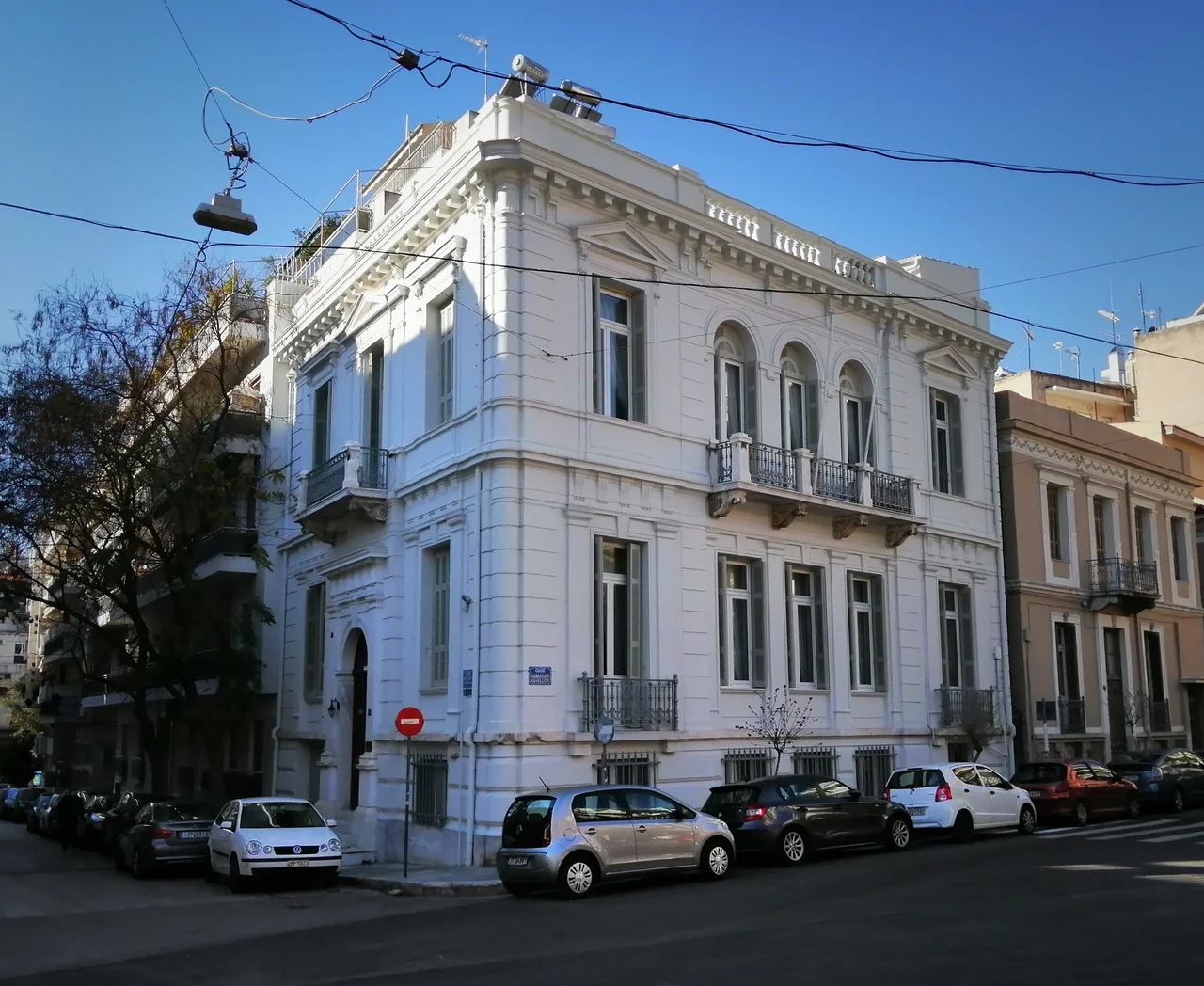

Swedish Institute at Athens
The corner of Mitseon and Kavalotti streets in Athens is not the most obvious address for a Swedish institution, yet it makes a certain poetic sense. The building sits in the shadow of the Acropolis, a few minutes' walk from the New Acropolis Museum, surrounded by the accumulated debris of three thousand years of civilisation. It was here, in 1976, that the Swedish Institute at Athens settled into its current home — a research centre operating, as its statutes put it, to "conduct research into the culture of ancient Greece, provide higher education in the field in order to enrich our own culture, and stimulate and support the cultural exchange between Sweden and Greece." Those three aims — scholarship, education, exchange — are deceptively modest. What the Institute actually does is stitch two countries together across centuries.
A Long Time Coming
Greece wanted a Swedish institute before Sweden was ready to build one. Greek authorities encouraged the foundation of a Swedish archaeological research institute during the 1920s and 1930s, but the moment kept slipping away — Sweden had already established its institute in Rome in 1926, which absorbed much of the available energy and funding. It took the push of the Second World War's aftermath, and the particular enthusiasm of Crown Prince Gustaf Adolf (later Gustaf VI Adolf, who was himself an active archaeologist), to get the project moving again. Einar Gjerstad, professor of classical archaeology at Lund University, drove the institutional effort. The institute was established in Stockholm in 1946, the archaeologist Erik J. Holmberg arrived in Athens in 1947 to set it up on the ground, and it was inaugurated in 1948 — becoming the seventh foreign archaeological institute in Greece and the first to be founded there since 1909. It began in the fashionable Kolonaki neighbourhood before the Greek government granted it full Archaeological School status in 1975, prompting the move to its current premises near the Acropolis the following year.
A Century of Digging
Swedish archaeologists were working in Greece long before the Institute existed. The first fieldwork came in 1894, when Sam Wide and Lennart Kjellberg excavated the Sanctuary of Poseidon at Kalaureia on the island of Poros in the Saronic Gulf — a project that had been proposed by the German archaeologist Wilhelm Dörpfeld. The summer campaign ran from June 11 to August 13, turning up bronze statuettes, inscriptions, and votive objects. That same summer, Wide also investigated Aphidna in northeast Attica, finding Mycenaean graves and Bronze Age metalwork. By the time the Institute was formally established, Swedish archaeologists had worked at Asine, Dendra, Malthi, Midea, Berbati, Kastelli Hill on Crete, and Paradeisos in Thrace. At Dendra in the Argolid, in 1960, came one of the most remarkable individual finds: a complete Mycenaean bronze suit of armour, now known as the Dendra panoply, recovered from a chamber tomb dating to the 15th century BC. It is currently on display at the Archaeological Museum of Nafplio. The Institute's active excavations today include Kalaureia (ongoing since 1997), Hermione at the tip of the Argolid Peninsula, Vlochos in Thessaly, and the newly begun Ancient Pergamos Project in Macedonia.
A Library of Forty Thousand Voices
Not all of the Institute's work happens in the field. The Nordic Library at Athens — owned jointly by the Swedish, Danish, Finnish, and Norwegian institutes — holds around 40,000 volumes, concentrated in classical archaeology and ancient history. It is open to Greek and foreign scholars alike, which is a condition of operating in Greece: foreign archaeological schools are required by Greek law to keep their research libraries accessible. The institute publishes the journal Opuscula, together with the Swedish Institute of Classical Studies in Rome, and runs a programme of scholarships for Swedish postgraduate students and researchers wishing to work in Greece. Alongside the archaeology, the institute runs film festivals, poetry readings, silk-craft collaborations between Swedish and Athenian art schools, and jazz masterclasses that bring musicians from Greece and Sweden together in Kavala and Corfu. The connection between two northern and southern cultures runs through many registers at once.
The Tobacco House in Kavala
The Institute's strangest asset may be a Bauhaus-style guesthouse in the port city of Kavala, 600 kilometres north of Athens. The house was built in 1936 to accommodate employees of the Swedish tobacco monopoly — Kavala was then a major centre of the tobacco trade — and was designed by Greek architect Panagiotis Manouilidis in a style unusual for its time and place: flat-roofed, light-façaded, functionally interior. When Kavala's tobacco era faded after the Second World War, the monopoly's director, Olof Söderström, decided in 1963 to turn the property into a guesthouse for Swedish artists and researchers. The sale was considered, then abandoned, and after years of negotiation the house was finally donated to the Institute. The transfer was signed at the Swedish embassy on June 6, 1976 — Sweden's national day. Today it offers residencies to Swedish writers, artists, and researchers. It survived a budget crisis in 2014, when the Swedish government proposed eliminating all three of its Mediterranean institutes by 2017. Protests from academic and cultural communities forced the proposal to be withdrawn. The Institute continues.
Between Two Countries
What the Swedish Institute at Athens has built over nearly eight decades is something harder to quantify than excavation reports: a sustained relationship between two cultures that might otherwise have little reason to talk to each other. A Swedish crown prince who loved digging, a Lund University professor who wanted an institution, a Greek state that welcomed outside archaeological expertise — and behind all of them, layer upon layer of ancient material waiting in the earth of Greece. The institute sits at their intersection. Its building is modest. What it connects is not.
From the Air
The Swedish Institute at Athens is located at approximately 37.968°N, 23.727°E, on the corner of Mitseon and Kavalotti streets in central Athens — a few hundred metres southwest of the Acropolis rock and adjacent to the New Acropolis Museum. From the air, approach from the west over the Saronic Gulf for the classic view: the flat urban grid of Athens, the limestone rock of the Acropolis rising sharply from it, and the modern glass roof of the Acropolis Museum visible just below. Athens Eleftherios Venizelos International Airport (LGAV) lies approximately 26 km to the east. Recommended viewing altitude: 1,500–3,000 ft AGL provides good detail of the Acropolis hill and the dense 19th-century street grid of central Athens below it.
Nearby Stories
- Parnitha 3.4 km away
- Kea (island) 7.3 km away
- Sanctuary of Apollo Maleatas 11 km away
- Sousaki Volcano 12 km away
- Battle of Leuctra 14 km away
- Great Sand Beach 18 km away
- Agios Georgios (island) 23 km away
- Skyros 84 km away