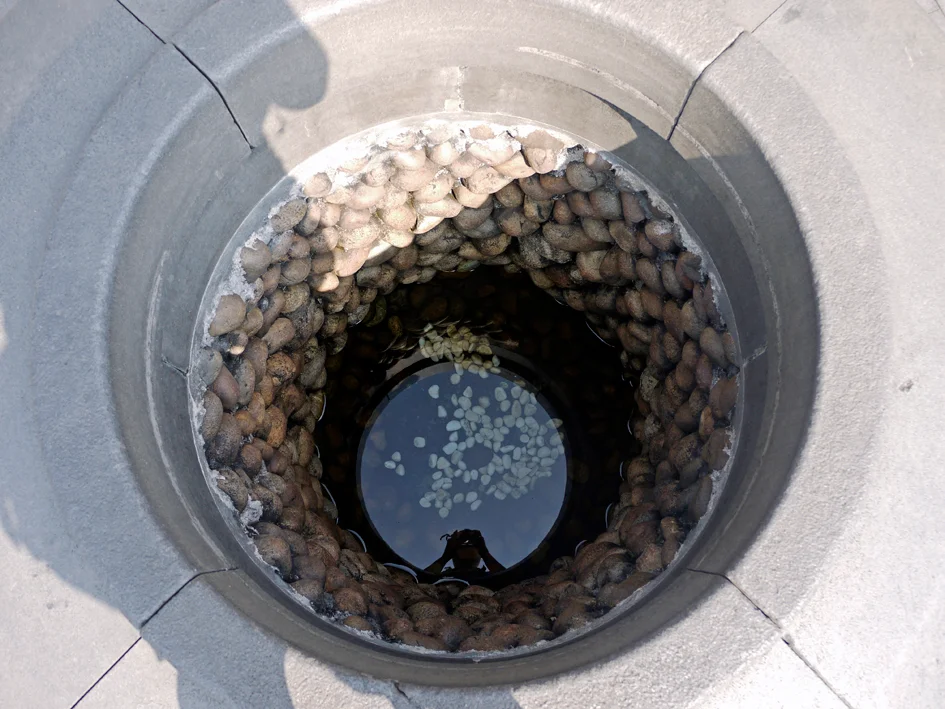

Sword Well
Koxinga drove his sword into the mountainside, and water came out. That is the story, at least — and in Taiwan, the story of Koxinga carries enormous weight. Zheng Chenggong, known by his honorific name Koxinga, was the Ming loyalist commander who expelled the Dutch from Taiwan in 1662 and established Chinese governance on the island. Legends of his passage dot the Taiwanese landscape, and this well in Dajia District, on the southern slope of Tiezhen Mountain, is one of the most enduring. Whether the miracle happened as told is beside the point; the well has been tended for centuries, repaired in 1953, renamed, and visited ever since.
The Story Behind the Stone
According to local tradition, Koxinga was stationed near what is now Dajia when his soldiers grew desperate for water. He prayed, and then he acted — driving his sword into the ground as an act of faith. Water poured from the southern slope of the mountain. The well created by this act was given the name Well of the Imperial Surname, a title that reflects Koxinga's family connection to the Ming imperial house: he had been granted the imperial surname Zhu as an honor, which is the root of the name Koxinga itself.
The story belongs to a tradition of miraculous wells associated with military commanders and holy figures across East Asian history. What distinguishes this one is its survival — the physical well still exists, and the community around it never stopped maintaining the site.
A Well Repaired and Renamed
By the time the well came to wider attention in the 20th century, it was in need of care. In 1953, local residents organized to repair it and constructed a brick wall around the opening. At that point, the name shifted: it became the Sword Well, a name that keeps the founding legend at the center without requiring visitors to know the full title of the Imperial Surname.
The well itself is modest in dimensions — 0.5 meters in diameter and 2 meters deep. That smallness is part of what makes it striking. This is not a grand hydraulic work but an intimate one, barely larger than a human torso and deep enough to be dark at the bottom. Visitors who peer into it are doing something people have done for generations: looking for evidence of something they half-believe.
Tiezhen Mountain and the Wider Landscape
The Sword Well sits within the Tiezhen Mountain Scenic Area near Dajia, a landscape of wooded hills above the flat coastal plain that stretches toward the Taiwan Strait. Tiezhen Mountain — whose name refers to iron needles, evoking the sharp profile of its rocky outcrops — is itself a destination for hikers and temple visitors. The well is one of several historical and religious sites in the area.
Dajia District is better known internationally for the Dajia Mazu Pilgrimage, one of the largest religious processions in the world, which draws millions of participants each spring. The Sword Well is quieter, more personal — a place where the Koxinga legend intersects with everyday devotion, and where the act of drawing water, once miraculous, is now a matter of visiting and remembering.
The Name That Travels
Koxinga occupies an unusual position in Taiwanese cultural memory: venerated by communities of Fujianese descent, honored in temple traditions across southern and central Taiwan, and claimed by both Taiwan and mainland China as a significant historical figure. His image appears in paintings, opera, and statuary across the island. Temples dedicated to him are scattered through the landscape.
The Sword Well represents something different from those grand commemorations — a local, almost accidental monument. It persists because neighbors decided it mattered, repaired it when it needed repair, and gave it a name that anyone could understand. The legend of the sword and the water is simple enough to pass from grandparent to grandchild without loss, which is perhaps the most durable kind of history there is.
From the Air
The Sword Well is located at 24.358°N, 120.643°E in Dajia District, Taichung, on the slopes of Tiezhen Mountain above the coastal plain. From the air at 2,000–4,000 feet, the Tiezhen Mountain area appears as a low ridge rising from the flat farmland west of the main Taichung basin, close to the coastline of the Taiwan Strait. Dajia town itself is visible to the south. Nearest major airport is RCMQ (Taichung International Airport), approximately 30 km to the southeast. Flying northwest from RCMQ, the Dajia River can be followed toward the coast; Dajia town sits at the mouth of the river valley. Visibility in this coastal area is often affected by haze from marine air in summer months.
Nearby Stories
- Wufeng Lin Family Mansion and Garden 6.5 km away
- Tapung Old Fort 9.4 km away
- 1991 Miaoli Train Collision 9.7 km away
- Taroko National Park 20 km away
- China Airlines Flight 204 21 km away
- Taiwan Strait 38 km away
- Taixi, Yunlin 43 km away
- China Airlines Flight 611 69 km away